Prelude and Firestorm: 2nd Mallet Percussion Sheet Music Preview

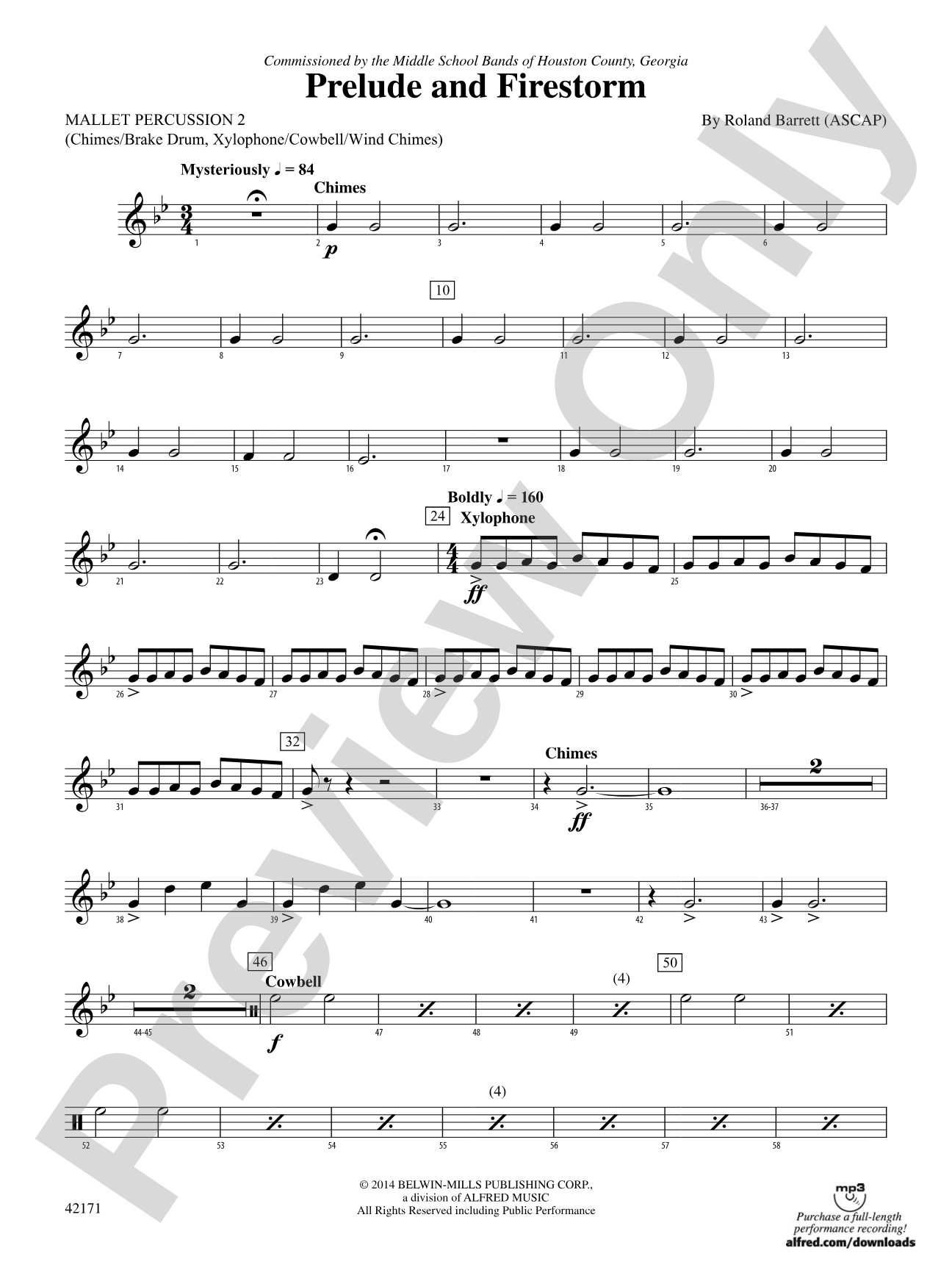
Prelude and Firestorm: 2nd Mallet Percussion

By Roland Barrett

Grade: 2 (Easy)

Item: 00-PC-0016543_M2

Digital Download
$3.00
Description
Drawing its title from the term firestorm, this original composition opens with a slow and mysterious chorale in 3/4 time, then yields to relentless waves of firestorms, each one building in intensity, then receding, then rising again in a successive series of escalating passages, finally reaching a powerful and emphatic conclusion. Intense! (3:45) This title is available in MakeMusic Cloud.

Don't just read it, hear it, play along with it, and watch your students grow with it. In MakeMusic Cloud, Prelude and Firestorm: 2nd Mallet Percussion comes alive with professional accompaniment, adjustable tempo, and built-in practice tools that turn solo practice into real progress.

Sample Audio
0:00
0:00
Sample Video
Additional Details
Series: Belwin Young Band
Publisher: Alfred Music
Page Count: 300
SKU: 00-PC-0016543_M2

More about this title

About the Composer: Roland Barrett

Roland Barrett

Roland Barrett has shaped generations of student musicians through his dual roles as composer and educator. Since 2001, he has held faculty positions in music theory and composition at the University of Oklahoma, where his teaching spans 20th century topics across undergraduate and graduate courses. He continues to arrange for the Pride of Oklahoma marching band, keeping him deeply connected to the student experience.

Barrett's catalog exceeds two hundred published works for symphonic band, chamber ensembles, and marching band. His compositions have been performed by the Dallas Wind Symphony, All-State honor bands, and featured on NPR and at major conventions including the Midwest Band & Orchestra Conference and the International Trumpet Guild. A multiple recipient of the ASCAP Plus award, Barrett brings both scholarly rigor and practical musicianship to every piece he creates.

Why we love this

Barrett's handling of dynamic trajectory here rewards careful conducting. The opening chorale establishes lyrical beauty in a modest time signature, then the successive firestorms give you real control over how each wave builds and subsides. Grade 2 bands rarely get this kind of architectural sophistication without overshooting their technical limits.

What to expect

The piece opens in hushed mystery, voices moving in gentle chorale textures before the storm arrives. Then the waves come: building intensity, crashing, pulling back, then surging again with greater force each time. By the end, you're in the heart of something fierce and undeniable, driven to a powerful conclusion that leaves both ensemble and audience breathless.

Who it's for

Grade 2 concert bands seeking a programmatic piece with real dramatic scope. This works equally well for contest festivals (where it showcases both restraint and power) and concert settings where you want a showpiece that doesn't demand virtuosic technique.

How to get the most out of it

  • Shape the opening chorale with long-lined phrasing and transparent voicing; this quiet moment establishes the contrast that makes the firestorms land harder.
  • Treat each firestorm as a distinct event with its own arc. Mark the receding moments with clear dynamic reductions so the next rise feels earned rather than relentless.
  • Lock the low reed and brass rhythm in the intense passages; rhythmic precision drives the mounting tension more than volume alone.
  • Bring the full ensemble together for the final conclusion with coordinated attacks and releases to maximize impact.

How to use it

Program this as a concert closer when you want to end on a dramatic high. It also works as the centerpiece of a contest set that opens with something smaller and builds to this climactic moment. At 3:45, it fits neatly into most formats without overstaying its welcome.

Skills your students will build

  • Sustaining tone control across dynamic contrasts (3/4 chorale sections)
  • Rhythmic precision in fast, repeated figures that build intensity
  • Listening for balance when multiple lines accelerate simultaneously
  • Responding to conductor cues that shape receding and rising sections
  • Building crescendos through ensemble coordination rather than individual loudness

You May Also Like