
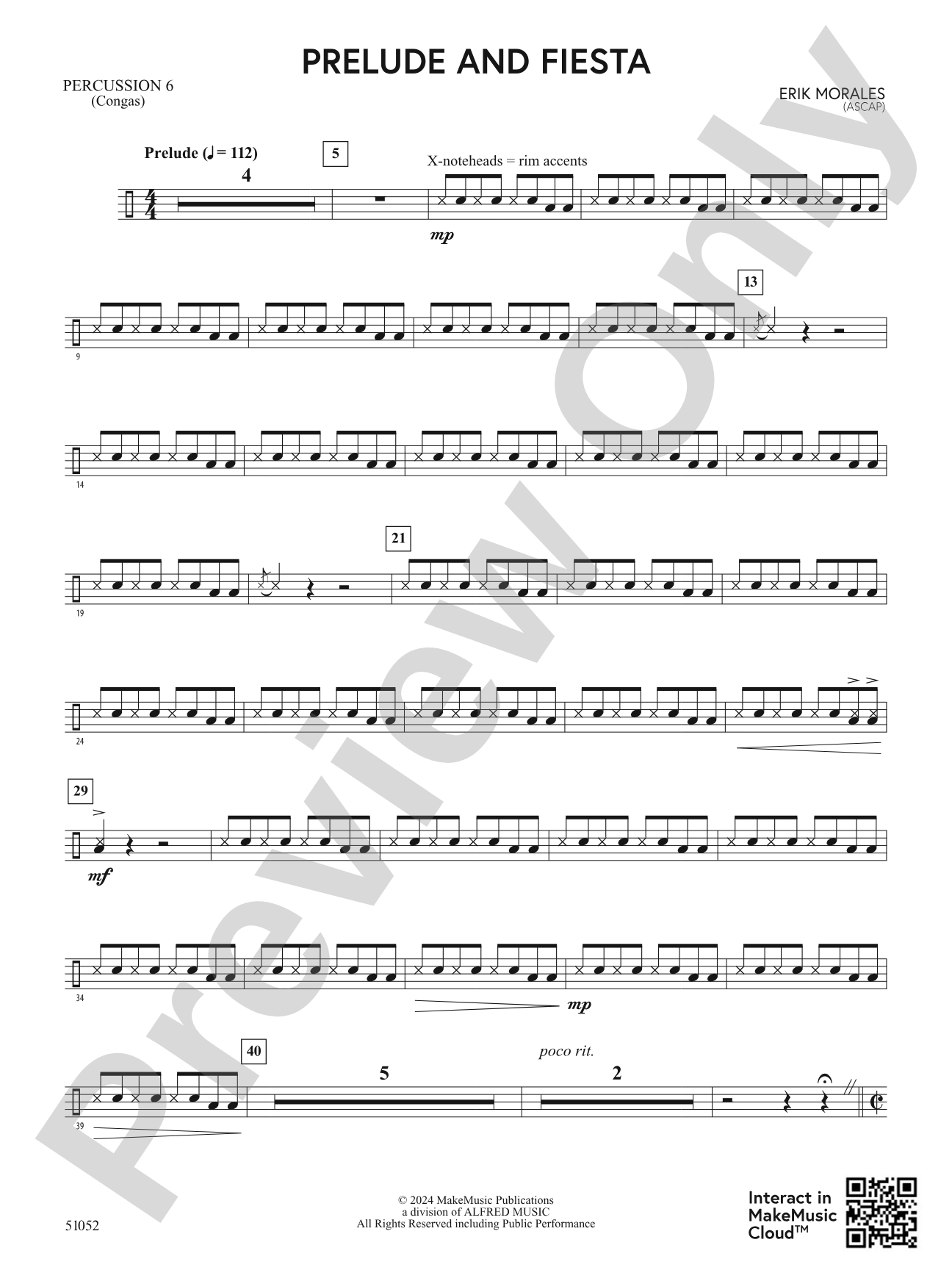

Prelude and Fiesta: 6th Percussion
By Erik Morales
Grade: 4.5
Item: 00-PC-0019254_PC6
$3.00
Pickup currently not available
Description
Exploring rhythms and chord changes emblematic of Afro-Cuban music, Prelude and Fiesta moves from a spicy ballad to a depiction of a fiery Latin street festival. Erik Morales includes a full percussion section but also includes condensed parts that only use two players. Consider opening it up for soloists to shine. Stunning! (4:50)


Don't just read it, hear it, play along with it, and watch your students grow with it. In MakeMusic Cloud, Prelude and Fiesta: 6th Percussion comes alive with professional accompaniment, adjustable tempo, and built-in practice tools that turn solo practice into real progress.
Open in the Player
Jump straight in and assign it today.
Start Your Free Trial
Open this title and explore the full library in minutes.
Sample Audio
1
Audio File
--:--
0:00
0:00
Sample Video
Additional Details
Series:
MakeMusic Symphony Strings
Publisher:
MakeMusic Publications
SKU:
00-PC-0019254_PC6
More about this title
About the Composer: Erik Morales

Erik Morales began composing during his high school years in South Florida, when a former band director invited him to arrange for the marching band in 1985. This early opportunity launched a career that has produced over 150 published works spanning classical, jazz, and commercial idioms. He holds degrees from Florida International University and the University of Louisiana, Lafayette, where he completed his bachelor's degree in 1989.
Morales has established himself as a voice in both the educational and professional music worlds. His trumpet ensemble works have earned recognition at the 2006 and 2008 National Trumpet Competitions, and his Concerto for Trumpet in C and Piano premiered at the 2009 International Trumpet Guild conference. In 2016, he was inducted into the Louisiana Association for Jazz Education's Hall of Fame. Schools and organizations across the country commission him regularly, drawn to his gift for balancing artistic integrity with pedagogical clarity across wind, orchestral, jazz, and chamber settings.
Why we love this
Morales brings authentic Afro-Cuban vocabulary to a piece that actually teaches what it explores rather than simply evoking the style. The structure itself is smart: a contemplative ballad entrance followed by full festival energy keeps both the ensemble and the audience engaged, and the flexible percussion options mean you can program it whether you have five percussionists or two. String orchestras at this level rarely get Latin material this well-crafted.
What to expect
The opening feels like stepping into a warm evening; the ballad moves with unhurried grace, its minor-tinged harmony rooted in place. Then the energy shifts dramatically as the festival arrives, filled with propulsive rhythms, bright harmonies, and the kind of infectious vitality that makes ensemble members want to dig into the strings with renewed conviction.
Who it's for
String orchestras with intermediate to strong ensemble control and musicians who respond well to cultural music exploration. The Grade 4.5 level demands accurate rhythm reading, secure intonation in the ballad's slower passages, and the independence to sustain harmonic support while other voices sing the line.
How to get the most out of it
- Lock the ballad section's rhythmic precision first; the swing feel in the opening depends on ensemble agreement about note placement and breath, not rushing the beat.
- Once your strings have the harmonic foundation solid, bring in percussion gradually so they can find where the conversation lives rather than simply doubling what's written.
- Shape the transition into the fiesta deliberately, treating it as a real shift in venue and energy rather than a tempo acceleration that loses the earlier material's melodic integrity.
- Feature your strongest string soloists in the passages Morales designates; the writing invites individual voices to speak within the ensemble texture.
How to use it
This works beautifully as a concert opener that signals a culturally adventurous program, or as a festival entry where the combination of sophistication and accessibility impresses adjudicators. Its tight four-minute fifty-second runtime makes it ideal pairing alongside a longer work in a chamber or full orchestra context.
Skills your students will build
- Reading and executing Afro-Cuban rhythmic patterns, particularly syncopation and clave-informed phrasing
- Harmonic awareness in extended chord progressions common to Latin music
- Dynamic control across contrasting textures (ballad lyricism to festival energy)
- Solo line projection within ensemble contexts
- Rhythmic precision in swing and Latin feels