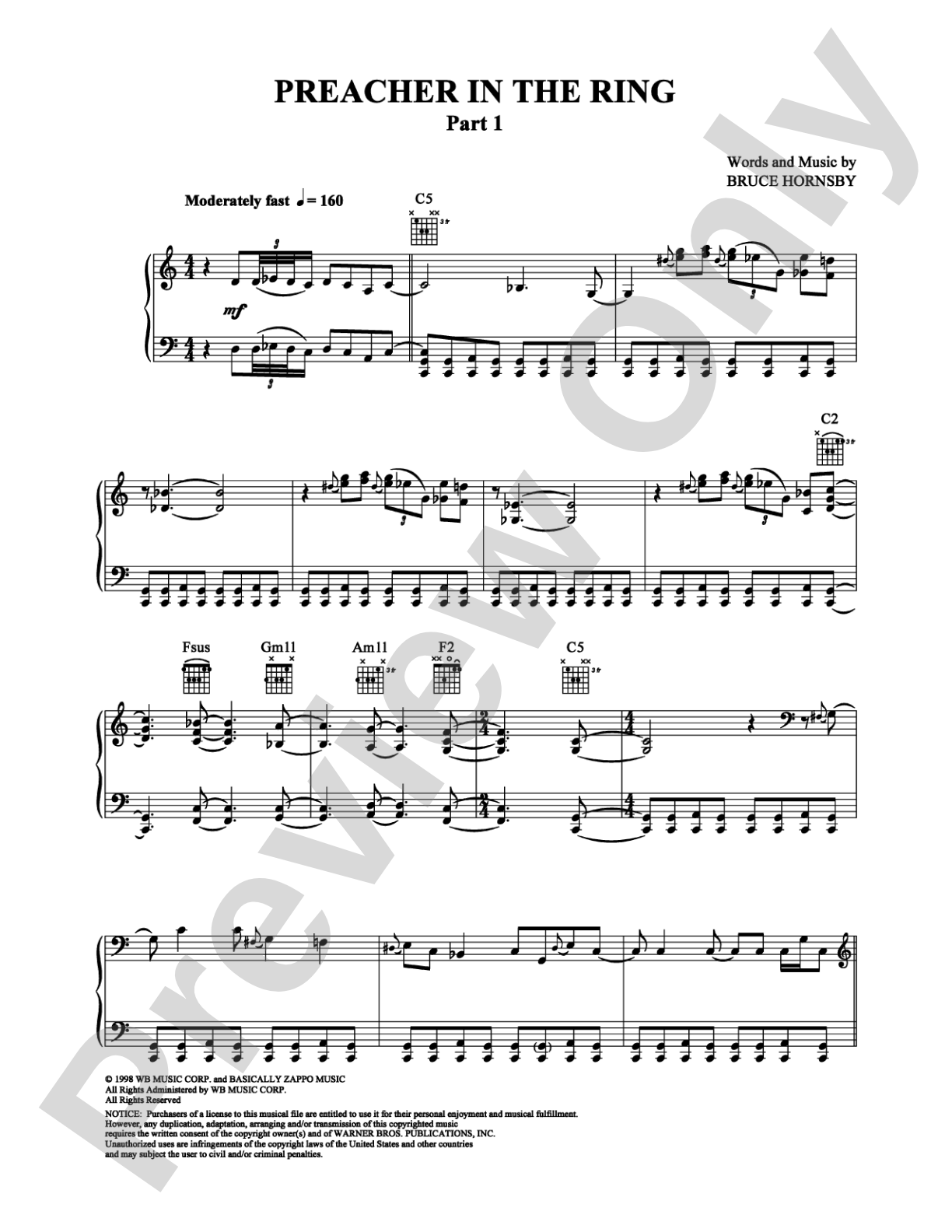
Preacher in the Ring, Part 1: Piano/Vocal/Chords Digital Sheet Music

Preacher in the Ring, Part 1: Piano/Vocal/Chords Digital Sheet Music

Bruce Hornsby

Item: 00-PS-0001496

Digital Download
$2.95
Description

Preacher in the Ring, Part 1: Piano/Vocal/Chords Digital Sheet Music isn't in MakeMusic Cloud just yet...but it could be. Let us know you'd like to see it, and you'll help shape what comes next. In the meantime, start a free trial and dive into thousands of interactive titles your students can play along with today.

Sample Audio
No sample audio found.
Sample Video
Additional Details
SKU: 00-PS-0001496

More about this title

About the Artist: Bruce Hornsby

Bruce Hornsby is a pianist and singer-songwriter whose work spans pop, rock, and Americana traditions. His keyboard-driven compositions, often built on sophisticated harmonic progressions and strong melodic hooks, have made him a distinctive voice in popular music since the 1980s. For music students and teachers, Hornsby's catalog offers accessible entry points into jazz-influenced harmony and contemporary song arrangement.

Why we love this

Hornsby's piano writing is neither overly simplified nor unnecessarily virtuosic, making this piece rewarding for intermediate pianists who want to work with genuine, record-accurate material. The vocal melody sits naturally in a conversational range, and the harmonic language deepens without demanding extended technique. Programming this lets singers explore contemporary song interpretation with a composer whose attention to craft shows in every phrase.

What to expect

The piece carries the conversational intimacy of a singer-pianist in a smaller venue, where the piano serves as both foundation and conversation partner to the voice. There's a pop-rock directness to the melody, but Hornsby's harmonic choices add color and sophistication beneath what might initially sound straightforward. The overall effect is grounded and present, inviting rather than flashy.

Who it's for

Piano students at the intermediate level who read chord charts and want to develop their comping skills with contemporary pop-rock material. Singers working on solo recitals or studio arrangements will find strong vocal writing that rewards attention to lyrical phrasing and emotional delivery. Music directors programming piano-vocal recitals or singer-songwriter style performance classes can use this to teach students how to balance instrumental and vocal roles.

How to get the most out of it

  • Lock the harmonic rhythm to the chord symbols before worrying about tempo. Hornsby's voicings often sit across beat lines, and understanding the harmonic pulse will steady your playing.
  • Sing through the melody first at a comfortable pitch, then transpose as needed. The vocal contour matters more than hitting a specific key; adjust to your range rather than straining.
  • Balance the vocal line against the piano accompaniment by listening to how much space the vocal takes. Keep your right hand light enough that the words stay in focus.
  • Pay attention to any rhythmic syncopation in the accompaniment pattern. These details carry the song's character, so practice them separately from the vocal line until they feel automatic.

How to use it

Slot this into a student recital program where it can stand alongside other contemporary singer-songwriter material or art song. It works well as a contrast piece in a program that includes classical or jazz standards, bringing the voice and piano together in a contemporary idiom. Use it in a piano-vocal coaching class to teach students how to handle chord symbols and work from lead sheets in a real-world songwriting context.

Skills your students will build

  • Reading and realizing chord symbols in a contemporary pop-rock context
  • Balancing vocal projection with piano accompaniment
  • Interpreting syncopated rhythmic patterns in the keyboard part
  • Translating a recorded arrangement into a learnable lead-sheet format
  • Adjusting vocal key and range to match individual singer abilities

You May Also Like