
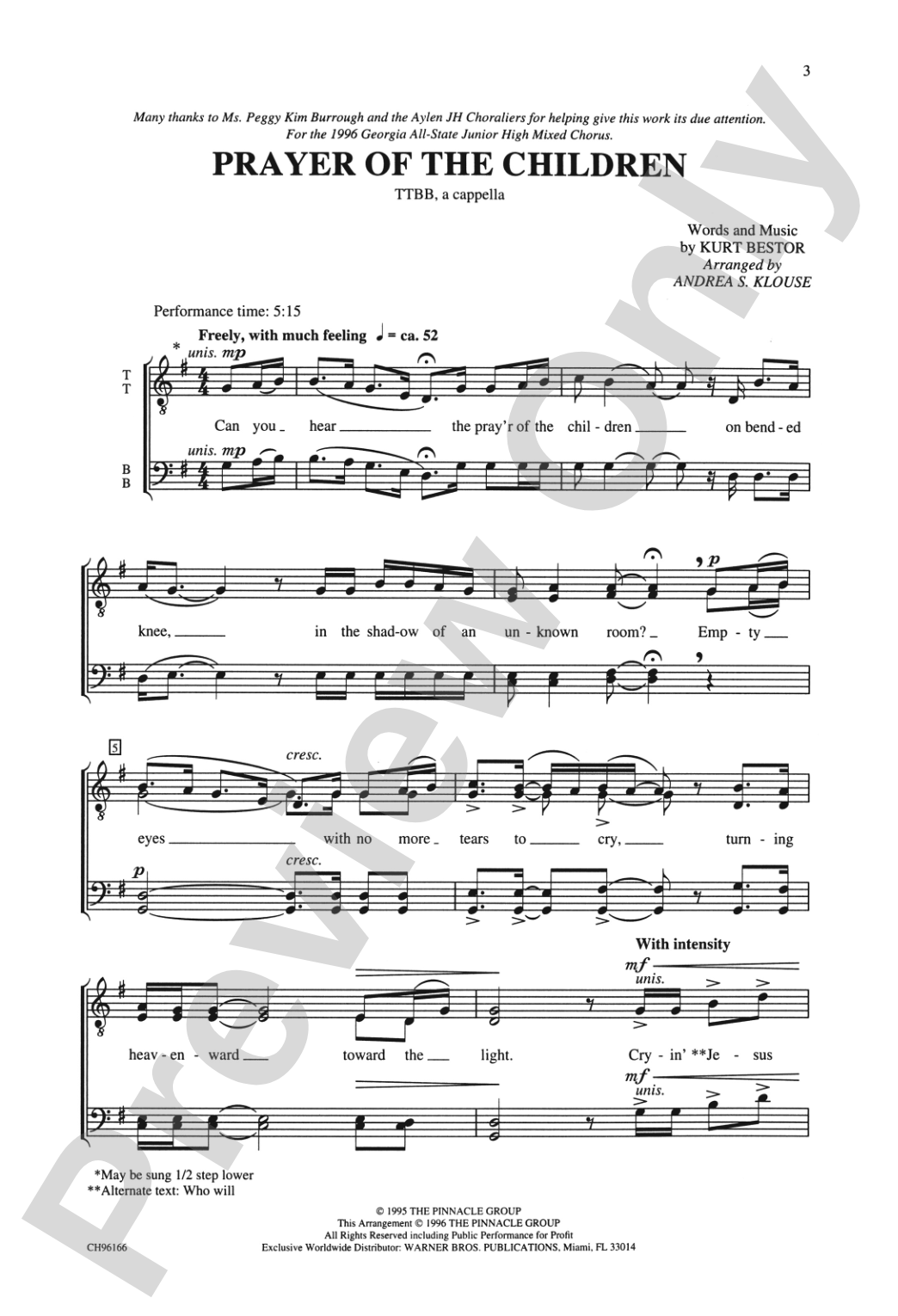

Prayer of the Children: TTBB, a cappella Choral Octavo
Words and music by Kurt Bestor / arr. Andrea S. Klouse
Item: 00-PO-0007696
$2.10
Minimum order quantity: 20 copies
Pickup currently not available
Description
This wonderful choral work has been heard by audiences across the nation. The piece was featured by the Luther College Choir conducted by Weston Noble during their 1996 tour and was performed at the national MENC conference in Kansas City. Also recently performed by the Georgia All-State Choir, "Prayer of the Children" is perfectly suited for concerts or festivals!


Prayer of the Children: TTBB, a cappella Choral Octavo isn't in MakeMusic Cloud just yet...but it could be. Let us know you'd like to see it, and you'll help shape what comes next. In the meantime, start a free trial and dive into thousands of interactive titles your students can play along with today.
Request This Title
Tell us you want it.
Start Your Free Trial
Explore everything that's ready to play right now.
Sample Audio
1
Audio File
--:--
0:00
0:00
Sample Video
No sample videos found.
Additional Details
Publisher:
Alfred Music
Page Count:
8
SKU:
00-PO-0007696
More about this title
About the Composer: Kurt Bestor
Kurt Bestor is a composer and recording artist known for his instrumental and choral works that blend contemporary sensibilities with accessible, emotionally resonant melodies. His compositions have gained widespread recognition through performances by respected collegiate choirs and appearances at major music education conferences, reflecting his deep engagement with the choral community.
Why we love this
This piece carries genuine performance history: Luther College Choir and the Georgia All-State Choir have already made it a centerpiece of their programs, giving you a work with proven resonance across different ensembles. The a cappella TTBB voicing sits comfortably for male voices while the sacred text offers substance without demanding virtuosic technical writing, making it accessible for strong festival-level choirs who want something substantial to sing.
What to expect
The piece unfolds with quiet dignity, its harmonic language contemporary yet grounded in chorale traditions. There is spaciousness in the voicing that allows each part to breathe while the text carries emotional weight, creating an atmosphere suited to moments of genuine reflection.
Who it's for
Collegiate and upper-level high school male choirs seeking substantial a cappella repertoire for concerts and festival competition. Directors programming sacred works that communicate spiritual sincerity without requiring extended vocal ranges or extreme technical demands.
How to get the most out of it
- Balance the harmonic foundation by having your basses anchor chord changes with clear pitch, especially in passages where the upper voices move more actively.
- Shape phrases through breath placement rather than tempo changes; identify natural text punctuation to guide where singers release and reset.
- Let the reverent quality of the text inform dynamic choices; avoid forcing volume and instead trust that clear vowels and supported tone will project the prayer's intimacy.
- In rehearsal, isolate chord progressions by parts to ensure each voice understands its harmonic function, which builds ownership of the sound.
How to use it
Position this as a concert centerpiece where its sacred character and contemplative nature can anchor a program's emotional arc. It works especially well following more energetic pieces, giving both singers and audience a moment to settle into deeper listening.
Skills your students will build
- Sustaining pitch accuracy in a cappella singing without instrumental reference
- Balancing four independent voice parts to create unified harmonic color
- Shaping longer phrases through text-driven expression rather than gesture
- Managing intonation across modal harmonic progressions