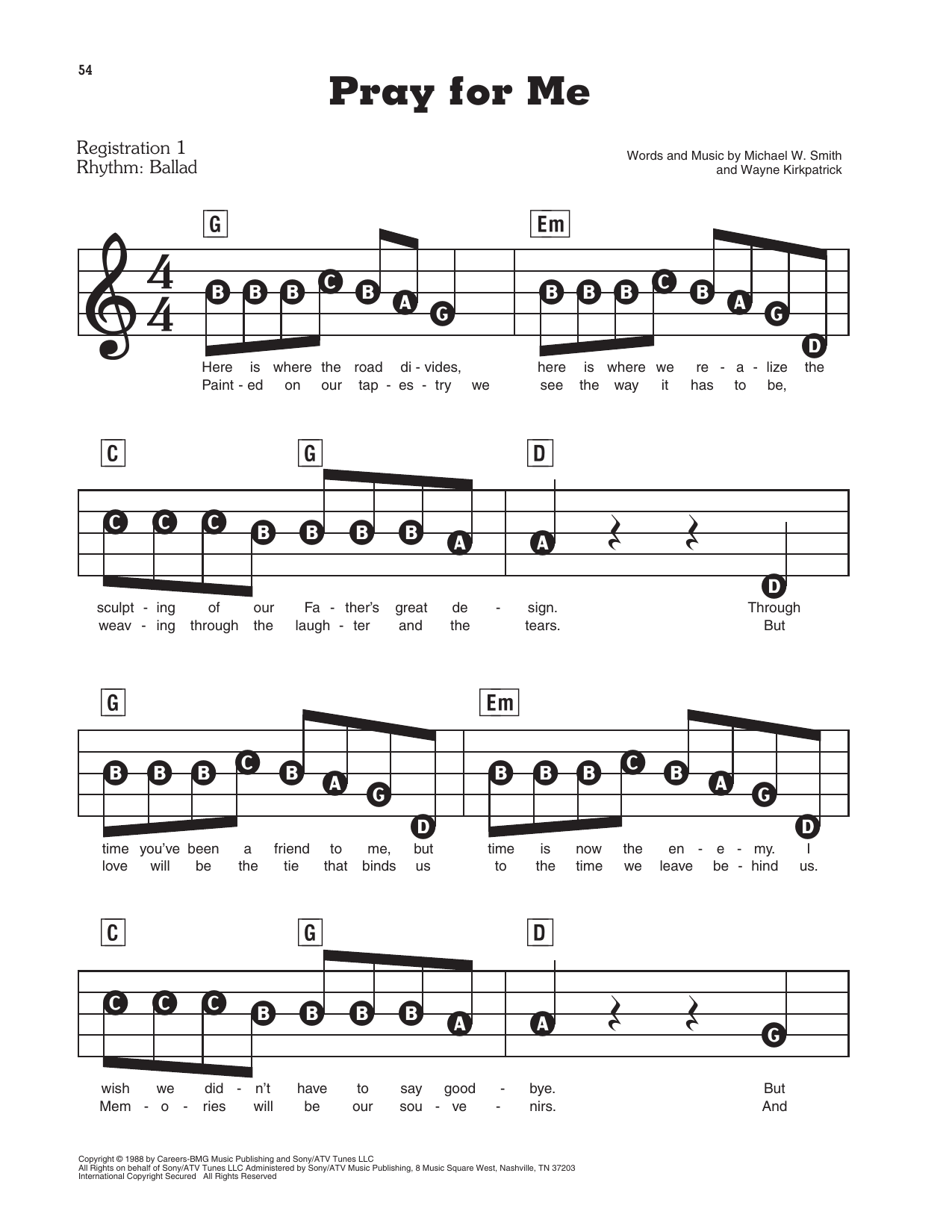
Pray For Me Sheet Music Preview

Pray For Me: E-Z Play Today

As performed by Michael W. Smith

Item: 35-DS01885560

Digital Download
$4.99
Description

Pray For Me: E-Z Play Today isn't in MakeMusic Cloud just yet...but it could be. Let us know you'd like to see it, and you'll help shape what comes next. In the meantime, start a free trial and dive into thousands of interactive titles your students can play along with today.

Sample Audio
No sample audio found.
Sample Video
Additional Details
Publisher: Hal Leonard
Page Count: 4
SKU: 35-DS01885560

More about this title

About the Artist: Michael W. Smith

Michael W. Smith built a career bridging contemporary Christian music and mainstream pop, establishing himself as one of the most commercially successful artists in the inspirational music space. His piano compositions often carry emotional directness paired with accessible harmonic language, making his work valuable for teaching students how to balance technical clarity with expressive depth.

Why we love this

This arrangement respects the song's emotional core while keeping the technical demands manageable for intermediate pianists. The E-Z Play format gives students access to a piece they may already know from radio or streaming, building motivation through familiarity while requiring genuine musicianship to shape the phrasing meaningfully.

What to expect

The piece carries quiet introspection, moving from intimate verse passages toward moments of gentle affirmation. The harmonic language feels warm and hopeful without veering into sentimentality, inviting performers to connect with both the message and the musical storytelling.

Who it's for

Intermediate pianists seeking contemporary repertoire with emotional resonance and students drawn to popular inspirational music who want to develop their ability to perform modern material with classical technique.

How to get the most out of it

  • Shape the melody through dynamic control rather than relying on tempo fluctuation; the lyrical quality depends on sensitive voice leading in the right hand.
  • Allow the left hand accompaniment to breathe without rushing, establishing a foundation that supports rather than drives the performance.
  • Listen for moments where the harmony shifts subtly and let those changes inform your tone color, even at moderate volumes.

How to use it

Consider this for recitals exploring the intersection of faith and popular music, or as a programming choice that acknowledges students' musical interests beyond traditional classical canon. The four-page length makes it suitable for a secondary piece on a mixed program.

Skills your students will build

  • Phrasing and shaping in contemporary harmonic contexts
  • Dynamic control to convey emotional content without excessive tempo variation
  • Balancing melody projection with accompaniment texture
  • Interpreting popular music styles with classical discipline

You May Also Like