Praise Ye the Lord Sheet Music Preview

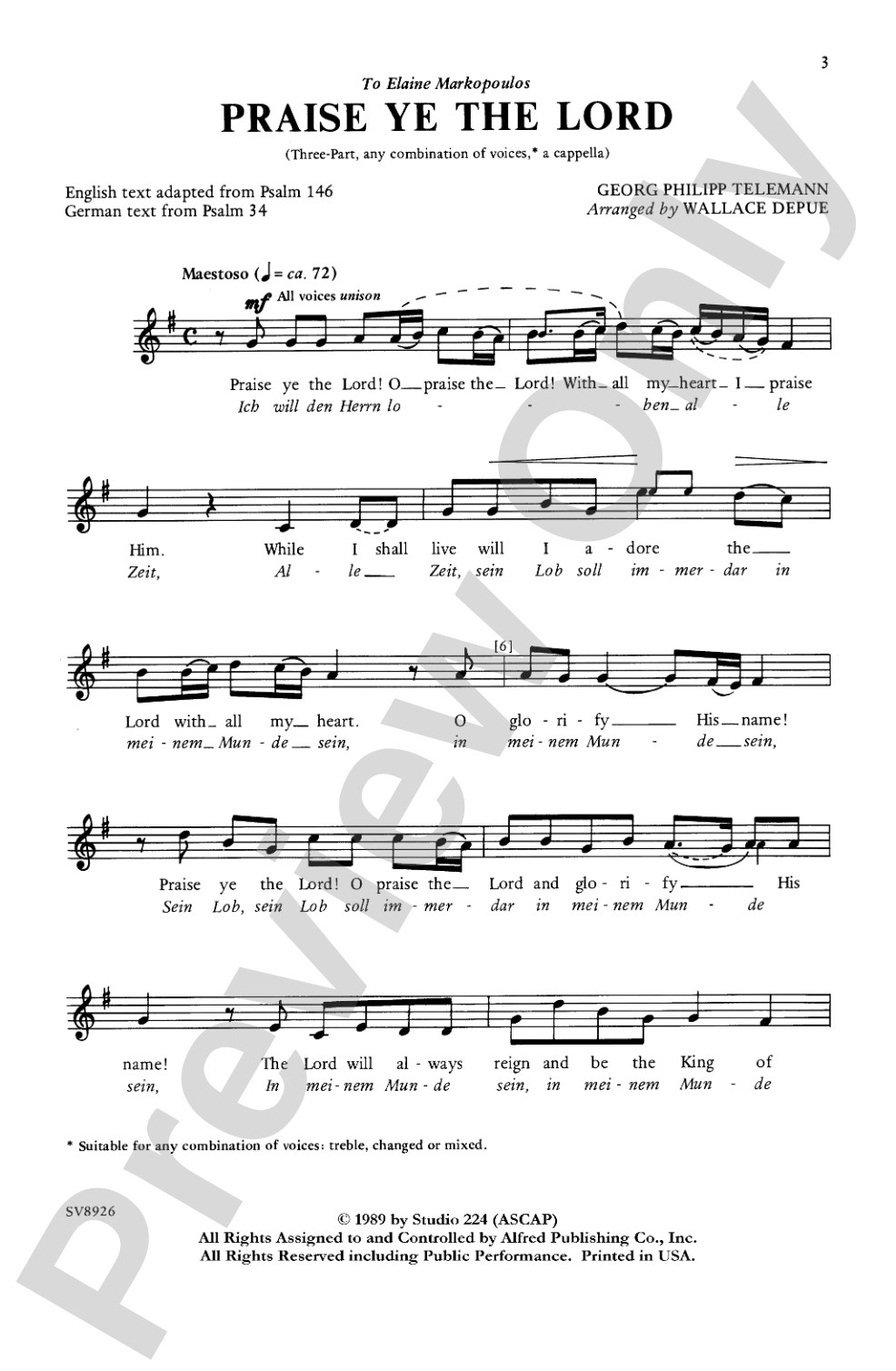
Praise Ye the Lord: 3-Part (any combination of voices), a cappella Choral Octavo

By Georg Philipp Telemann / ed. Wallace DePue

Item: 00-PO-0005211

Digital Download
$2.25

Minimum order quantity: 20 copies

Description

Praise Ye the Lord: 3-Part (any combination of voices), a cappella Choral Octavo isn't in MakeMusic Cloud just yet...but it could be. Let us know you'd like to see it, and you'll help shape what comes next. In the meantime, start a free trial and dive into thousands of interactive titles your students can play along with today.

Sample Audio
No sample audio found.
Sample Video
Additional Details
Series: Alfred Archive Edition: Studio PR Catalog
Publisher: Alfred Music
Page Count: 8
SKU: 00-PO-0005211

More about this title

About the Composer: Georg Philipp Telemann

Georg Philipp Telemann (1681-1767) was one of the most prolific composers of the Baroque era, producing over 3,000 works across nearly every genre. A master of counterpoint and melody, he served as Kapellmeister in several German courts and held the prestigious position of Cantor at the Johanneum in Hamburg, where he composed extensively for the church.

Telemann's gift for writing vocal music that is both musically sophisticated and genuinely singable made him enormously popular during his lifetime. His sacred choral works remain invaluable for directors seeking repertoire that combines Baroque craftsmanship with accessibility, offering singers the chance to engage with high-quality counterpoint without excessive technical demands.

Why we love this

This octavo delivers genuine Baroque artistry in a package your singers can actually manage. The three-part writing allows flexible casting while maintaining the harmonic integrity and contrapuntal interest that made Telemann's music so respected in his own time. It's the kind of piece that sounds far more complex than it is to learn.

What to expect

Elegant, reverent, and quietly confident. The writing flows with the natural grace of Baroque melody while the three-part texture creates an intimate sonic landscape. There's brightness here, not heaviness, with the harmonic language reinforcing the text's message of praise.

Who it's for

Directors building a stronger Baroque choral repertoire who need pieces that work with mixed voices or evolving choral rosters. This arrangement suits intermediate to advanced singers who are ready to engage with counterpoint and independent voice lines without needing the large voicing of a full five-part motet.

How to get the most out of it

  • Shape the phrase through to the ends rather than waiting for punctuation; Baroque phrasing relies on musical architecture, not written breaths, so map out your arch before rehearsal.
  • Balance the voices carefully in rehearsal so the inner line isn't buried; Telemann's three-part writing depends on clarity across all three parts.
  • Maintain consistent vowel shapes across the ensemble, especially on sustained passages where blend becomes immediately audible in a cappella texture.
  • Distinguish between rhythmic and harmonic downbeats; sometimes the text accent and the harmonic weight don't align, and honoring both creates nuance.

How to use it

Pair this with other sacred Baroque works to anchor a liturgical or concert program, or use it as a centerpiece for a worship service where Baroque repertoire resonates with your audience. It also works beautifully as a festival or contest selection where judges appreciate solid counterpoint and clean musical thinking.

Skills your students will build

  • Independent voice part reading and maintenance in three-part texture
  • Baroque phrasing across longer melodic lines without excessive text repetition
  • Balance and blend in a cappella singing
  • Harmonic awareness through functional bass lines and voice leading
  • Diction clarity in Latin sacred text

You May Also Like