Prairie Sunrise - Piano Solo Sheet Music Preview

Prairie Sunrise - Piano Solo: Piano

By Melody Bober

Level: Intermediate

Item: 00-PB-0000779

Digital Download
$3.50
Description
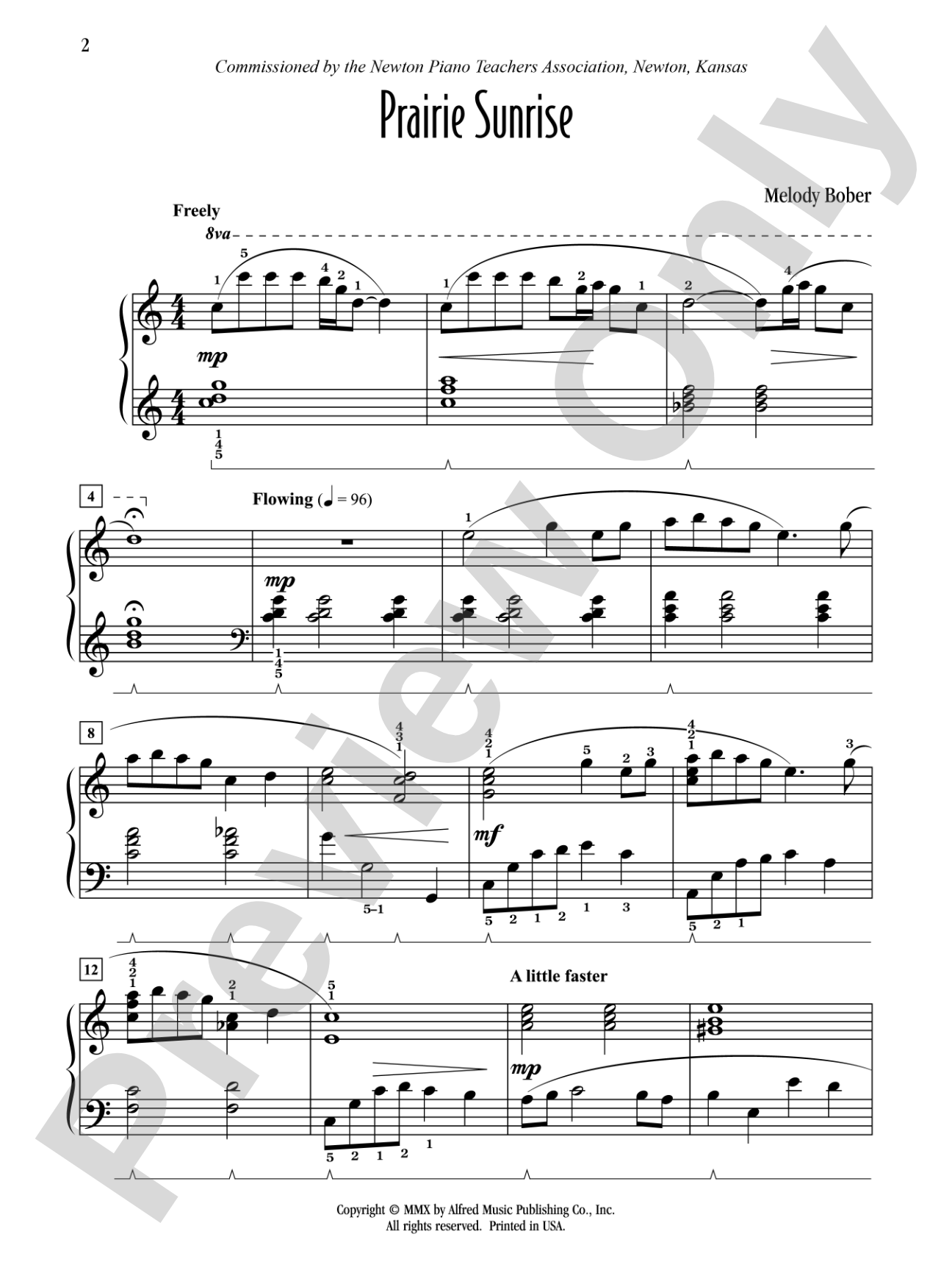
Sunrise over the Kansas prairie is depicted in this programmatic solo. In 4/4 meter, it begins with just the first hint of morning rays in the introduction, and then builds in intensity through changes in tempo in the A and B sections. A change of key from C major to D major highlights the brilliant dawn depicted in the majestic C section. The return to the theme from the introduction brings this beautiful solo full circle.

"A delightful piece for the intermediate student, full of color and imagery!"
- Progressions magazine A Federation Festivals 2020-2024 selection. A Federation Festivals 2024-2028 selection.

Prairie Sunrise - Piano Solo: Piano isn't in MakeMusic Cloud just yet...but it could be. Let us know you'd like to see it, and you'll help shape what comes next. In the meantime, start a free trial and dive into thousands of interactive titles your students can play along with today.

Sample Audio
No sample audio found.
Sample Video
Additional Details
Series: Signature Series
Publisher: Alfred Music
Page Count: 4
SKU: 00-PB-0000779

More about this title

About the Composer: Melody Bober

Melody Bober

Melody Bober writes piano music rooted in her dual expertise as a performer and educator. She holds a bachelor's degree in music education from the University of Illinois at Champaign-Urbana and a Master of Arts in piano performance from Minnesota State University, Moorhead, where she studied with notable teachers including Joel Shapiro and Andrew Froelich.

Beyond composing, Bober brings 20 years of public school teaching, university instruction, and private studio work to her creative practice. Active as a church pianist, accompanist, and music director, she has become a sought-after clinician at piano teacher conferences and workshops across North America. Her compositions consistently balance accessibility with musical substance, designed to deepen students' engagement with the instrument.

Why we love this

Bober's gift for programmatic writing shines here: the piece unfolds like watching actual weather, with each section marking a genuine shift in light and energy rather than arbitrary tempo changes. The key modulation from C major to D major serves a real musical purpose, painting the moment of full sunrise rather than functioning as mere contrast. Students hear exactly why these compositional choices matter.

What to expect

The piece begins in quiet mystery, as if you're waiting for something to happen. Gradually, urgency and brightness build. By the climactic D major section, the music feels wide open and radiant. The return to the simple opening brings a sense of completion, like you've witnessed something transformative.

Who it's for

Intermediate pianists ready to move beyond technical exercises into expressive, narrative-driven playing. This solo rewards students who can sustain a musical idea across longer phrases and respond thoughtfully to tempo and dynamic shifts without losing shape.

How to get the most out of it

  • Shape the introduction with restraint; the opening measures should feel tentative and hushed, as if the sun hasn't yet broken the horizon. Avoid any impulse to rush these early pages.
  • Track the tempo changes carefully between sections A and B. The increasing intensity comes from building momentum, not from playing mechanically faster.
  • Lean into the brilliance of the D major section by letting the tone open up naturally; the key change itself does much of the work without forcing extra volume.
  • Return to the opening theme with fresh ears in the final section. This is recognition, not repetition, so allow slight flexibility in timing to honor the journey the piece has traveled.

How to use it

Program this as a standalone recital piece for a student advancing into intermediate repertoire, or pair it with other character pieces for a thematic concert about nature or time of day. Its four pages and moderate length make it ideal for festival competitions, where it has earned consistent recognition.

Skills your students will build

  • Sustaining lyrical phrasing across longer melodic lines
  • Managing tempo changes while maintaining musical coherence
  • Understanding key relationships and hearing harmonic color shifts
  • Building dynamic intensity gradually without sacrificing control
  • Responding to programmatic text to inform interpretive choices

You May Also Like