
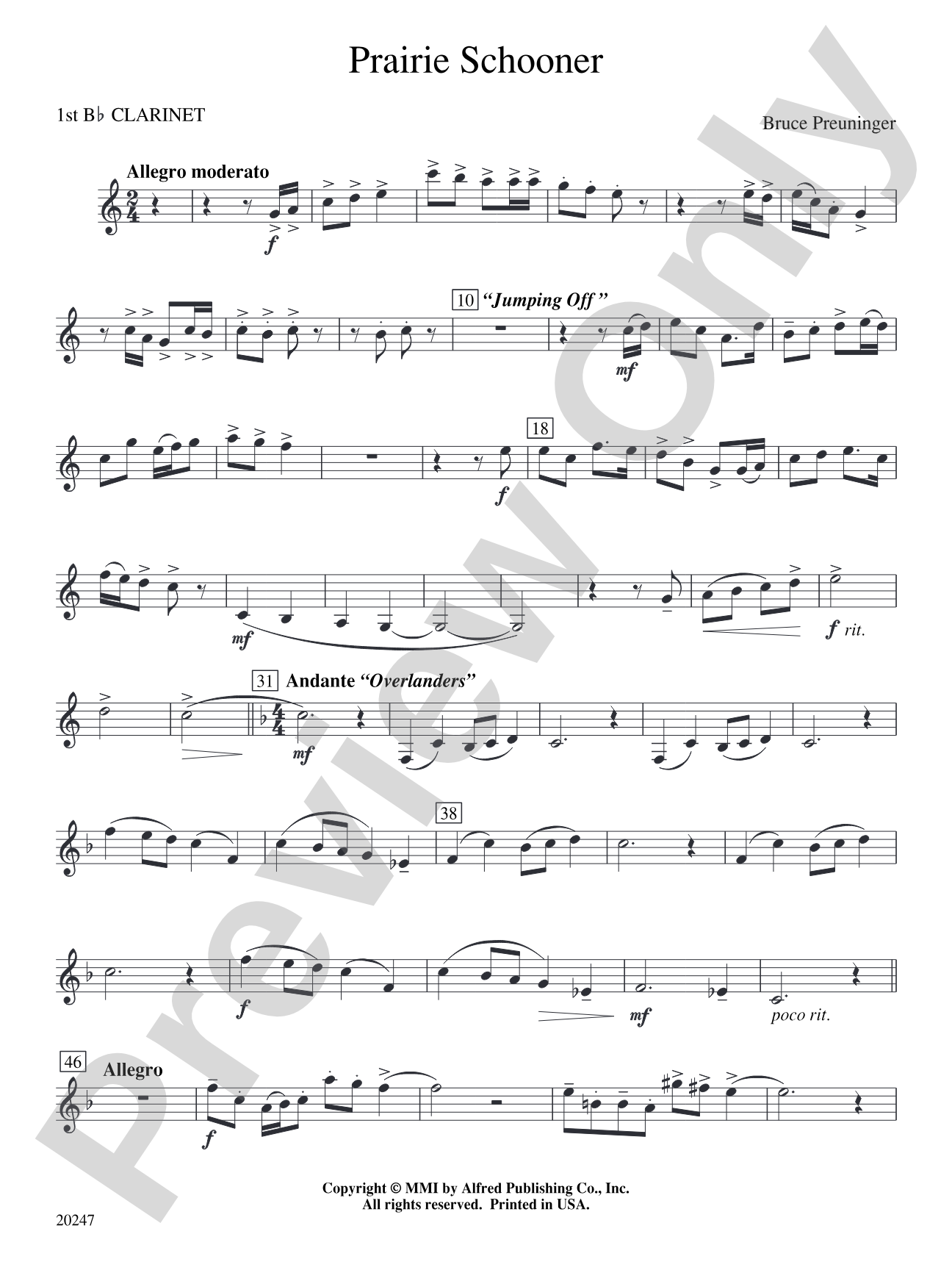

Prairie Schooner: 1st B-flat Clarinet
By Bruce Preuninger
Grade: 2 (Medium Easy)
Item: 00-PC-0000368_C1
$3.00
Pickup currently not available
Description
Portraying four scenes along the Oregon Trail, Prairie Schooner reflects the travels of more than a half-million people as they follow this great path, hoping to begin new lives in what is now the Western United States. Creative and dramatic, Prairie Schooner is sure to stir thoughts of our ancestors' great travels in the Old West. This title is available in MakeMusic Cloud.


Don't just read it, hear it, play along with it, and watch your students grow with it. In MakeMusic Cloud, Prairie Schooner: 1st B-flat Clarinet comes alive with professional accompaniment, adjustable tempo, and built-in practice tools that turn solo practice into real progress.
Open in the Player
Jump straight in and assign it today.
Start Your Free Trial
Open this title and explore the full library in minutes.
Sample Audio
1
Audio File
--:--
0:00
0:00
Sample Video
No sample videos found.
Additional Details
Series:
Young Symphonic
Publisher:
Alfred Music
Page Count:
256
SKU:
00-PC-0000368_C1
More about this title
About the Composer: Bruce Preuninger

Bruce Preuninger earned his undergraduate degree in Music Education from Eastern Washington University and later completed graduate work at Gonzaga University, where he studied administration and curriculum with a focus on K-12 music instruction. He spent 36 years teaching instrumental music in public schools across Washington, starting in Bellevue and moving to the East Valley School District in Spokane before retiring after the 2004-2005 school year.
Since 1999, Preuninger has composed for band with Alfred Music as his publisher. His works have become fixtures on state and international contest and festival programs, reflecting his deep understanding of what student musicians need to grow as performers and ensemble members.
Why we love this
Preuninger crafts a narrative arc that feels genuinely cinematic without requiring advanced technical writing; Grade 2 bands can actually convey the drama and scope of westward expansion rather than just playing notes. The four distinct scenes stay focused enough to teach young musicians how to shape longer forms while keeping pacing energetic and rewarding throughout rehearsals.
What to expect
Prairie Schooner captures the momentum and hardship of the trail with orchestration that feels expansive without overwhelming younger players. The music evokes open landscapes, determination, and the weight of historical journey through clear melodic writing and dramatic contrasts that let students feel the scope of what they're performing.
Who it's for
This works perfectly for Grade 2 concert bands preparing for festival or contest season with a single substantial piece that tells a story. Conductors seeking music that balances technical accessibility with genuine musical substance will find an immediate fit for rehearsals and performances alike.
How to get the most out of it
- Shape each of the four scenes as distinct movements with clear character changes. Mark section transitions clearly in parts so players understand when the emotional territory shifts.
- Balance the ensemble across the main melodic material. Preuninger often distributes the Oregon Trail theme among different sections, so be intentional about who carries the tune in each passage.
- Use the recorded accompaniment (available separately) to solidify tempo and phrasing, especially helpful when rehearsing sections independently before full ensemble work.
- Take the dramatic moments with confidence. Grade 2 players sometimes rush during big tutti passages from nervousness; conduct with steady authority to ground the sound and let the orchestration breathe.
How to use it
Program this as a contest or festival feature that gives your band a genuine centerpiece without requiring soloists or unusual instrumentation. It also pairs well on a concert focusing on American themes or historical narratives, anchoring the second half of a program where the band has warmed up and is ready for dramatic storytelling.
Skills your students will build
- Sustaining long melodic phrases across multiple measures
- Playing with dynamic contrast between soft passages and full ensemble sections
- Responding to sectional cues and entrances within a longer narrative structure
- Balancing part independence when themes pass between instruments
- Maintaining consistent tempo across transitions between contrasting sections