
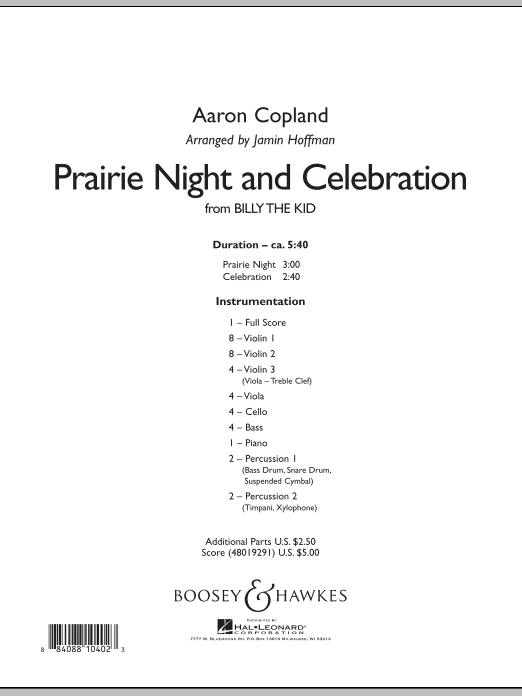

Prairie Night And Celebration (from Billy The Kid): String Orchestra Conductor Score & Parts
By Aaron Copland / Arranged by Jamin Hoffman
Grade: 3-4
Item: 35-PK00143717
$55.00
Pickup currently not available
Buy Extra Parts (Digital PDF Download)
Parts Added to Cart!
Description
These two popular vignettes from the classic American ballet "Billy the Kid" have been staples in the orchestral concert repertoire since their introduction in 1940. Now available for string orchestra, the music is distinctively Copland in two contrasting styles -- the pastoral innocence of "Prairie Night" (also known as "Card Game at Night") and the rhythmic, dissonant "Celebration," depicting the capture of the famed outlaw. Dur: 5:40


Prairie Night And Celebration (from Billy The Kid): String Orchestra Conductor Score & Parts isn't in MakeMusic Cloud just yet...but it could be. Let us know you'd like to see it, and you'll help shape what comes next. In the meantime, start a free trial and dive into thousands of interactive titles your students can play along with today.
Request This Title
Tell us you want it.
Start Your Free Trial
Explore everything that's ready to play right now.
Sample Audio
No sample audio found.
Sample Video
No sample videos found.
Additional Details
Publisher:
Hal Leonard
SKU:
35-PK00143717
More about this title
About the Composer: Aaron Copland
Aaron Copland (1900–1990) shaped American classical music by drawing directly from folk idioms, hymn melodies, and open-interval harmonies that evoke the country's landscapes and spirit. His ballets Billy the Kid, Rodeo, and Appalachian Spring remain cornerstones of the concert repertoire, instantly recognizable for their blend of populism and compositional sophistication.
Why we love this
Copland's orchestration translates beautifully to strings, and Jamin Hoffman's arrangement preserves the emotional arc of both movements without losing the composer's distinctive voice. The contrasting moods give students a concrete study in how harmonic language and rhythmic gesture shape character, while the 5:40 total duration makes this ideal for programming between larger works or as a concert opener.
What to expect
The opening unfolds like a landscape at dusk: spare, open, with the kind of stillness that invites listening. Then the music shifts abruptly into restless energy, dissonant clusters, and driving rhythms that capture both the outlaw's notoriety and the frontier's raw vitality. Both movements feel unmistakably American, rooted in the soil.
Who it's for
String orchestras at the high school or early college level looking for substantial American repertoire that sits squarely in Grade 3–4 territory. Teachers value this work because students encounter Copland's compositional language directly while building ensemble maturity through lyrical and rhythmic challenges alike.
How to get the most out of it
- Establish the pastoral quality of 'Prairie Night' through sustained, singing tone and careful dynamic control; the music breathes in long phrases rather than rhythmic articulation.
- Balance the dissonance in 'Celebration' so that it reads as excitement rather than chaos; tight rhythmic coordination in the string section is essential here.
- Lean into the open intervals and sparse textures that Copland uses; resist the urge to over-blend or smooth out the harmonic color.
- Let the contrast between movements be stark. Move confidently from the stillness of 'Prairie Night' into the kinetic energy of 'Celebration' without losing focus.
How to use it
Pair this with other Americana or early 20th-century works to build a thematic concert, or program it mid-concert as a breather between more virtuosic pieces. The 'Celebration' finale also serves as a natural way to close a program with energy and contemporary harmonic color without straying into minimalism or modern idioms.
Skills your students will build
- Sustaining tone quality across long phrases in contrasting registers
- Responding to sudden shifts in harmonic language and rhythmic texture
- Balancing dissonance without losing ensemble cohesion
- Understanding how open intervals and sparse orchestration create distinctive color
- Ensemble coordination across contrasting moods and tempos