
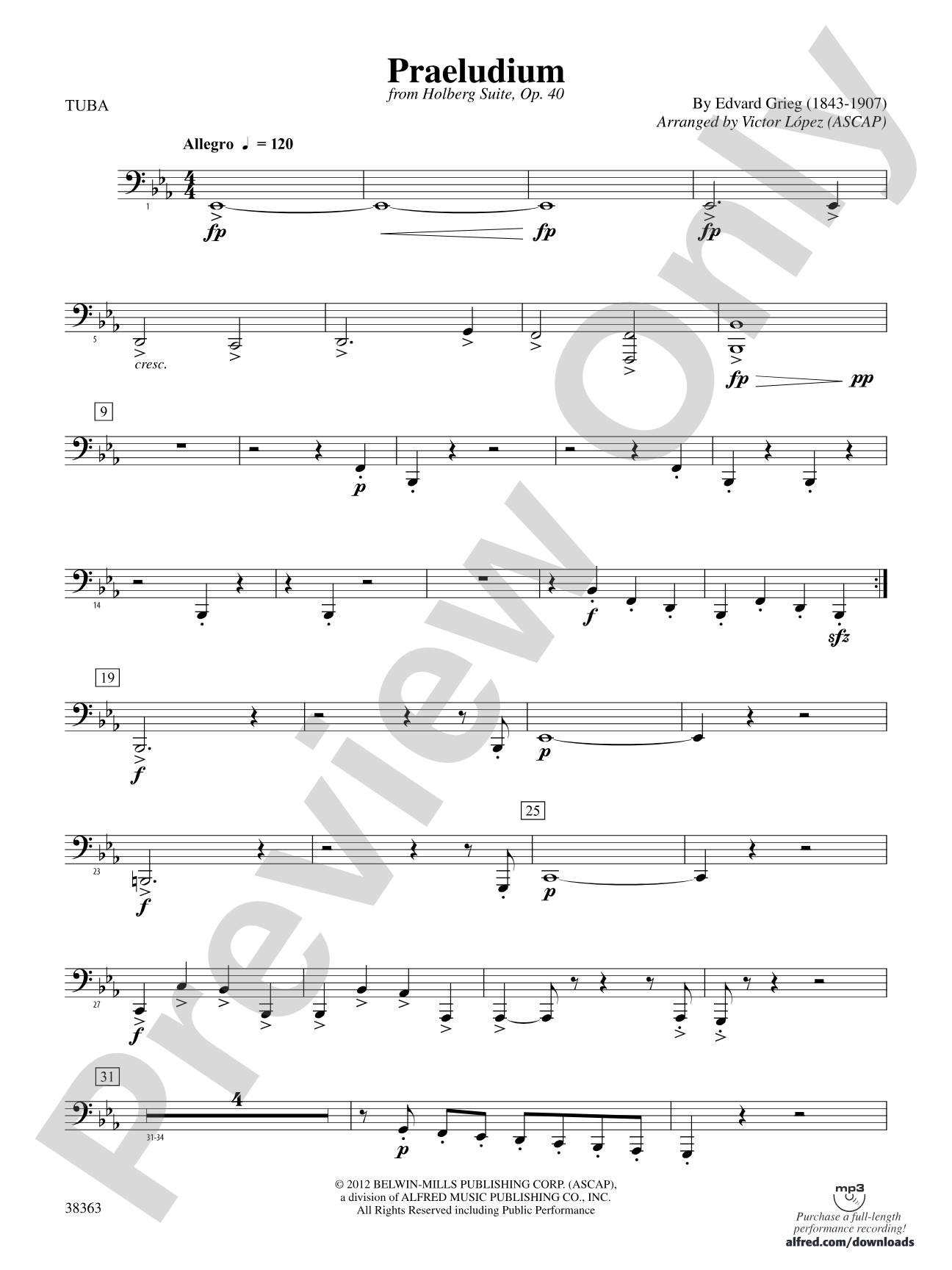

Praeludium: Tuba
By Edvard Grieg / arr. Victor López
Grade: 3 (Medium Easy)
Item: 00-PC-0015449_TB1
$3.00
Pickup currently not available
Description
From Grieg's Holberg Suite, Op. 40, the "Praeludium" is the first---and perhaps the most powerful---movement of that cherished work. Regal and bold in nature, this transcription will serve admirably as well in both concert or contest settings. A welcomed addition to the concert band literature. (3:15) This title is available in MakeMusic Cloud.


Don't just read it, hear it, play along with it, and watch your students grow with it. In MakeMusic Cloud, Praeludium: Tuba comes alive with professional accompaniment, adjustable tempo, and built-in practice tools that turn solo practice into real progress.
Open in the Player
Jump straight in and assign it today.
Start Your Free Trial
Open this title and explore the full library in minutes.
Sample Audio
1
Audio File
--:--
0:00
0:00
Sample Video
No sample videos found.
Additional Details
Series:
Belwin Concert Band
Publisher:
Alfred Music
Page Count:
244
SKU:
00-PC-0015449_TB1
More about this title
About the Composer: Edvard Grieg
Edvard Grieg (1843-1907) stands as Norway's most influential composer, and his music remains central to the concert band repertoire. A master of melody and orchestral color, Grieg created works that speak across centuries and instrumental combinations, never losing their emotional directness or structural clarity.
The Holberg Suite, which includes this Praeludium, came late in Grieg's career as a tribute to the Norwegian playwright Ludwig Holberg. Originally written for solo piano, the suite has proven endlessly adaptable, finding new life in every transcription while maintaining the distinctive voice that made Grieg beloved by musicians and audiences alike.
Why we love this
Victor López's transcription captures everything that makes the original powerful while writing idiomatically for concert band. The Praeludium's architectural strength translates beautifully to this medium; it's substantial enough to anchor a concert program yet accessible enough at Grade 3 to let your students feel the weight of performing a genuine masterwork.
What to expect
Regal and ceremonial, with an undercurrent of northern European gravitas. The Praeludium unfolds like a formal procession, each section building naturally from what came before, moving toward a powerful statement before receding into reflection. This is music that commands attention without shouting.
Who it's for
Any concert band mature enough to handle a sophisticated harmonic palette and willing to commit to the work's architectural integrity. This arrangement serves Grade 3 bands that have solid fundamentals in balance, intonation, and ensemble control. Directors seeking repertoire that satisfies both concert and festival competition contexts will find a dependable standard here.
How to get the most out of it
- Shape the opening fanfare with clarity and presence. The regal character depends on precise articulation across the brass section; ask for a unified tongue and confident attack that makes the announcement feel ceremonial rather than tentative.
- Balance the tutti passages carefully, particularly when the melody moves through different choirs. The harmonic foundation matters as much as the soaring line; a transparent texture keeps the architecture visible.
- Resist the urge to rush through moments of repose. Grieg writes breathing space deliberately. Allow the band to settle and listen between phrases, especially in the development section.
- Attend to dynamic control in the final climax. The piece builds naturally toward a powerful conclusion; let the crescendo happen gradually rather than jumping immediately to full volume, and keep the final statement noble rather than crude.
How to use it
Program this as a concert opener or closer; its formal bearing and structural completeness make it equally effective in either position. It pairs well with contemporary works or lighter fare, offering ballast to a program and demonstrating your band's ability to handle a masterwork with maturity. At 3:15, it leaves time for substantial pairings without demanding an entire concert.
Skills your students will build
- Balancing melody and harmonic accompaniment across multiple instrumental choirs
- Sustaining long phrases without losing forward momentum
- Achieving clarity and precision in forte passages while maintaining musical intent
- Understanding harmonic structure and phrase architecture in classical music
- Responding to conductor direction in a work with formal, defined sections