
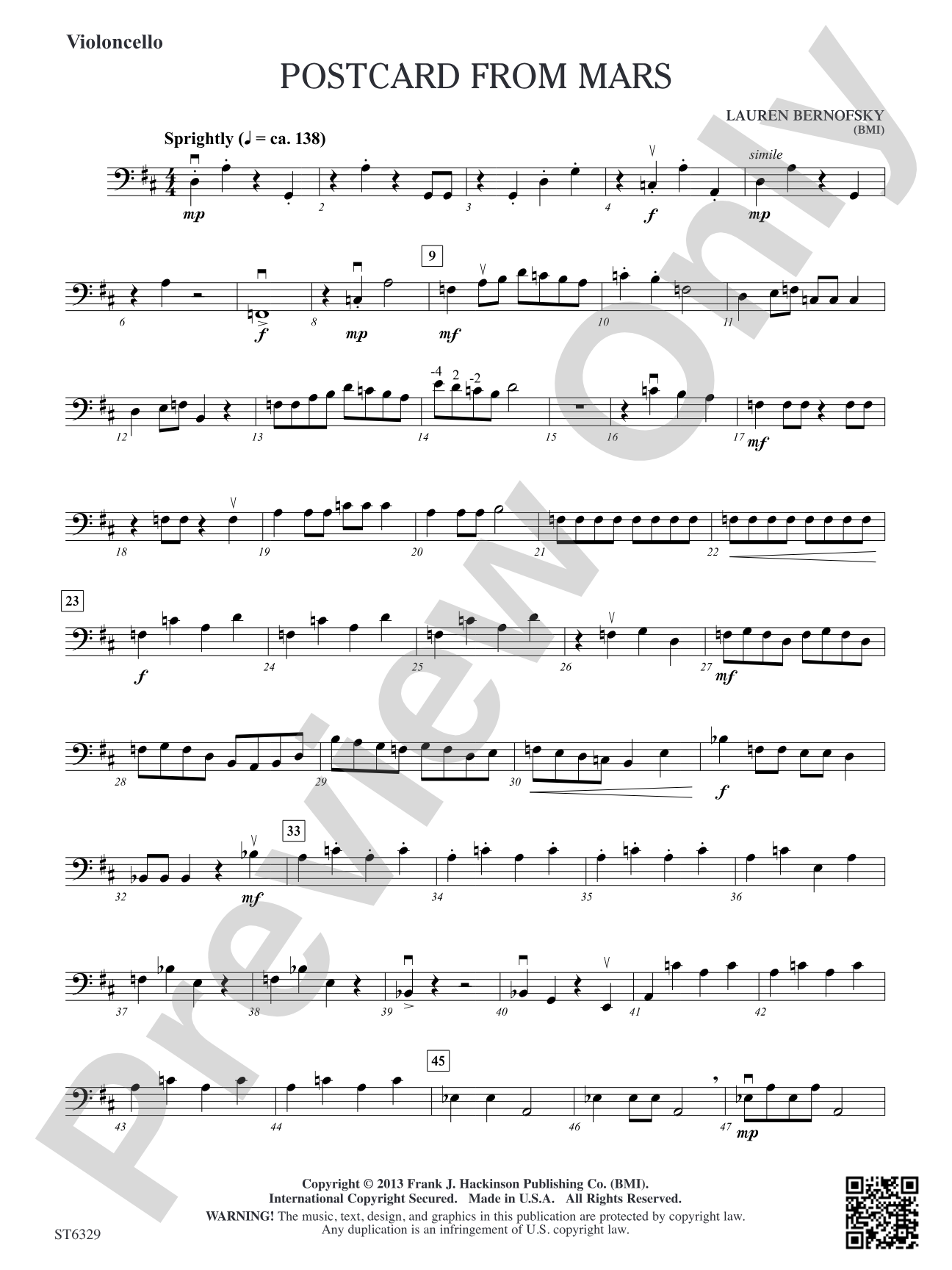

Postcard from Mars: Violoncello
By Lauren Bernofsky
Grade: 2.5
Item: 98-PC-DST6329_VC1
$7.00
Pickup currently not available
Description
Looking for a fun, yet stimulating piece for your group? Then how about some music from Mars? This fantastic original contains all the notes from traditional minor and major scales, but you have never heard them played in these combinations before! The music is cleverly designed to fit well under the fingers, but the melodic and harmonic gestures are, well, out of this world!


Don't just read it, hear it, play along with it, and watch your students grow with it. In MakeMusic Cloud, Postcard from Mars: Violoncello comes alive with professional accompaniment, adjustable tempo, and built-in practice tools that turn solo practice into real progress.
Open in the Player
Jump straight in and assign it today.
Start Your Free Trial
Open this title and explore the full library in minutes.
Sample Audio
1
Audio File
--:--
0:00
0:00
Sample Video
No sample videos found.
Additional Details
Series:
FJH Developing Strings
Publisher:
The FJH Music Company, Inc.
SKU:
98-PC-DST6329_VC1
More about this title
About the Composer: Lauren Bernofsky

Lauren Bernofsky brings a distinctive voice to contemporary composition, crafted through rigorous training at The Hartt School, New England Conservatory, and Boston University. Her catalog spans over a hundred works across solo, chamber, orchestral, operatic, and ballet idioms, earning recognition from major institutions and commissioning ensembles worldwide. Her Sonatine won the National Flute Association's Newly Published Music Competition, and her choral work Prayer of Shantideva was commissioned as the winning entry of the Dalai Lama Composition Contest, premiering at a prayer service attended by the Dalai Lama himself.
Bernofsky's compositions balance intellectual rigor with lyrical expression, a quality evident in pieces ranging from her string quartet Anacostia Journal (featured on PBS's NOW with Bill Moyers) to her Concerto for Trumpet and Orchestra. She has received support from The National Foundation for the Advancement of the Arts, The American Music Center, and The American Composers Forum. Her teaching experience includes faculty positions at the Peabody Institute and Interlochen Center for the Arts, and she regularly guests conduct and lead clinics at festivals nationally and internationally.
Why we love this
Bernofsky writes for developing orchestras with real musical substance. The piece uses familiar scale material as a springboard for genuinely inventive harmonic and melodic ideas, so your students aren't just playing exercises disguised as music. The clever voice writing and fingering-friendly passages make it accessible without feeling simplistic, and the novelty character gives your group permission to have fun while still building real musicianship.
What to expect
Imaginative and playful, with a sense of discovery. The familiar scale tones suddenly appear in combinations that feel fresh and surprising, creating a lighthearted yet sophisticated sound world. It's music that makes listeners smile while players feel like they're making something genuinely creative.
Who it's for
Intermediate string orchestras at the developing stage (around Grade 2.5) looking for fresh concert material that challenges without overwhelming. This works especially well for groups preparing for festival or contest, or for any director seeking a piece that engages audiences while respecting where players are technically.
How to get the most out of it
- Pay attention to balance between sections. The clever orchestrations mean that inner voices often carry important harmonic color, so avoid letting first violins dominate even when they're on the melody.
- Experiment with slight tempo flexibility during the more whimsical passages. The "out of this world" character comes partly from rhythmic surprises, so precision paired with interpretive breathing will bring the humor to life.
- Use the accessibility of the fingering patterns to your advantage in rehearsal. Students can learn their parts quickly, freeing rehearsal time to focus on blend, articulation consistency, and the character of individual phrases rather than note-learning.
How to use it
Program this as a concert opener or closer to establish a playful tone, or pair it with a more serious contemporary work to showcase range. It's particularly effective at festivals where novelty pieces break up longer programs, and it works beautifully in family concerts or outreach performances where you want to demonstrate that contemporary music can be accessible and fun.
Skills your students will build
- Intonation control in major and minor scale contexts
- Ensemble balance when important harmonic material lives in inner voices
- Stylistic interpretation of contemporary novelty writing
- Quick score learning and independence (accessible fingering patterns)
- Articulation consistency across the orchestra