
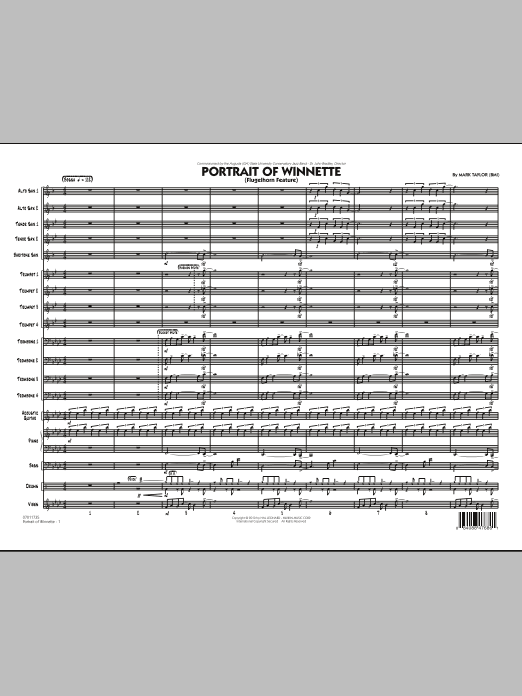

Portrait Of Winnette: Jazz Ensemble Conductor Score & Parts
By Mark Taylor
Grade: 4
Item: 35-PK00143101
$50.00
Pickup currently not available
Buy Extra Parts (Digital PDF Download)
Parts Added to Cart!
Description
Flugelhorn Feature


Portrait Of Winnette: Jazz Ensemble Conductor Score & Parts isn't in MakeMusic Cloud just yet...but it could be. Let us know you'd like to see it, and you'll help shape what comes next. In the meantime, start a free trial and dive into thousands of interactive titles your students can play along with today.
Request This Title
Tell us you want it.
Start Your Free Trial
Explore everything that's ready to play right now.
Sample Audio
No sample audio found.
Sample Video
No sample videos found.
Additional Details
Publisher:
Hal Leonard
SKU:
35-PK00143101
More about this title
About the Composer: Mark Taylor
Mark Taylor has established himself as one of the most prolific and respected composers in contemporary jazz education. His output spans big band charts, small ensemble works, and concert band pieces, all marked by accessible writing that never sacrifices musical substance for pedagogical convenience.
Taylor's arrangements are known for their clarity of voice leading, logical part construction, and ability to challenge students without overwhelming them. Educators consistently turn to his catalog when they need music that teaches ensemble discipline while remaining genuinely enjoyable to perform.
Why we love this
The flugelhorn voice cuts through a jazz ensemble with warm authority, and Taylor writes for it with real understanding of the instrument's expressive range. This Grade 4 setting gives your soloists a feature that feels substantial without requiring virtuosic chops, while the Latin rhythmic framework keeps the ensemble engaged and precise.
What to expect
Warm and introspective, with the kind of easy swing that feels less about virtuosity and more about groove and sensitivity. The Latin flavor gives the piece rhythmic momentum without driving toward frenzy; this is music that rewards listening as carefully as playing.
Who it's for
Jazz ensembles working at the Grade 4 level who want to feature a soloists with a piece that teaches both Latin jazz vocabulary and standard ensemble musicianship. The part writing stays accessible enough for developing musicians while offering real textural and harmonic interest.
How to get the most out of it
- Balance the flugelhorn sound against the rhythm section by having your saxes voice lightly underneath the solo passages; the goal is highlighting the soloist without creating an accompaniment that drowns them out.
- Lock the clave or cascara pattern early in rehearsal so the ensemble inhabits the Latin pocket before layering in harmonic complexity.
- Shape the flugelhorn's phrasing toward the natural breath points rather than fighting the written articulation; this instrument's tone deepens when given room to breathe musically.
- Adjust the overall dynamic level based on your room acoustics; flugelhorn projects differently than trumpet, and what reads as forte in rehearsal may sound thin in a reverberant hall.
How to use it
Position this as the centerpiece of a concert section devoted to the flugelhorn's expressive voice, pairing it with ballads or other features that showcase tone over technique. It works equally well as a vehicle for a student soloist to gain confidence in a supportive ensemble setting.
Skills your students will build
- Latin jazz rhythmic patterns and clave awareness
- Accompanying skills with dynamic restraint
- Harmonic listening within jazz voicings
- Phrasing and breath management for wind soloists