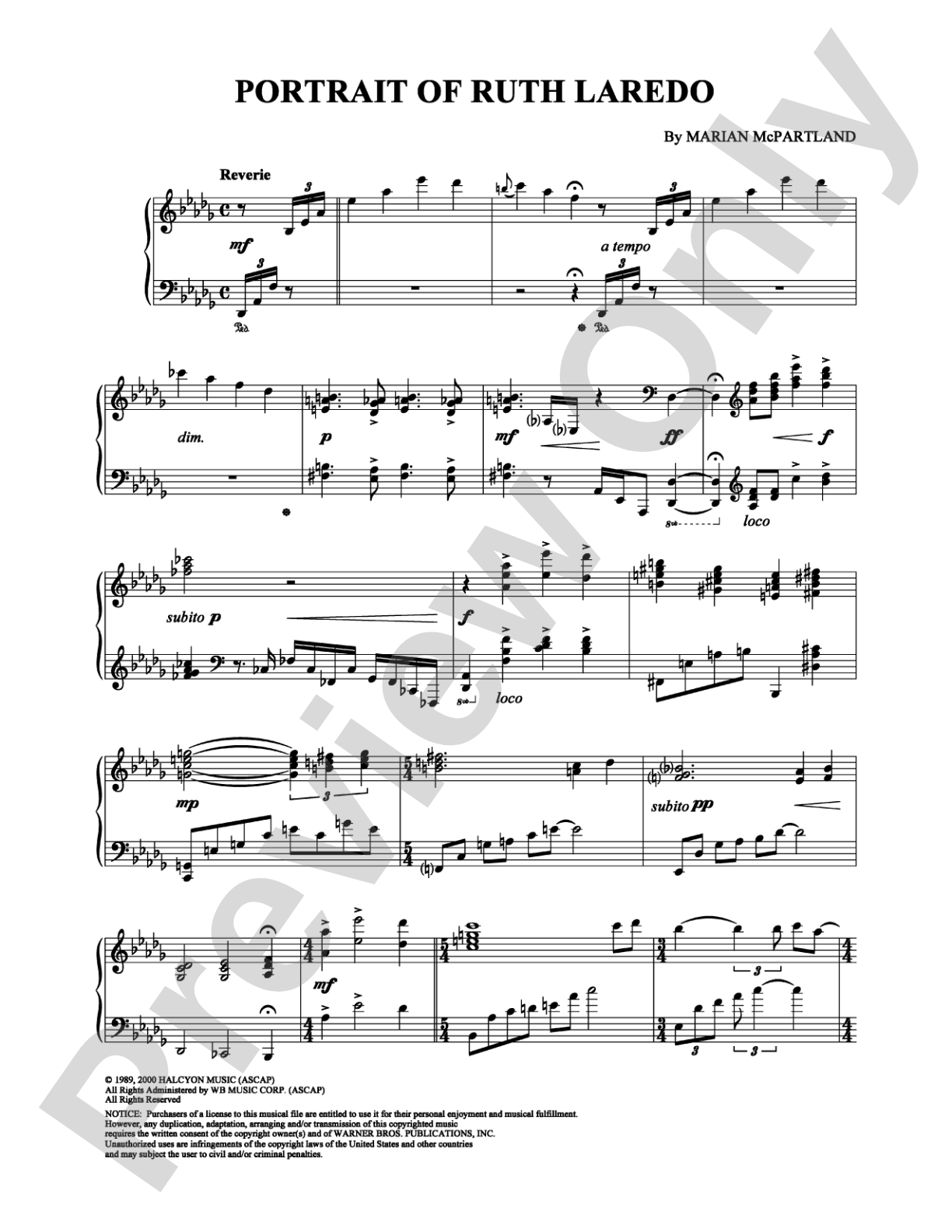
Portrait of Ruth Laredo: Piano Digital Sheet Music

Portrait of Ruth Laredo: Piano Digital Sheet Music

Marian McPartland

Item: 00-PS-0008348

Digital Download
$3.99
Description

Portrait of Ruth Laredo: Piano Digital Sheet Music isn't in MakeMusic Cloud just yet...but it could be. Let us know you'd like to see it, and you'll help shape what comes next. In the meantime, start a free trial and dive into thousands of interactive titles your students can play along with today.

Sample Audio
No sample audio found.
Sample Video
Additional Details
SKU: 00-PS-0008348

More about this title

About the Artist: Marian McPartland

Marian McPartland was a British-American jazz pianist and composer whose career spanned seven decades. She co-founded the Halmark Records label, became the longest-running host of a radio show in public broadcasting history (Piano Jazz, 1978, 2007), and performed and recorded with some of jazz's most significant figures. Her compositions blend accessible melody with harmonic sophistication, making her work valuable for pianists studying how to voice jazz chords with clarity and intention.

Why we love this

McPartland's own interpretations reveal how deeply she understood jazz piano repertoire and the specific demands of making melody sing within harmonic complexity. Students studying her recordings and arrangements gain insight into how a trained musician approaches jazz vocabulary with intention rather than cliché. This is the voice of someone who could bridge classical rigor and improvisational freedom.

What to expect

A portrait in sound: reflective and intimate, with melodic lines that bloom within sophisticated harmonies. There is both gentleness and intelligence here, the feeling of being drawn into someone's musical conversation.

Who it's for

This piece serves pianists working toward jazz fluency and students who want to study how a serious composer approached both melody and harmony. Advanced high school pianists and college jazz students will find it rewarding for understanding how classical training and jazz sensibility coexist.

How to get the most out of it

  • Listen to McPartland's recorded performance first. Her touch and phrasing reveal interpretive choices that notation alone cannot capture, especially in how she voices chords and shapes rubato.
  • Pay attention to the harmonic movement beneath the melody line. McPartland composed with specific voicings in mind; honor those choices as structural anchors even when improvising.
  • Shape the left hand with intention. The bass and comping patterns should breathe as part of the overall narrative, not merely accompany the right hand melody.
  • Approach the form with flexibility. Jazz piano rewards understanding the architecture, but also demands responsiveness to the music's emotional arc in real time.

How to use it

Consider this for a jazz recital or concert where you want to showcase compositional craft alongside interpretive skill. It pairs well with other jazz standards and original compositions by women composers, creating programming that tells a fuller story about jazz history.

Skills your students will build

  • Interpreting jazz harmony and chord substitution from notation
  • Balancing written melody with accompaniment patterns
  • Developing touch control and pedal technique in a jazz context
  • Understanding how classical voice leading informs jazz composition

You May Also Like