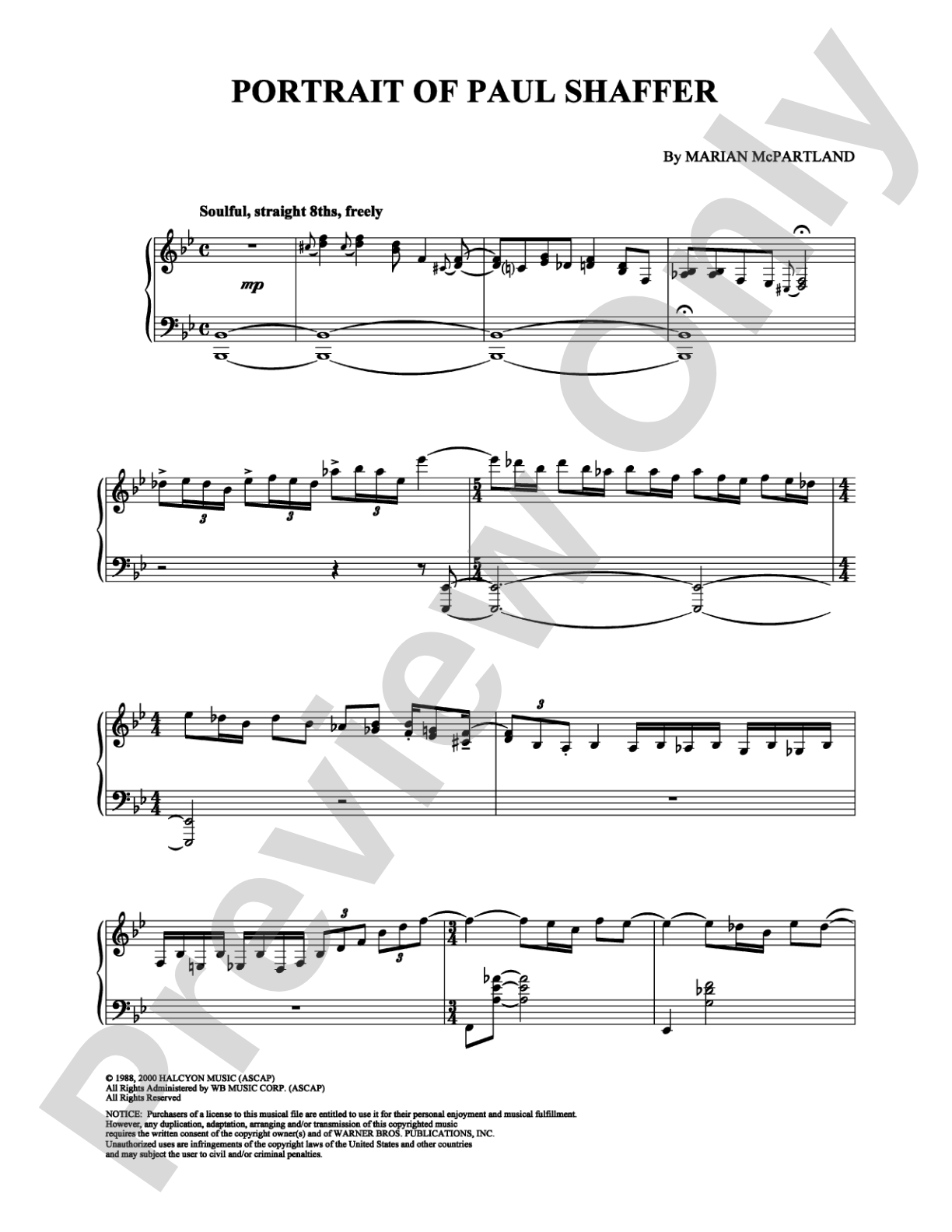
Portrait of Paul Shaffer: Piano Digital Sheet Music

Portrait of Paul Shaffer: Piano Digital Sheet Music

Marian McPartland

Item: 00-PS-0005115

Digital Download
$3.99
Description

Portrait of Paul Shaffer: Piano Digital Sheet Music isn't in MakeMusic Cloud just yet...but it could be. Let us know you'd like to see it, and you'll help shape what comes next. In the meantime, start a free trial and dive into thousands of interactive titles your students can play along with today.

Sample Audio
No sample audio found.
Sample Video
Additional Details
SKU: 00-PS-0005115

More about this title

About the Artist: Marian McPartland

Marian McPartland (1918–2011) was a pioneering jazz pianist and composer whose career spanned seven decades. Born in England, she moved to the United States and became a central figure in American jazz, known for her sophisticated harmonic sense, lyrical touch, and ability to accompany and collaborate with some of jazz's greatest musicians. Beyond performing, McPartland was a tireless advocate for jazz education and founded the Piano Jazz radio program, through which she interviewed and performed with hundreds of artists, cementing her role as a keeper and educator of the jazz tradition.

Why we love this

McPartland's original compositions offer jazz pianists a direct window into the aesthetic and harmonic thinking of one of the instrument's true masters. This portrait of Paul Shaffer showcases her gift for melody and her ability to capture personality in music, making it rewarding material for pianists seeking pieces that demand both technical facility and interpretive maturity.

What to expect

A lyrical, character-driven portrait that feels intimate without being sentimental. The music balances melodic directness with harmonic sophistication, creating a piece that honors its subject while showcasing McPartland's ability to suggest personality and warmth within a sophisticated jazz language.

Who it's for

This piece is ideal for jazz pianists with solid reading skills and a working knowledge of chord voicings and comping. It suits musicians interested in learning from composers who shaped the jazz tradition and want to deepen their understanding of how jazz pianists think through melody and harmony.

How to get the most out of it

  • Listen to McPartland's own recordings to absorb her phrasing and approach to rhythm section accompaniment; her time feel and touch directly inform how this piece should breathe.
  • Balance the melody line with harmonic independence in the left hand; McPartland often weaves countermelodic material beneath the main theme, so avoid letting one hand dominate.
  • Explore the harmonic palette deliberately; McPartland's chord voicings are intentional and often contain unexpected color, so allow slight space around complex sonorities to let them register.
  • Treat comping figures with the same care as melodic passages; in jazz piano writing, accompaniment material is rarely filler and often reveals compositional craft.

How to use it

Feature this as a solo recital piece on a jazz concert or as part of a program celebrating women composers in jazz. It also works well in a teaching context where you want students to study how a jazz master composes for her own instrument.

Skills your students will build

  • Interpreting jazz piano comping and accompaniment figures
  • Reading and voicing chord symbols with jazz harmonic color
  • Balancing melody and harmony in a single-line jazz composition
  • Understanding phrasing and time feel through a composer-performer's own aesthetic

You May Also Like