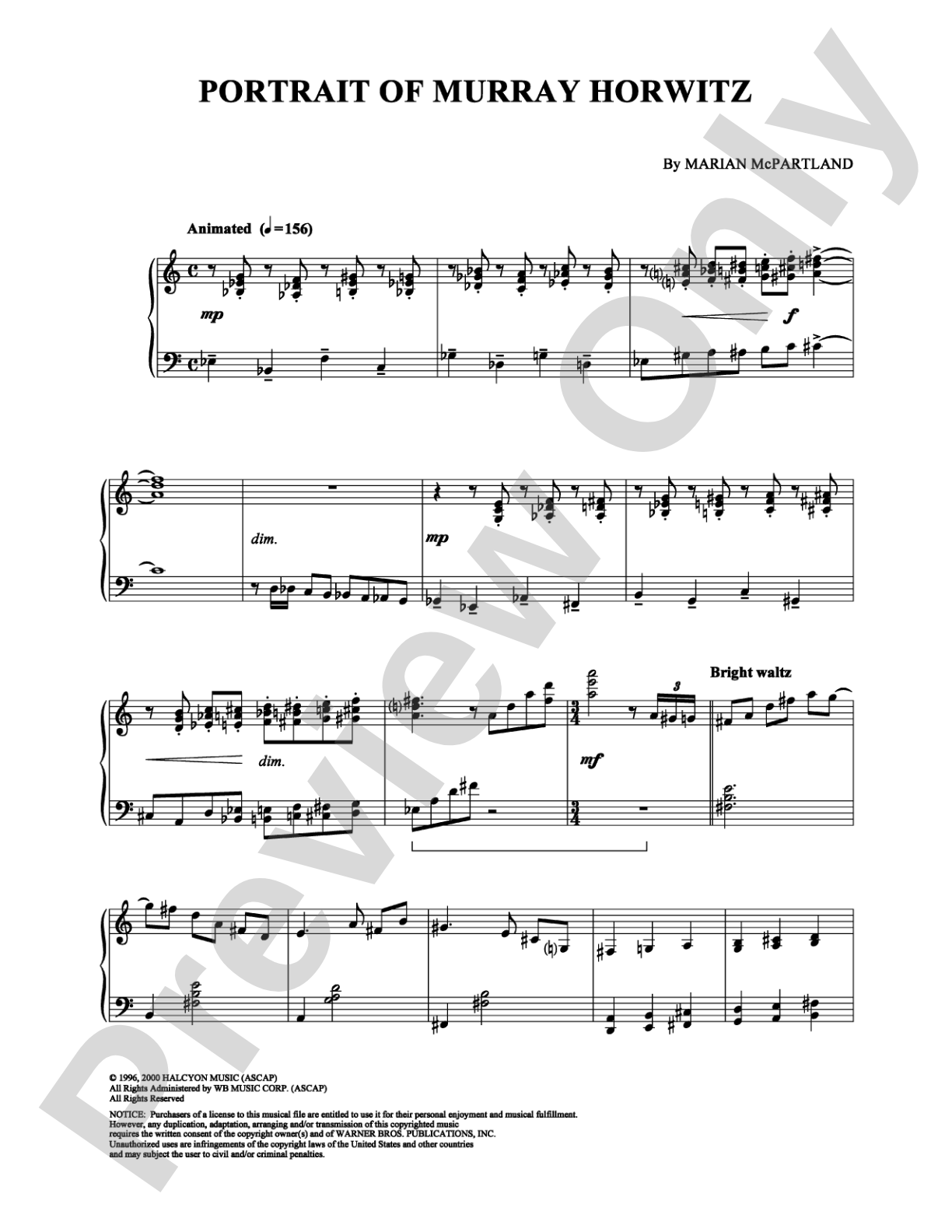
Portrait of Murray Horwitz: Piano Digital Sheet Music

Portrait of Murray Horwitz: Piano Digital Sheet Music

Marian McPartland

Item: 00-PS-0008077

Digital Download
$3.99
Description

Portrait of Murray Horwitz: Piano Digital Sheet Music isn't in MakeMusic Cloud just yet...but it could be. Let us know you'd like to see it, and you'll help shape what comes next. In the meantime, start a free trial and dive into thousands of interactive titles your students can play along with today.

Sample Audio
No sample audio found.
Sample Video
Additional Details
SKU: 00-PS-0008077

More about this title

About the Artist: Marian McPartland

Marian McPartland (1918-2013) was a British-American pianist and composer who became one of jazz's most respected voices over a seven-decade career. She founded the influential Trio Records label, hosted the long-running NPR program Piano Jazz, and earned recognition as both a bandleader and a prolific composer of jazz standards that remain central to the repertoire.

Why we love this

McPartland's compositions carry the mark of someone who understood how to write for the instrument from the inside. This solo showcases her gift for melodic clarity and harmonic sophistication, making it rewarding to learn while remaining firmly rooted in authentic jazz vocabulary.

What to expect

The piece unfolds with the elegance of a portrait rendered in real time. Melodic phrases breathe with conversational ease, supported by harmonies that suggest walking exploration rather than rigid structure, creating space for the player's own interpretive choices.

Who it's for

Intermediate to advanced jazz pianists ready to tackle a piece rooted in the swing tradition but demanding genuine harmonic fluency and touch. This works equally well for students exploring composition through a master's work or musicians building a personal jazz standard repertoire.

How to get the most out of it

  • Listen to McPartland's own recording to absorb the rubato and phrasing choices that give the melody its character; jazz notation leaves room for interpretation that the page alone won't capture.
  • Approach the comping (accompaniment figures) with conversational intent, thinking of the left hand as responding to rather than simply supporting the right hand.
  • Balance transparency in fast passages against the lyrical weight of the theme; resist the urge to rush through busier sections.

How to use it

Feature this in a jazz recital or as part of a program celebrating women composers in jazz. It pairs naturally with other McPartland compositions or works from pianists in her orbit, and serves equally well as a study piece in jazz history seminars or private studio repertoire.

Skills your students will build

  • Reading and interpreting jazz notation and chord symbols
  • Developing swing comping techniques and left-hand independence
  • Shaping rubato and phrasing within a jazz context
  • Understanding harmonic movement through a composer's own voice

You May Also Like