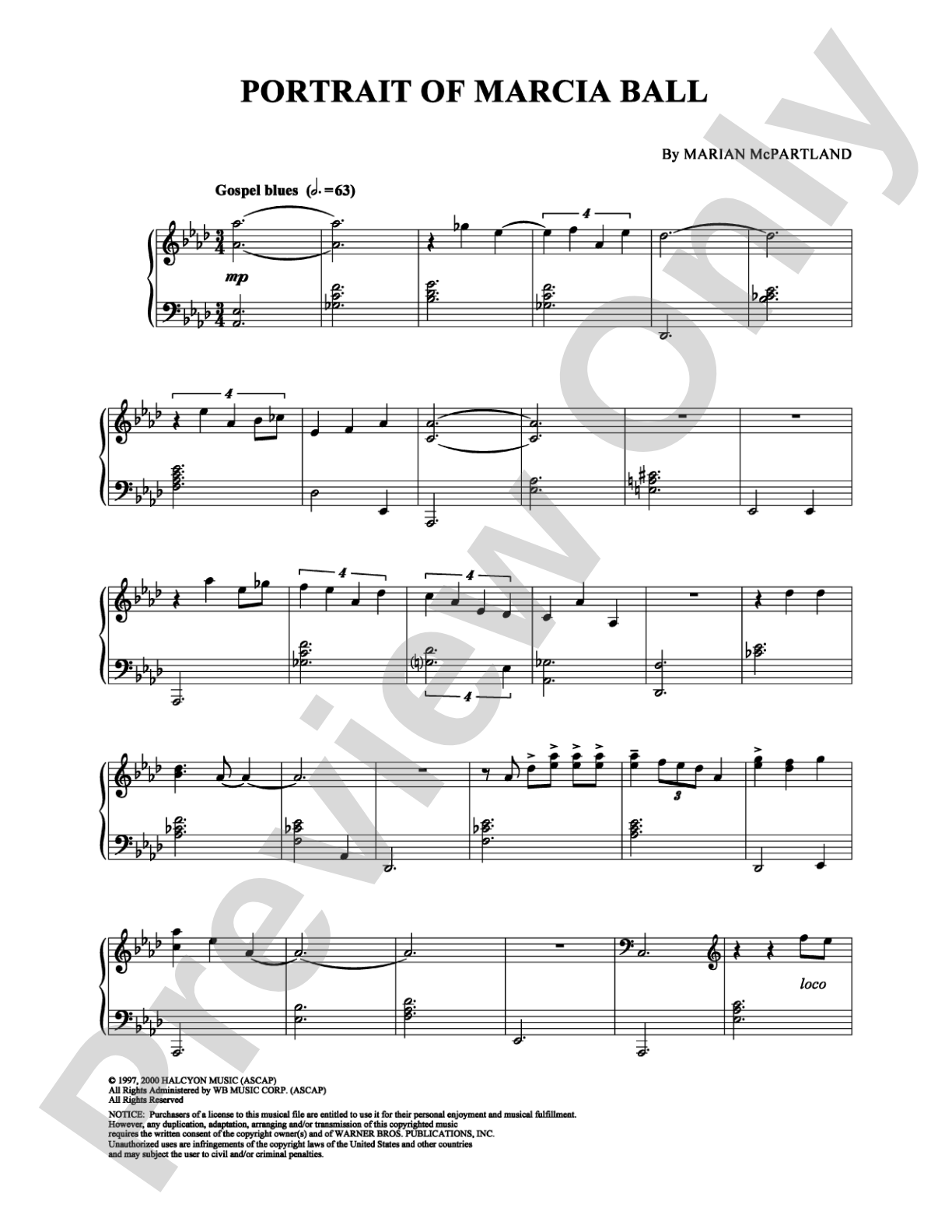
Portrait of Marcia Ball: Piano Digital Sheet Music

Portrait of Marcia Ball: Piano Digital Sheet Music

Marian McPartland

Item: 00-PS-0005117

Digital Download
$3.99
Description

Portrait of Marcia Ball: Piano Digital Sheet Music isn't in MakeMusic Cloud just yet...but it could be. Let us know you'd like to see it, and you'll help shape what comes next. In the meantime, start a free trial and dive into thousands of interactive titles your students can play along with today.

Sample Audio
No sample audio found.
Sample Video
Additional Details
SKU: 00-PS-0005117

More about this title

About the Artist: Marian McPartland

Marian McPartland (1918-2020) was a pioneering jazz pianist whose career spanned seven decades. Born in England and trained in classical piano, she moved to the United States after World War II and became a founding figure in modern jazz, known for her lyrical touch, harmonic sophistication, and ability to honor the jazz tradition while pushing it forward. Her "Piano Jazz" radio series, which she hosted and produced from 1978 to 2011, became the longest-running jazz program in American broadcasting and introduced countless listeners to jazz history and artistry.

As a performer and composer, McPartland combined the precision of her classical training with the improvisational freedom of jazz. She recorded extensively, performed at major festivals and venues worldwide, and mentored younger musicians throughout her life. Her compositions reflect her gift for melodic invention and emotional depth, making her work valuable for pianists seeking to understand the intersection of classical technique and jazz sensibility.

Why we love this

This piece captures McPartland's signature approach to jazz composition: strong melodic content anchored by sophisticated harmony. Rather than demanding virtuosic technical display, it rewards thoughtful interpretation and the kind of musical maturity that comes from understanding both classical form and jazz idiom. For pianists studying the jazz standards tradition, learning a McPartland original provides insight into how a classically trained musician transformed jazz language.

What to expect

The piece reflects McPartland's refined musical sensibility: unhurried, elegant, and introspective rather than flashy. There's a sense of intimate storytelling in the melody, supported by harmonies that suggest depth without demanding flashy reharmonization. It's a portrait that invites the performer to inhabit its emotional landscape carefully.

Who it's for

This is ideal for intermediate to advanced jazz pianists developing a working knowledge of jazz composition and standards beyond the bebop and swing era foundations. Students studying jazz history and repertoire will find McPartland's original compositions especially valuable, as they represent a distinct voice in American jazz and offer compositional models that blend accessibility with musical substance.

How to get the most out of it

  • Shape the melody with rubato and dynamic nuance rather than strict metronomic time; McPartland's phrasing favored expression over rigidity
  • Listen closely to recordings of McPartland performing her own work to understand her approach to harmony and touch at the piano
  • Explore the harmonic changes fully during improvisation rather than treating them as a framework to escape; McPartland's compositions reward harmonic investigation
  • Balance the needs of the composition as written with space for personal interpretation; jazz performance is about conversation with the material, not strict reproduction

How to use it

Feature this as part of a recital devoted to jazz composers and artists who have shaped the American jazz tradition. It pairs naturally with standards of the same era and works well in contexts that celebrate women composers in jazz. For jazz history curricula, use it to illustrate how trained musicians brought classical discipline to jazz composition.

Skills your students will build

  • Reading jazz chord symbols and reharmonization options
  • Balancing composed melody with harmonic exploration
  • Expressive phrasing and rubato in a jazz context
  • Understanding the compositional voice of a specific jazz artist
  • Interpreting written jazz music while maintaining improvisational intent

You May Also Like