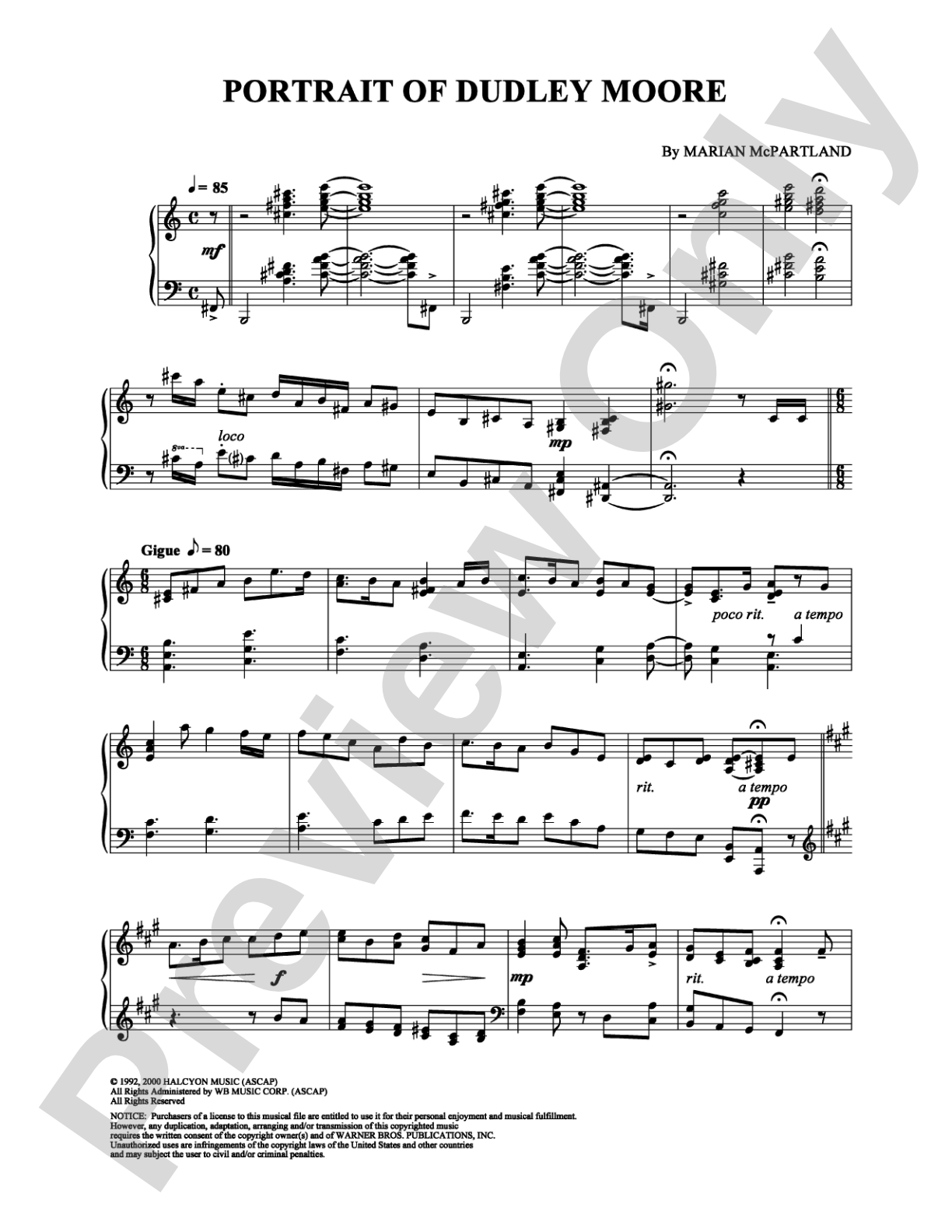
Portrait of Dudley Moore: Piano Digital Sheet Music

Portrait of Dudley Moore: Piano Digital Sheet Music

Marian McPartland

Item: 00-PS-0006130

Digital Download
$3.99
Description

Portrait of Dudley Moore: Piano Digital Sheet Music isn't in MakeMusic Cloud just yet...but it could be. Let us know you'd like to see it, and you'll help shape what comes next. In the meantime, start a free trial and dive into thousands of interactive titles your students can play along with today.

Sample Audio
No sample audio found.
Sample Video
Additional Details
SKU: 00-PS-0006130

More about this title

About the Artist: Marian McPartland

Marian McPartland (1918, 2011) was a British-American jazz pianist and composer who became one of the most influential voices in jazz education and performance. Her career spanned seven decades, during which she founded the Halcyon label, hosted the long-running NPR program Jazz Profiles, and mentored generations of musicians through her teaching and broadcasting work.

Why we love this

McPartland's portrait compositions carry the unmistakable mark of a pianist-composer who understood how the instrument speaks. This piece gives students a genuine jazz composition written by someone who lived and taught jazz history, offering more authentic harmonic language and structural thinking than many generalized jazz piano pieces.

What to expect

This piece opens as a quiet observation, intimate and reflective, before gradually revealing layers of wit and warmth. There's a gentle intelligence here, a composer thinking out loud at the keyboard, sketching a portrait through musical gesture rather than grand statement.

Who it's for

Jazz pianists in the intermediate to advanced range who are ready to engage with composed jazz rather than purely improvisation-focused material. This piece also works well for students exploring the history of jazz composition through the work of significant women composers in the genre.

How to get the most out of it

  • Approach the harmonic movement with attention to voice leading within the left hand; McPartland's jazz voicings reward careful listening to chord color and tension.
  • Explore the piece's dynamic range. Jazz piano need not be loud to be expressive; subtle variations in touch and dynamics reveal McPartland's compositional intention.
  • Establish a steady but flexible pulse rather than metronomic rigidity. Listen to McPartland's own recordings if available to understand the rhythmic buoyancy she favored.
  • Work the melody and comping independently before combining them, as the piece likely asks the hands to operate with some rhythmic independence.

How to use it

Feature this in a jazz recital celebrating women composers in jazz, or pair it with other McPartland compositions to showcase her range and influence. It also serves well as a bridge piece for students transitioning from standards-based repertoire into original jazz composition.

Skills your students will build

  • Reading jazz chord voicings and upper-structure harmony
  • Balancing melodic phrasing with comping texture
  • Interpreting rhythmic flexibility within a jazz context
  • Understanding how pianists compose for their own instrument
  • Developing touch control and dynamic nuance in jazz playing

You May Also Like