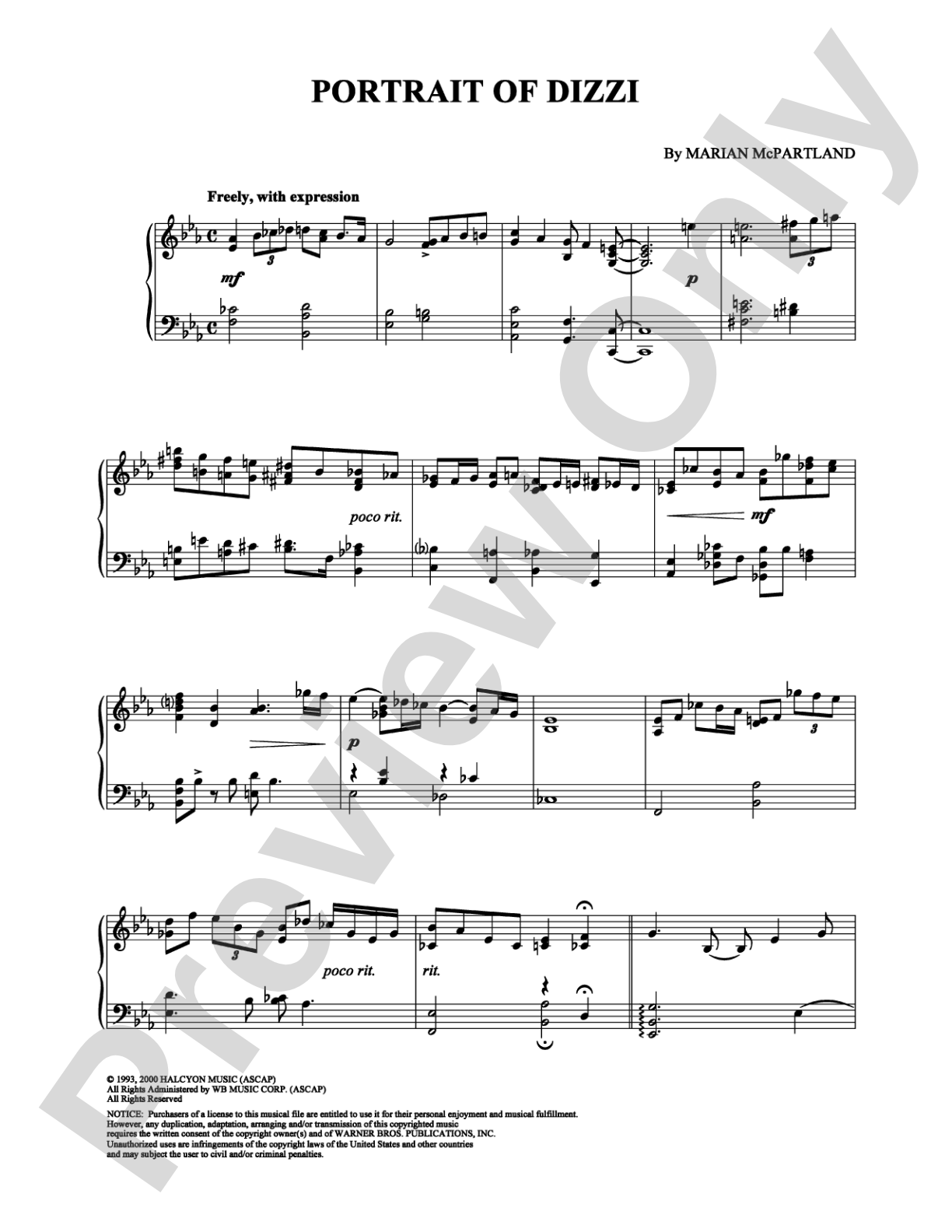
Portrait of Dizzy Gillespie: Piano Digital Sheet Music

Portrait of Dizzy Gillespie: Piano Digital Sheet Music

Marian McPartland

Item: 00-PS-0008347

Digital Download
$3.99
Description

Portrait of Dizzy Gillespie: Piano Digital Sheet Music isn't in MakeMusic Cloud just yet...but it could be. Let us know you'd like to see it, and you'll help shape what comes next. In the meantime, start a free trial and dive into thousands of interactive titles your students can play along with today.

Sample Audio
No sample audio found.
Sample Video
Additional Details
SKU: 00-PS-0008347

More about this title

About the Artist: Marian McPartland

Marian McPartland (1918-2011) was a British-born jazz pianist and composer who became one of the most respected voices in jazz education and performance. She founded the influential Jazz Piano Summit series and hosted "Piano Jazz," a long-running NPR program that documented conversations with jazz luminaries. McPartland's compositional voice balanced sophisticated harmonic language with melodic accessibility, making her work valuable for pianists studying jazz composition and arrangement.

Why we love this

McPartland's portrait of Gillespie captures the essence of bebop virtuosity through pianistic language that respects both the subject's musical legacy and the instrument's own voice. The piece serves as a bridge for intermediate-to-advanced pianists moving from classical training into jazz idiom, offering a real compositional model rather than a lead sheet.

What to expect

The piece vibrates with the energy and harmonic sophistication of bebop, honoring Gillespie's brilliance through McPartland's lyrical, pianistic lens. You'll encounter moments of sparkling virtuosity alongside introspective passages that let the harmony breathe, creating a portrait that feels intimate rather than merely celebratory.

Who it's for

Intermediate to advanced jazz pianists and classical pianists developing fluency in jazz language will find this piece rewarding. It works equally well for students studying jazz composition, arrangement, and harmonic analysis, or for pianists preparing a recital program that bridges classical and jazz traditions.

How to get the most out of it

  • Study Gillespie's recorded solos before approaching this piece; McPartland's harmonic choices and melodic shapes reference specific characteristic phrases of his style.
  • Treat the left hand as an active compositional element, not merely accompaniment; McPartland layers chord voicings that deserve independence and clarity.
  • Work the jazz articulation and phrasing separately from the technical passages; the piece demands both clarity in fast lines and singing tone in lyrical sections.
  • Listen to McPartland's own recording to understand her interpretive approach to tempo flexibility and dynamic shaping within the jazz idiom.

How to use it

Program this in jazz recitals or mixed repertoire concerts where it can anchor a tribute set or represent the intersections between classical composition and jazz. It also works beautifully in educational settings as a performance model for jazz composition classes or as a capstone piece for advanced jazz piano students.

Skills your students will build

  • Jazz harmonic voicing and reharmonization
  • Bebop melodic language and phrasing
  • Left-hand comping independence and voice leading
  • Bridging classical technique with jazz articulation
  • Interpreting and performing original jazz compositions

You May Also Like