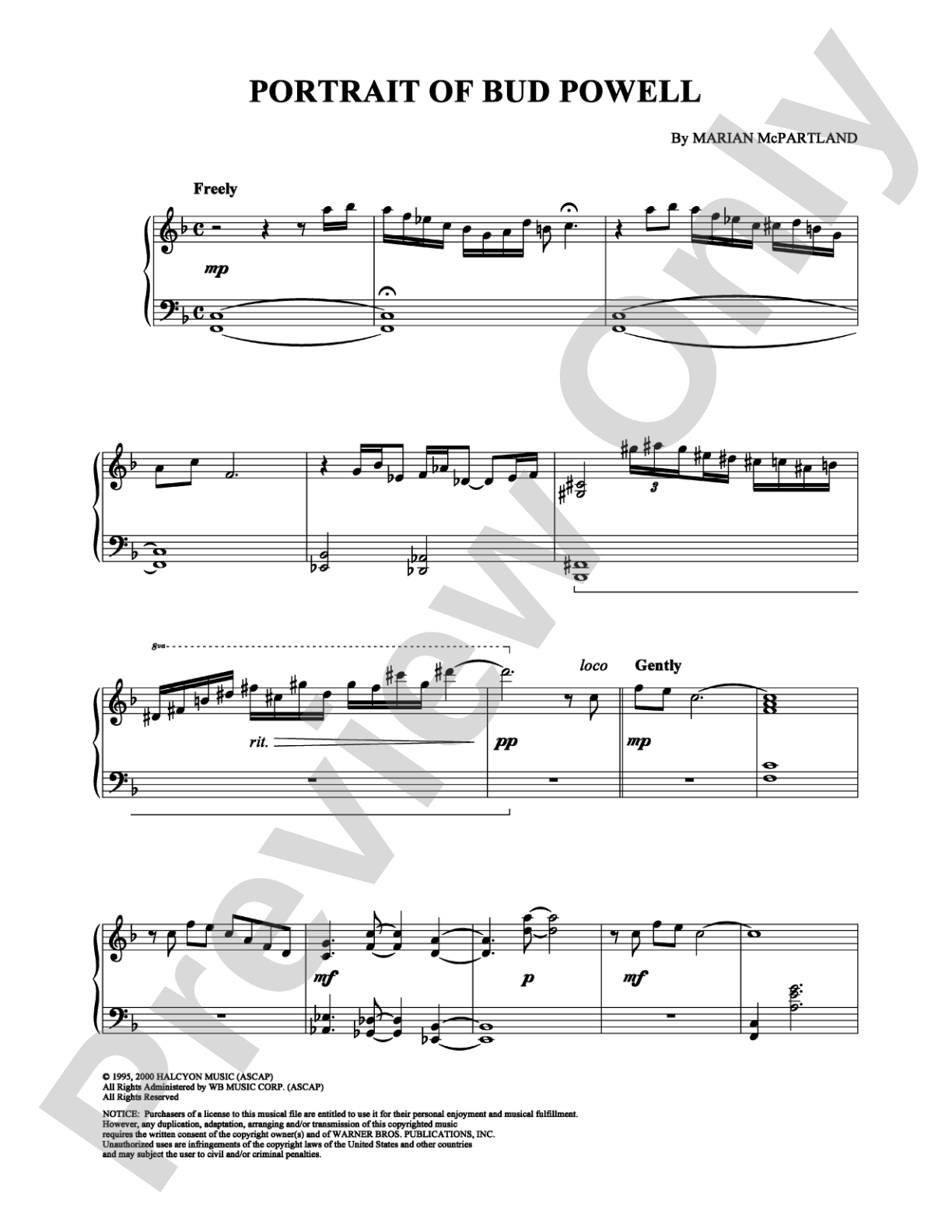
Portrait of Bud Powell: Piano Digital Sheet Music

Portrait of Bud Powell: Piano Digital Sheet Music

Marian McPartland

Item: 00-PS-0008351

Digital Download
$3.99
Description

Portrait of Bud Powell: Piano Digital Sheet Music isn't in MakeMusic Cloud just yet...but it could be. Let us know you'd like to see it, and you'll help shape what comes next. In the meantime, start a free trial and dive into thousands of interactive titles your students can play along with today.

Sample Audio
No sample audio found.
Sample Video
Additional Details
SKU: 00-PS-0008351

More about this title

About the Artist: Marian McPartland

Marian McPartland (1918-2016) was a pioneering jazz pianist and composer whose seven-decade career helped reshape the landscape of jazz education and performance. Born in Windsor, England, she moved to the United States after World War II and became a fixture of the New York jazz scene, known for her lyrical touch, harmonic sophistication, and unwavering commitment to mentoring emerging musicians. She founded the Womens Jazz Festival, hosted the long-running radio program Jazz Alliance, and recorded extensively as both a soloist and collaborator, earning recognition as one of the most influential pianists in jazz history.

McPartland's approach to jazz was marked by deep listening and intellectual curiosity. She composed pieces that blended bebop language with impressionistic harmony, and her educational efforts through radio, performance, and advocacy opened doors for countless musicians who might otherwise have been overlooked. Her legacy extends far beyond performance; she fundamentally changed how jazz is taught and valued in American musical life.

Why we love this

This tribute piece captures the spirit of Bud Powell, the bebop virtuoso, through McPartland's distinctive voice as a composer and pianist. The piece is substantial enough to reward serious practice and interpretation while remaining accessible to pianists developing their jazz language. Programming it signals to your audience that your school or studio values jazz as a legitimate art form and honors the artists who shaped it.

What to expect

This portrait carries the quicksilver energy and harmonic sophistication of bebop, yet filtered through a lyrical sensibility that is distinctly McPartland. The piece moves with intelligence and warmth, honoring Powell's virtuosity while offering its own musical voice; it feels less like a replication and more like a musician speaking directly about another musician she admired.

Who it's for

Pianists with solid jazz fundamentals who understand bebop language and can navigate changes confidently will find this piece most rewarding. It's ideal for advanced high school jazz pianists, college-level music students, or accomplished adult learners seeking substantial original jazz composition beyond standard lead sheets.

How to get the most out of it

  • Balance melodic clarity with harmonic density. McPartland's writing often layers modern chord extensions beneath a straightforward melody; resist the urge to hammer the harmony and let the tune breathe on top.
  • Listen deeply to McPartland's own recordings of her work before you begin. Her interpretive choices around tempo flexibility and touch are part of the composition itself.
  • Pay attention to the interplay between written and implied swing. Not every note needs to be metronomic; jazz phrasing lives in the space between notation and feel.
  • Approach the piece as a conversation with Powell's legacy rather than a showpiece. McPartland was a musician's musician; she wrote this with affection and respect, not ego.

How to use it

Feature this as a solo work in a jazz or contemporary music recital, where it can stand beside works by other jazz composers and serve as a bridge between jazz history and living artistic tradition. It works equally well as a centerpiece for a jazz history presentation or educational concert that explores how musicians document and celebrate their peers.

Skills your students will build

  • Reading and executing bebop melody lines over modern changes
  • Interpreting jazz articulation, swing, and phrasing in a composed context
  • Understanding harmonic voice leading typical of post-bop piano writing
  • Developing interpretive independence and expressive choice within written notation

You May Also Like