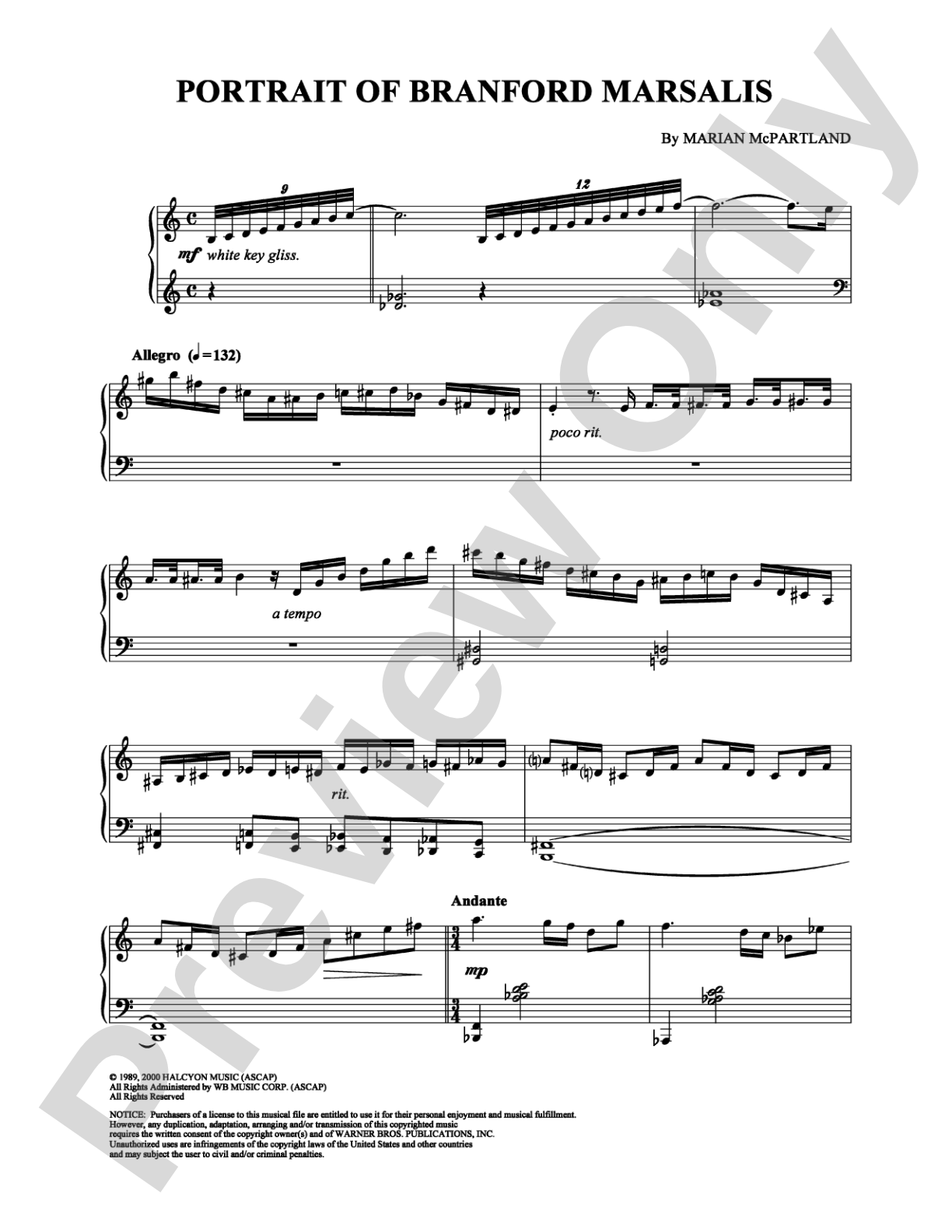
Portrait of Branford Marsalis: Piano Digital Sheet Music

Portrait of Branford Marsalis: Piano Digital Sheet Music

Marian McPartland

Item: 00-PS-0005120

Digital Download
$3.99
Description

Portrait of Branford Marsalis: Piano Digital Sheet Music isn't in MakeMusic Cloud just yet...but it could be. Let us know you'd like to see it, and you'll help shape what comes next. In the meantime, start a free trial and dive into thousands of interactive titles your students can play along with today.

Sample Audio
No sample audio found.
Sample Video
Additional Details
SKU: 00-PS-0005120

More about this title

About the Artist: Marian McPartland

Marian McPartland (1918, 2013) was a British-American jazz pianist and composer who became one of the most significant figures in jazz education and performance. A fearless improviser with deep harmonic sophistication, McPartland co-founded the Hickory House jazz club in New York and later hosted the long-running NPR series Piano Jazz, where she interviewed and performed alongside countless jazz legends. Her compositions bridge accessible melodic writing with genuine jazz vocabulary, making her work invaluable for educators introducing students to how jazz thinking extends beyond standards.

Why we love this

McPartland's portrait pieces capture the essence of their subjects through melody and harmony rather than flashy technique, giving pianists room to explore character and phrasing. A tribute to Branford Marsalis, a musician known for intellectual curiosity across genres, this piece rewards thoughtful interpretation and serves as a bridge between classical training and jazz language.

What to expect

The piece carries McPartland's signature lyricism and harmonic sensitivity, inviting the pianist into a thoughtful conversation about another musician's artistry. Elegant without being precious, the music unfolds with the naturalness of a skilled improviser while maintaining the intentional structure of a composed work.

Who it's for

This piece suits intermediate to advanced pianists with jazz experience who want to develop their ability to interpret a composed solo in the modern mainstream jazz tradition. It works particularly well for students preparing for jazz competitions, building a solo recital, or exploring how composition and improvisation intersect in contemporary jazz practice.

How to get the most out of it

  • Approach the harmonic movement with awareness of how each chord progression reveals something about Marsalis's musical personality; don't rush through changes that ask for reflection.
  • Let the melody sing rather than overshadow it with comping; McPartland's lines are designed to be heard clearly, which requires restraint in the left hand.
  • Experiment with swing feel and articulation in the rhythm section, this is where your interpretation of the subject's character can emerge most distinctly.
  • Use rubato tastefully in moments that feel introspective, but keep the groove grounded where the piece settles into straight eighth-note feels.

How to use it

Program this alongside other portrait compositions or jazz standards to showcase how mature musicians pay tribute to one another through music. It works well in a jazz recital, a faculty or student solo concert, or as part of a programming block that explores the interplay between composition and interpretation in jazz.

Skills your students will build

  • Interpreting jazz composition with harmonic depth and restraint
  • Understanding how melody and harmony interact in mainstream jazz writing
  • Building interpretive choices in a non-improvised solo context
  • Recognizing compositional voice and musical character

You May Also Like