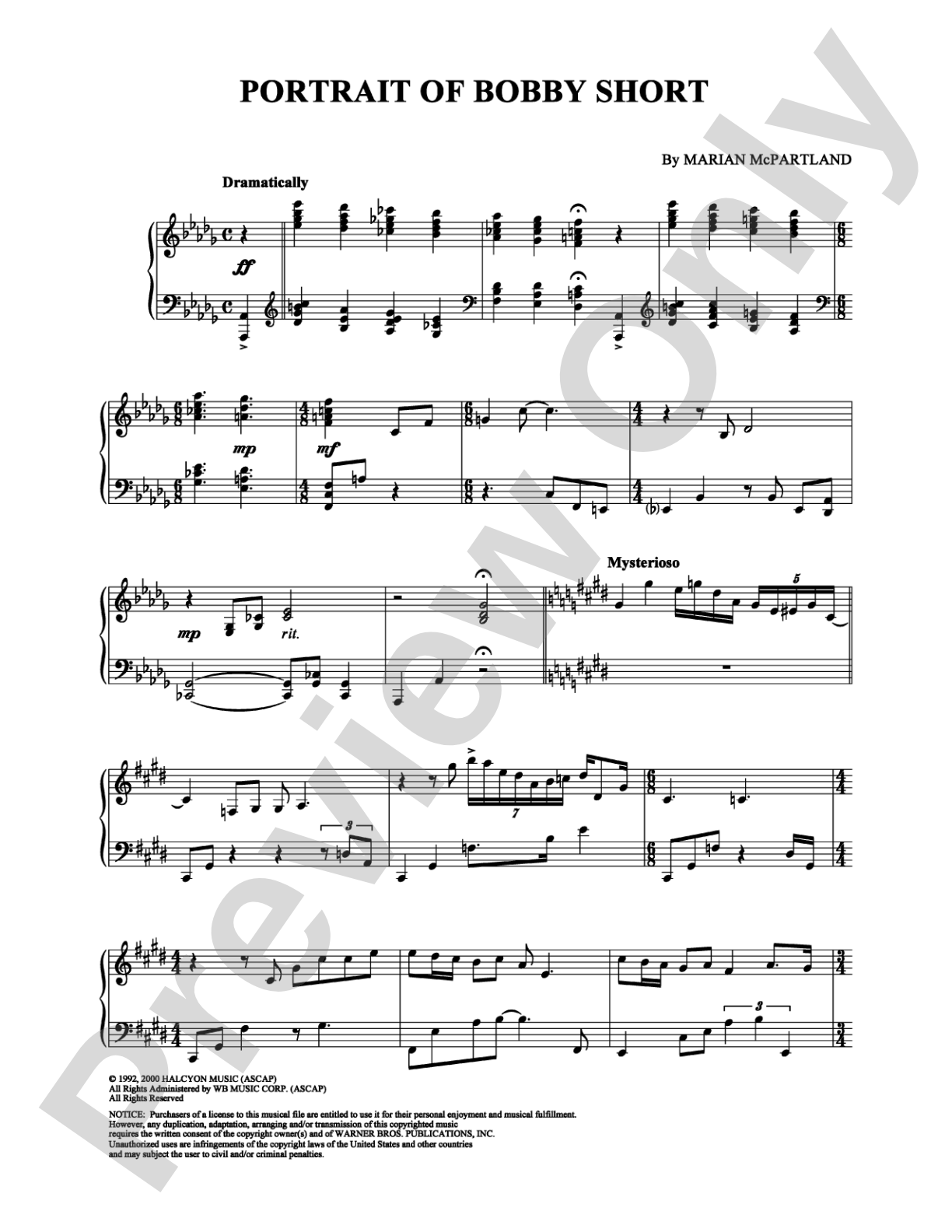
Portrait of Bobby Short: Piano Digital Sheet Music

Portrait of Bobby Short: Piano Digital Sheet Music

Marian McPartland

Item: 00-PS-0005116

Digital Download
$3.99
Description

Portrait of Bobby Short: Piano Digital Sheet Music isn't in MakeMusic Cloud just yet...but it could be. Let us know you'd like to see it, and you'll help shape what comes next. In the meantime, start a free trial and dive into thousands of interactive titles your students can play along with today.

Sample Audio
No sample audio found.
Sample Video
Additional Details
SKU: 00-PS-0005116

More about this title

About the Artist: Marian McPartland

Marian McPartland (1918–2013) was a British-American jazz pianist and bandleader whose career spanned seven decades. She co-founded the Hickory House in New York, performed with jazz luminaries across multiple eras, and became one of the most respected interpreters of the jazz standard repertoire. Her playing combined classical training with deep harmonic understanding and conversational melodic sensibility.

Why we love this

McPartland's tributes to fellow musicians offer pianists authentic windows into how a master soloist voices standards and develops thematic material. Her harmonic sophistication and clear touch make this piece both musically rewarding and pedagogically transparent for students studying jazz comping, reharmonization, and melodic interpretation.

What to expect

Intimate and reflective, with the character of a pianist thinking aloud at the keyboard. McPartland's harmonic language opens familiar harmonic territory to fresh angles, creating moments of gentle surprise without abandoning the warmth of a musical portrait.

Who it's for

Jazz pianists at the intermediate-advanced level who are developing their ability to read and interpret contemporary jazz compositions grounded in the standard repertoire. This piece works well for students studying jazz arranging, harmonic development, or the legacy of mid-century jazz pianists.

How to get the most out of it

  • Listen to McPartland's original recording to absorb the conversational phrasing and space she builds around the melody; her timing defines the piece as much as the notes do.
  • Approach the harmonic substitutions with intention rather than playing through them mechanically; each reharmonization serves a specific melodic or emotional purpose.
  • Balance left-hand accompaniment so it supports rather than overshadows the right-hand narrative; this is a portrait, not a display piece.

How to use it

Feature this in a jazz recital exploring composer-pianists or pieces that honor other musicians. It pairs well alongside other McPartland compositions or works by her contemporaries, offering audiences a personal, human-scaled alternative to more virtuosic showcases.

Skills your students will build

  • Reading jazz chord symbols and contemporary harmonic substitutions
  • Interpreting rubato and phrasing in jazz standards
  • Left-hand independence in accompaniment patterns
  • Analyzing and performing reharmonized melodies

You May Also Like