
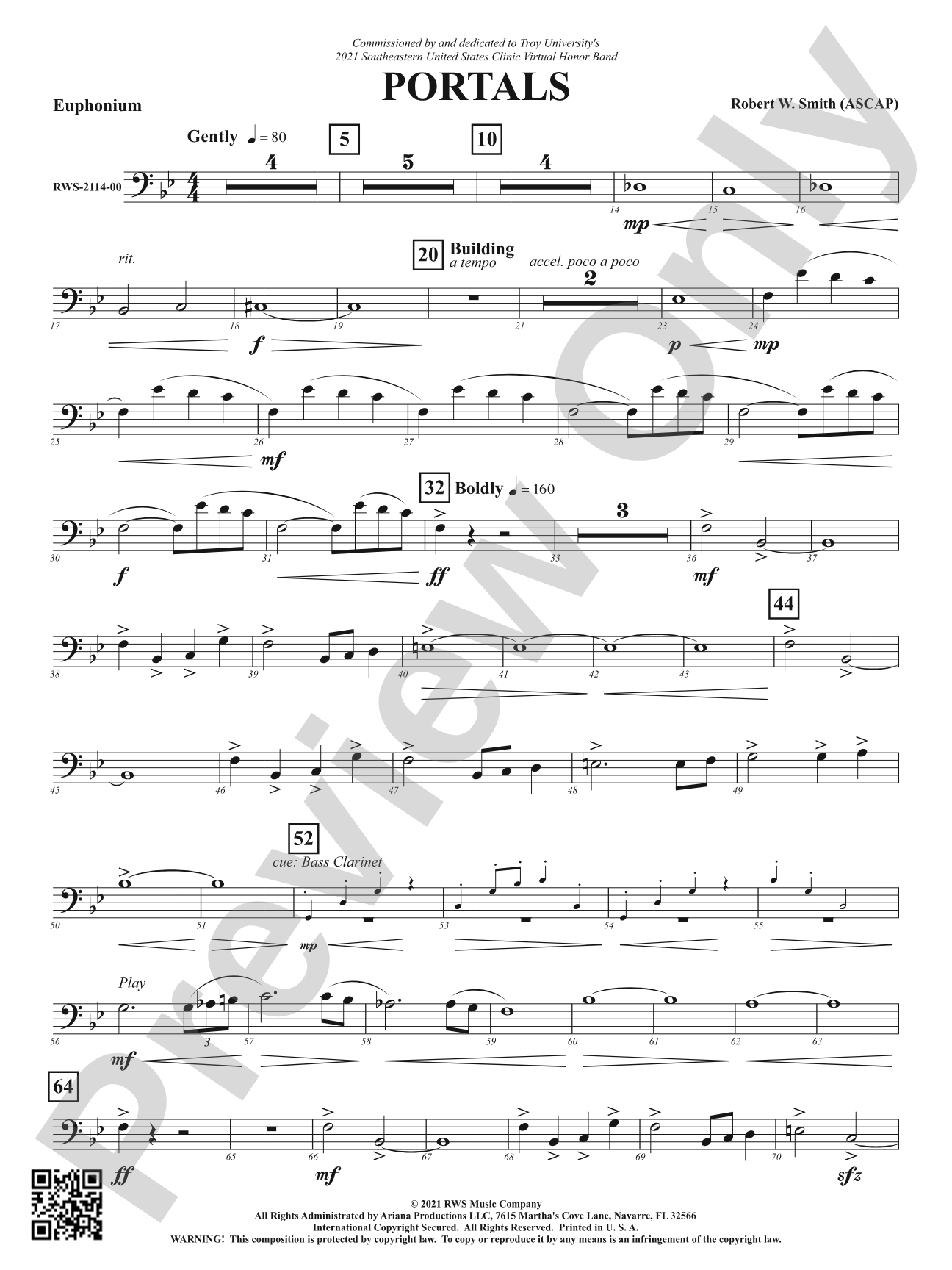

Portals: Baritone B.C.
By Robert W. Smith
Grade: 3.5
Item: 98-PC-RWS2114_BBC1
$3.99
Pickup currently not available
Description
Written during the pandemic of 2020-21, "Portals" was inspired by the digital portals or windows that allowed us to view our world. From the human interaction and expression through videoconference windows, to the living room television screens that served as portals to our outside world, our views drastically changed. Featuring soloists as well woodwind and brass choirs, this joyous composition builds to a bold and majestic full ensemble statement and exciting conclusion. Optional middle school parts are included allowing for full pyramid concert performance. Written for the live concert band or virtual ensemble performance, "Portals" will be a valued addition to your next concert as we celebrate the combined musical voices of our world.
Original Item#: RWS-2114-00


Original Item#: RWS-2114-00
Discover MakeMusic Cloud: thousands of interactive titles your students can play along with today.
Sample Audio
1
Audio File
--:--
0:00
0:00
Sample Video
No sample videos found.
Additional Details
Series:
RWS - Concert Band
Publisher:
RWS Music Company
SKU:
98-PC-RWS2114_BBC1
More about this title
About the Composer: Robert W. Smith

Robert W. Smith stands among America's most recorded composers for concert band and orchestra, with more than 400 published works performed globally across six continents. Educated at Troy State University (AL) and the University of Miami (FL), Smith has built a catalog dominated by original compositions and arrangements released primarily through Alfred Music. His symphonies, including The Divine Comedy and The Odyssey, have become touchstones in the repertoire, while works like The Tempest have established themselves as standards for developing ensembles.
Beyond the concert hall, Smith's music has reached millions through television broadcasts, Olympic ceremonies, the Macy's Thanksgiving Day Parade, and sporting events including Opening Day at Dodger Stadium. His work as a clinician and conductor has taken him across North America, Europe, Asia, Australia, and beyond, where he continues to shape how bands approach contemporary concert music.
Why we love this
Smith wrote "Portals" from genuine reflection on how the pandemic reshaped our sense of connection and perspective, and that emotional specificity translates into music that feels both timely and timeless. The piece respects the full range of your program through optional middle school parts, making it genuinely flexible for pyramid instrumentation rather than forcing compromise. The scoring balances soloists and sectional choirs before resolving into a sweeping full ensemble moment, giving every musician something meaningful to play while building toward a satisfying, celebratory climax.
What to expect
"Portals" captures the strange, luminous quality of screens and windows that became our lifelines during isolation, translating that visual metaphor into sound that feels both intimate and expansive. The opening moments are contemplative and spare, the soloists speaking across digital distance, before voices gradually gather and the music opens into something joyous and defiant. By the conclusion, you're swept into a bold, majestic affirmation of shared musical purpose.
Who it's for
This score serves bands at Grade 3.5 working toward a program that includes both soloists and ensemble-focused pieces. Directors building a concert or festival set will find a work that highlights individual musicianship while celebrating collective sound. The optional middle school instrumentation opens the piece to pyramid ensembles where younger players can participate meaningfully alongside the primary band.
How to get the most out of it
- Establish clarity in the sectional passages by balancing woodwind and brass choirs so that each group projects without drowning out the soloist. Smith writes these moments to be conversational, not competitive.
- Shape the arch across the middle section by gradually increasing dynamic intensity and broadening the tempo slightly as momentum builds toward the full ensemble statement.
- In the final section, resist the urge to rush the exciting conclusion. Maintain rhythmic precision in the ensemble to let the bold writing land with its full impact.
- If incorporating the optional middle school parts, ensure the doubling reinforces the primary voices without muddying the orchestration; lighter touches from developing players work better than full-voiced doublings.
How to use it
Program "Portals" as a centerpiece that allows you to feature soloists while building ensemble pride across your full band. It works particularly well as a bridge between lighter concert openers and heavier symphonic works, offering emotional substance without demanding the weight of a full transcription or large-scale original. Consider pairing it with other contemporary works that reflect on connection and community, creating a thematic concert that resonates with both musicians and audiences.
Skills your students will build
- Balancing solo voices against sectional accompaniment without sacrificing blend
- Shaping musical lines across extended dynamic ranges and tempo changes
- Responding to programmatic content and historical context in contemporary music
- Sustaining ensemble cohesion during transitions between sectional and full ensemble textures
- Reading and executing articulation and expression marks that convey emotional intent