Porgy and Bess® (Medley): String Bass Sheet Music Preview

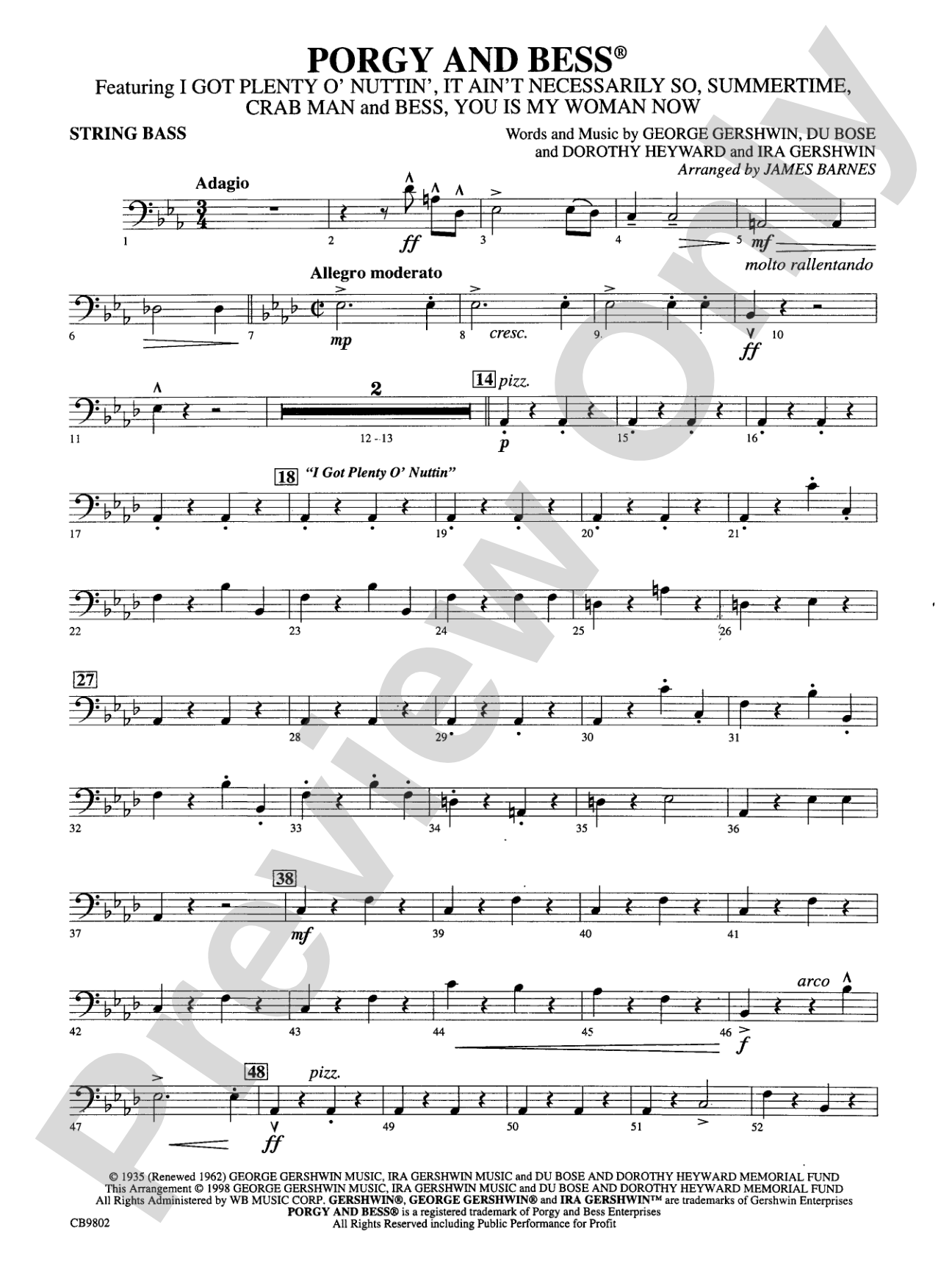
Porgy and Bess® (Medley): String Bass

Featuring: I Got Plenty o' Nuttin' / It Ain't Necessarily So / Summertime / Crab Man / Bess, You Is My Woman Now

By George Gershwin / arr. James Barnes

Grade: 4 (Medium)

Item: 00-PC-0016066_SB

Digital Download
$3.00
Description
The music from the timeless masterwork Porgy and Bess®has fascinated generation after generation. Oddly enough, at its premiere the critics presented mixed reaction: some calling it the pioneering work of a new folk-opera genre, and others condemning it as merely a succession of hit songs. Fortunately, time has secured its place in history. James Barnes has skillfully crafted a wonderful scoring of "I Got Plenty O' Nuttin'," "It Ain't Necessarily So," "Summertime," "Crab Man," and "Bess, You Is My Woman Now." This is Gershwin at his best! (8:30)

Don't just read it, hear it, play along with it, and watch your students grow with it. In MakeMusic Cloud, Porgy and Bess® (Medley): String Bass comes alive with professional accompaniment, adjustable tempo, and built-in practice tools that turn solo practice into real progress.

Sample Audio
0:00
0:00
Sample Video
Additional Details
Series: Pop Symphonic Band
Publisher: Alfred Music
Page Count: 252
SKU: 00-PC-0016066_SB

More about this title

About the Composer: George Gershwin

George Gershwin (1898-1937) bridged the worlds of concert music and American popular song with an ease that few composers have matched. His gift for melody was matched by his orchestration skill, and he understood how to write for both Broadway audiences and concert halls without compromise. Gershwin's influence on American music education remains profound; his works appear in curricula across the country because they demonstrate how serious compositional craft can coexist with immediate, accessible appeal.

Why we love this

James Barnes has distilled five signature moments from Porgy and Bess into an arrangement that lets bands experience Gershwin's melodic brilliance without getting lost in the full opera's scope. At Grade 4, it's challenging enough to engage serious young musicians while remaining achievable for schools building toward more complex repertoire. The medley format creates natural energy shifts that keep audiences engaged from start to finish.

What to expect

A journey through some of American popular music's most enduring melodies, each one landing with clarity and warmth. The scoring captures the emotional pull of the original opera while maintaining the swagger and accessibility that made these songs standards in the first place.

Who it's for

Concert bands at the Grade 4 level who want to program music with historical weight and immediate musical reward. It works equally well for groups new to Gershwin and experienced ensembles looking for a showcase arrangement that audiences recognize immediately.

How to get the most out of it

  • Shape the lyrical passages in "Summertime" and "Bess, You Is My Woman Now" with genuine rubato; these songs need room to breathe, not metronomic precision.
  • Balance the ensemble carefully in the busier sections of "It Ain't Necessarily So." The syncopation reads clearer when inner voices don't overwhelm the melodic line.
  • Use the tempo transitions between movements as opportunities for section resets; the medley gains momentum when each song feels like its own small performance event.
  • Highlight the Crab Man section's character work; this brief moment gives the band a chance to show rhythmic personality before returning to the more lyrical material.

How to use it

This medley works beautifully as a standalone concert opener or closer, or as the centerpiece of a program exploring American musical theater and its influence on concert music. It pairs well with other 20th-century popular arrangements and gives audiences a bridge between Broadway and the traditional concert band repertoire.

Skills your students will build

  • Phrasing across multiple song forms within a single piece
  • Balancing melodic prominence with accompaniment in arrangement
  • Stylistic flexibility between lyrical and rhythmically driven sections
  • Ensemble coordination through tempo and character transitions

You May Also Like