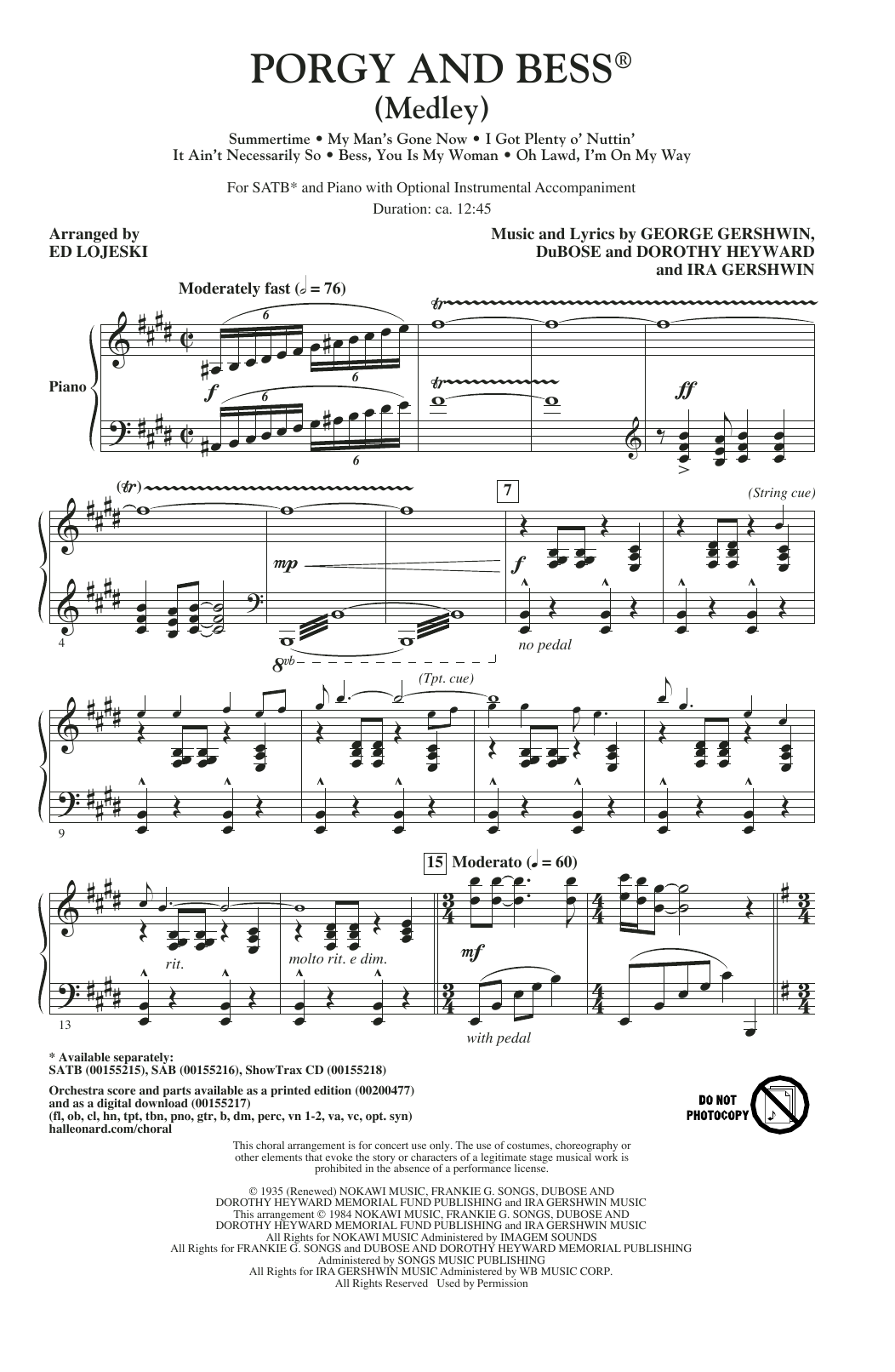
Porgy And Bess (Medley) Sheet Music Preview

Porgy And Bess (Medley): SATB Choral Octavo

As performed by Ira Gershwin / As performed by DuBose Heyward / As performed by Dorothy Heyward / Arranged by Ed Lojeski

Item: 35-DS00344313

Digital Download
$4.10
Description

Porgy And Bess (Medley): SATB Choral Octavo isn't in MakeMusic Cloud just yet...but it could be. Let us know you'd like to see it, and you'll help shape what comes next. In the meantime, start a free trial and dive into thousands of interactive titles your students can play along with today.

Sample Audio
No sample audio found.
Sample Video
Additional Details
Publisher: Hal Leonard
Page Count: 31
SKU: 35-DS00344313

More about this title

About the Artist: Ira Gershwin

Ira Gershwin (1896–1983) was one of American musical theater's most brilliant lyricists, partnering with his brother George to create some of the era's most enduring songs. His wit, sophistication, and ability to craft lyrics that served both comedic and emotional purposes made him essential to the Golden Age of Broadway. For "Porgy and Bess," Gershwin collaborated with composers George Gershwin and DuBose Heyward to create a folk opera that blended classical forms with American vernacular, producing some of the most recognizable melodies in American music.

In the classroom and rehearsal hall, Gershwin's work continues to teach singers about phrasing, character development, and the marriage of words to music. His melodies are memorable enough to engage singers immediately, yet substantive enough to reward deep musical study. Directors prize his music for its ability to connect with audiences while pushing students toward artistic maturity.

Why we love this

Ed Lojeski's medley distills the opera's most powerful moments into a 31-page arrangement that works for community choirs, high school programs, and university ensembles alike. You get the narrative arc and emotional weight of Gershwin's score without requiring a full-scale production, making this ideal for directors who want sophisticated repertoire with manageable rehearsal demands. The voicing sits comfortably for mixed choirs while preserving the harmonic richness that makes this music so compelling.

What to expect

Stepping into this medley feels like entering a world of American warmth and melancholy. The opening "Summertime" settles you into a languid, dreamy space before the music awakens with joy and conflict. You move through sorrow, resilience, and moments of genuine hope, all delivered through some of the most singable melodies ever written for voices.

Who it's for

This arrangement suits choirs with solid fundamental technique and some experience navigating jazz-influenced harmony and rhythmic subtlety. Both competitive and community choirs will find the material accessible yet rewarding; the familiar melodies draw singers in quickly, while the arranging details provide plenty to refine over weeks of rehearsal.

How to get the most out of it

  • Establish the spiritual quality of "Summertime" by letting the sopranos breathe fully through the long lines; resist the urge to rush through the melody's gentle contours.
  • Treat the rhythm section material with jazz sensibility rather than symphonic precision. A light, relaxed feel in the pulse serves the music better than rigid metronomic accuracy.
  • Layer your dynamic approach across the medley's contrasting sections. The folk melodies need warmth and directness, while the dramatic moments require genuine emotional commitment from all four voice parts.
  • Balance text intelligibility with sustained legato phrasing. Gershwin's lyrics tell essential story; articulate them clearly without sacrificing the vocal line's flow.

How to use it

Build a concert around early American musical theater by pairing this with other Broadway standards arranged for choir, or use it as an anchor piece in a program exploring the American songbook. The medley's length and accessibility also make it effective as a show-closer that leaves audiences humming as they leave the hall. Consider placing it mid-program where its emotional journey can provide a bridge between other contrasting works.

Skills your students will build

  • Singing jazz harmonies and blue notes
  • Phrasing and shaping melodic lines with dramatic intention
  • Ensemble balance across contrasting textural moments
  • Interpreting lyrics with emotional authenticity
  • Rhythmic independence within syncopated accompaniment patterns
  • Blending legato technique with clear diction in sustained passages

You May Also Like