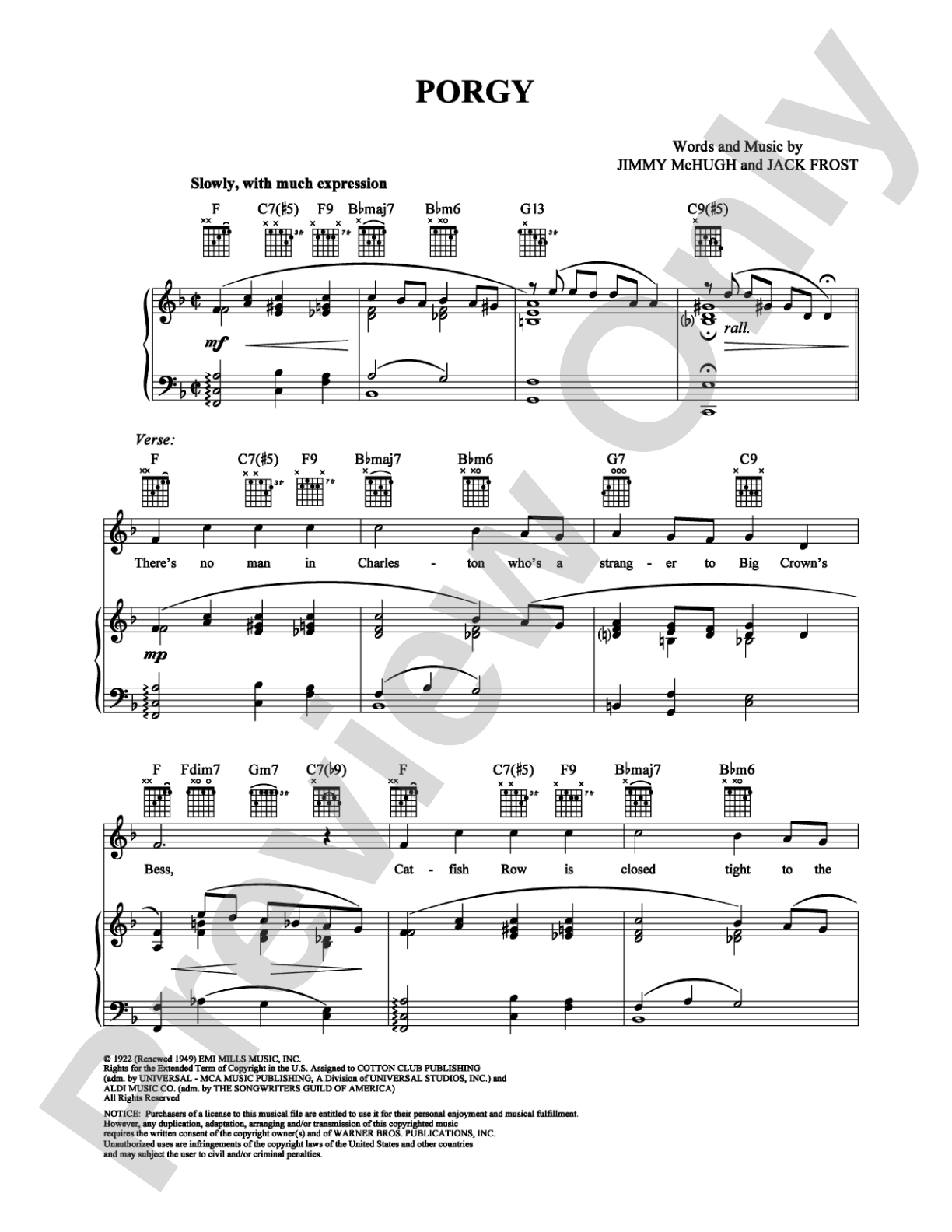
Porgy: Piano/Vocal/Chords Digital Sheet Music

Porgy: Piano/Vocal/Chords Digital Sheet Music

Jimmy McHugh, Jack Frost

Item: 00-PS-0005053

Digital Download
$3.99
Description

Porgy: Piano/Vocal/Chords Digital Sheet Music isn't in MakeMusic Cloud just yet...but it could be. Let us know you'd like to see it, and you'll help shape what comes next. In the meantime, start a free trial and dive into thousands of interactive titles your students can play along with today.

Sample Audio
No sample audio found.
Sample Video
Additional Details
SKU: 00-PS-0005053

More about this title

About the Creator: George Gershwin

George Gershwin composed "Porgy and Bess" in 1935, creating one of American music's most enduring operatic works. The score blends classical compositional ambition with the rhythms and idioms of jazz and folk music, drawing on his deep engagement with American vernacular styles. Gershwin's gift for melody and harmonic sophistication made him a bridge figure in twentieth-century music, equally comfortable writing for Broadway, concert halls, and the burgeoning American songbook.

The "Porgy" theme in particular became a jazz standard, adapted and reinterpreted by countless singers and instrumentalists. Its richness rewards both faithful interpretation and creative reharmonization, making it a fixture in jazz repertoire and vocal music curricula.

Why we love this

This arrangement captures the intimate, conversational quality that makes 'Porgy' so compelling in jazz settings. The piano/vocal/chords format gives singers room to interpret the lyrical lines while pianists have enough harmonic detail to voice chords expressively and support the vocal phrasing naturally.

What to expect

Wistful and reflective, with the quiet dignity of a character speaking truth about love and longing. The melody sits naturally in the voice while the harmonic landscape invites sophisticated, subtle accompaniment.

Who it's for

Vocalists building a jazz repertoire and pianists seeking accessible yet musically substantial accompaniement material. This works equally well for recital preparation, jazz combo performance, or singers exploring the American songbook.

How to get the most out of it

  • Let the piano's voicings breathe; resist the urge to fill every space. The strength of this standard lies in what's left unsaid between vocalist and accompanist.
  • Approach the vocal line with conversational warmth rather than theatrical projection. The most affecting performances treat this as intimate storytelling.
  • Use the chord symbols to explore reharmonization options. Jazz standards reward pianists who listen closely to the vocalist and adjust voicings in response to their interpretation.
  • Pay attention to rhythmic flexibility. Rubato and slight pushes against the beat often emerge naturally when singer and pianist are truly listening to each other.

How to use it

Program this alongside other jazz standards in a vocal recital or jazz ensemble concert. It pairs well with other songs from the American songbook and gives jazz-focused singers a chance to showcase both stylistic command and emotional depth in a single focused piece.

Skills your students will build

  • Jazz phrasing and articulation appropriate to ballad singing
  • Reading and voicing jazz chord symbols with flexibility
  • Maintaining lyrical connection while supporting a vocalist's interpretation
  • Rhythmic independence and flexibility in 4/4 jazz time
  • Harmonic listening and response between vocalist and accompanist

You May Also Like