
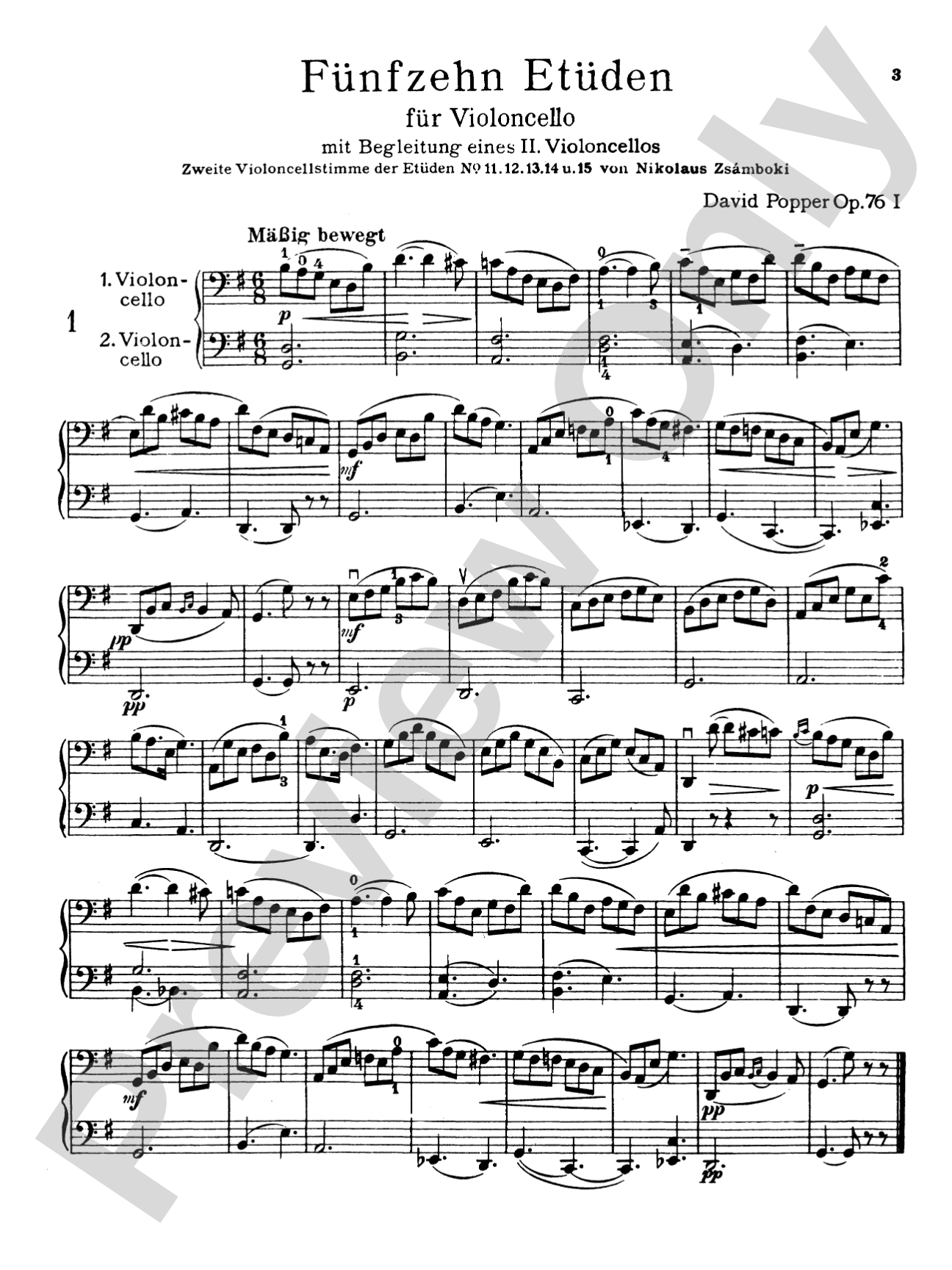

Popper: Fifteen Etudes for Cello, Op. 76: Cello Book
By David Popper
Item: 00-PK-0003506

$10.99
Pickup currently not available
Buy Extra Parts (Digital PDF Download)
Parts Added to Cart!
Related Items
Fifteen Etudes for Cello, Opus 76: Cello Book |
$10.95
|
View |
Description
Expertly arranged Cello Collection by David Popper from the Kalmus Edition series. This collection is from the Romantic era.


Don't just read it, hear it, play along with it, and watch your students grow with it. In MakeMusic Cloud, Popper: Fifteen Etudes for Cello, Op. 76: Cello Book comes alive with professional accompaniment, adjustable tempo, and built-in practice tools that turn solo practice into real progress.
Open in the Player
Jump straight in and assign it today.
Start Your Free Trial
Open this title and explore the full library in minutes.
Sample Audio
No sample audio found.
Sample Video
No sample videos found.
Additional Details
Series:
Kalmus Edition
Publisher:
Alfred Music
Page Count:
28
SKU:
00-PK-0003506
More about this title
About the Composer: David Popper
David Popper (1843-1913) was a Czech cellist and composer who fundamentally shaped the modern cello repertoire. As principal cellist of the Imperial Opera in Vienna and later professor at the Budapest Conservatory, Popper combined virtuosic performance with a gift for writing music that sits naturally under the fingers while demanding genuine musicianship. His etudes remain essential tools for cello pedagogy because they address specific technical challenges without sacrificing musical content.
Popper's output for cello is substantial and purposeful. Beyond his fifteen etudes, he composed concertos, chamber works, and numerous character pieces that give cellists genuine artistic material to explore. His writing reflects the Romantic sensibility of his era while maintaining clarity and directness in instruction; a student playing a Popper etude is not merely drilling a technique but encountering music worth performing.
Why we love this
These fifteen etudes are the gold standard for intermediate to advanced cello technique precisely because Popper never separates the workout from the music. Each study targets a specific challenge (double stops, rapid passagework, bow control, intonation across positions) while remaining genuinely rewarding to play and listen to. A student finishing one of these pieces has solved a real technical problem and has something beautiful to show for it.
What to expect
The Popper etudes occupy the sweet spot between Romantic lyricism and technical clarity. You encounter singing melodies, expressive phrasing, and genuine harmonic interest alongside passages demanding clean double stops, rapid position shifts, and nuanced bow control. Playing through them feels like unlocking pieces of the standard cello repertoire rather than grinding through dry exercises.
Who it's for
Intermediate to advanced cellists (roughly high school through early college level and serious adult students) seeking etudes that build genuine facility while maintaining artistic integrity. Music directors and private teachers use this collection to target specific technical gaps without resorting to mechanical drills.
How to get the most out of it
- Approach intonation with particular care in the double-stop studies; Popper's voice-leading often reveals imprecision that single-line passages might hide.
- Honor the Romantic character marks and tempo indications as structural elements, not decorations. They shape how the technical demands resolve musically.
- Use these etudes as performance pieces, not just practice tools. Programming individual studies in student recitals gives them proper weight and motivation.
How to use it
Individual etudes work beautifully on student recitals, particularly when grouped thematically (three etudes exploring different aspects of double stops, for example) or when paired with longer works by the same composer. Some teachers use them as supplementary material alongside a standard method, assigning specific studies to address technical problems that arise in concerto or sonata preparation.
Skills your students will build
- Double-stop intonation and execution across multiple positions
- Rapid passagework and finger dexterity in upper positions
- Bow control for sustained double stops and rapid string crossing
- Vibrato control and expressive tone production in lyrical passages
- Position shifts and navigation across the fingerboard with accuracy