Pomp and Circumstance: 1st Violin Sheet Music Preview

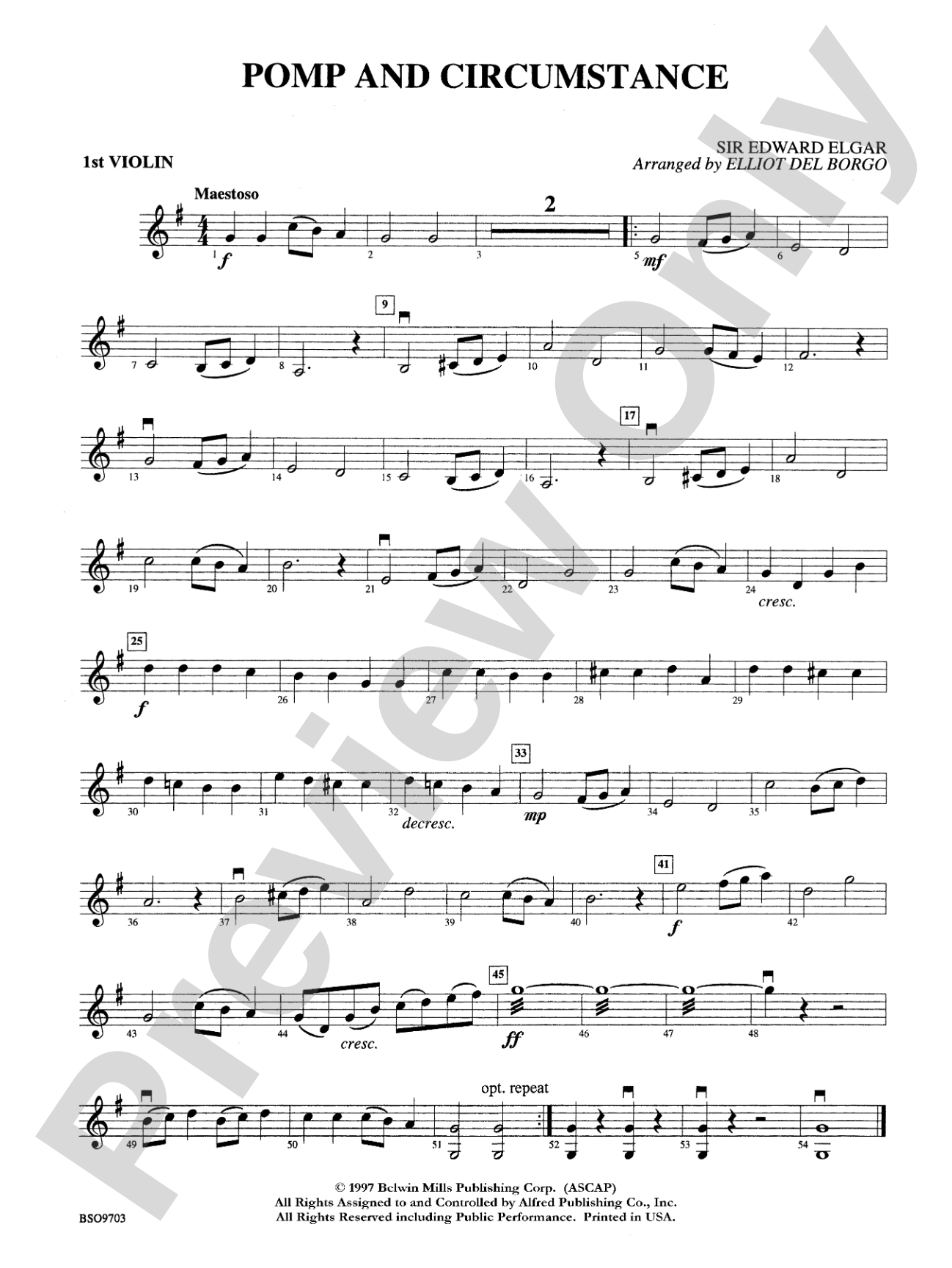
Pomp and Circumstance: 1st Violin

By Edward Elgar / arr. Elliot Del Borgo

Grade: 2.5

Item: 00-PC-0002252_VN1

Digital Download
$5.99
Description
We welcome a most playable string orchestra arrangement of Elgar's first of five military marches originally scored for symphony orchestra. The work shows the composer's love for ceremony and echoes the grand moments of composers Verdi and Mayerbeer. Of course, for any type of 'graduation' this piece is a MUST and should be in EVERY library. (2:43)

Don't just read it, hear it, play along with it, and watch your students grow with it. In MakeMusic Cloud, Pomp and Circumstance: 1st Violin comes alive with professional accompaniment, adjustable tempo, and built-in practice tools that turn solo practice into real progress.

Sample Audio
No sample audio found.
Sample Video
Additional Details
Series: Belwin Intermediate String Orchestra
Publisher: Alfred Music
Page Count: 40
SKU: 00-PC-0002252_VN1

More about this title

About the Composer: Edward Elgar

Edward Elgar (1857, 1934) was an English composer who elevated British music to international prominence during the Romantic and early twentieth-century periods. His facility for sweeping melody and his sophisticated orchestration made him a master of the grand gesture, whether composing intimate chamber works or massive symphonic scores. Elgar's ability to capture ceremony and pageantry remains unmatched in the repertoire.

The Pomp and Circumstance Marches represent some of Elgar's most enduring work. Written between 1901 and 1930, these five military marches became synonymous with processional dignity, institutional pride, and landmark occasions across the English-speaking world. His compositional voice here is direct, confident, and built on the foundation of melodic architecture that singers and instrumentalists find deeply satisfying to perform.

Why we love this

This arrangement succeeds where many simplified versions fall short: it preserves the swagger and ceremonial weight of Elgar's original without requiring a full symphony orchestra. Del Borgo's scoring gives every voice in the string section something meaningful to do, making it rewarding for both accomplished ensembles and groups still building confidence. The 2:43 duration and Grade 2.5 difficulty make it practical for any program calendar without sacrificing musical substance.

What to expect

Stately and assured, with a march rhythm that feels inevitable rather than rushed. The melodies unfold with Romantic-era generosity, and moments of harmonic richness give the arrangement warmth alongside its formal dignity.

Who it's for

String orchestras at the intermediate level who need a processional work that commands respect without excessive technical demands. This is equally suited to graduation ceremonies, festival competitions, or any program that calls for ceremonial music with immediate audience recognition.

How to get the most out of it

  • Shape the opening march theme with long, unhurried phrasing; resist the temptation to rush forward even as the rhythm feels propulsive. The grandeur lives in the breath, not the tempo.
  • Balance the viola and cello lines that support the main melody. These inner voices deserve clarity so that harmonic movement reads distinctly to the audience.
  • Mark the key shift and thematic return in the trio section; these moments benefit from a slight broadening or a conductor's clear gesture to help the ensemble understand the emotional arc.

How to use it

Schedule this as an opening or closing number for graduation rehearsals or ceremonies where its processional character will anchor the event. Alternatively, program it as a bridge piece between contrasting works on a concert: its structural clarity and crowd appeal make it an effective programming tool to reset ensemble and audience energy between movements in a longer concert.

Skills your students will build

  • Sustaining tone quality in long melodic lines without dynamic wavering
  • Responding to conductor gesture and textural balance cues
  • Understanding harmonic function in Romantic-era tonal progressions
  • Executing march rhythm with precision while maintaining lyrical expression
  • Reading multi-voice string orchestra textures with independent part awareness

You May Also Like