Poker Face (arr. Stefan Flügel) Sheet Music Preview

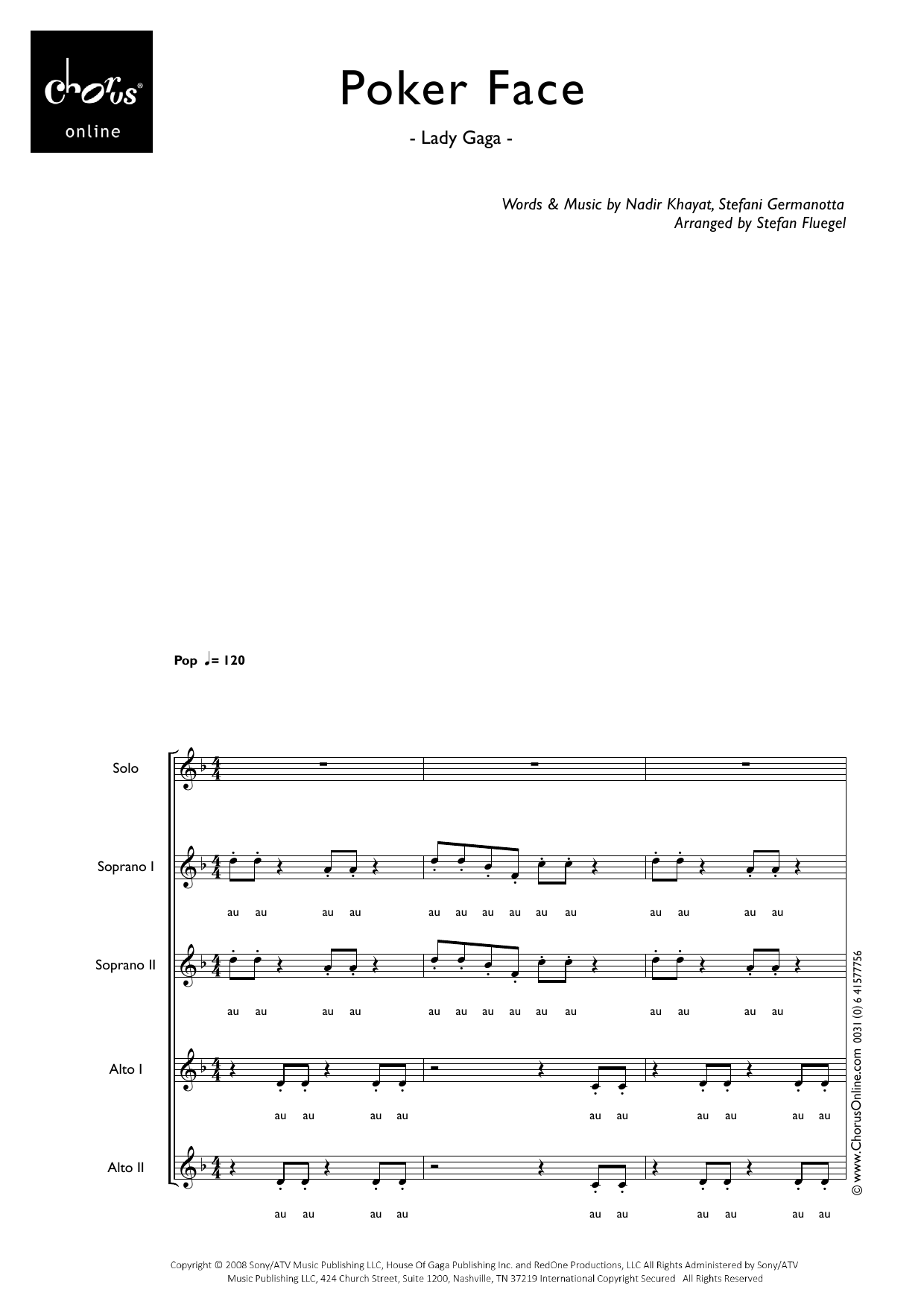
Poker Face (arr. Stefan Flügel): SSAA Choral Octavo

As performed by Lady Gaga / Arranged by Stefan Flügel

Item: 35-DS00497313

Digital Download
$2.99
Description

Poker Face (arr. Stefan Flügel): SSAA Choral Octavo isn't in MakeMusic Cloud just yet...but it could be. Let us know you'd like to see it, and you'll help shape what comes next. In the meantime, start a free trial and dive into thousands of interactive titles your students can play along with today.

Sample Audio
No sample audio found.
Sample Video
Additional Details
Publisher: Hal Leonard
Page Count: 17
SKU: 35-DS00497313

More about this title

About the Artist: Lady Gaga

Lady Gaga emerged in the late 2000s as a pop force defined by theatrical presentation and fearless genre blending. Her songwriting combines accessible hooks with production sophistication, making her work particularly engaging for arrangers seeking material that resonates with student singers while offering genuine musical substance.

Beyond the spectacle, Gaga's catalog demonstrates strong melodic and harmonic foundations. This makes her compositions natural fits for choral adaptation, where the bones of a song matter as much as its surface appeal.

Why we love this

Stefan Flügel's arrangement captures the obsessive groove and propulsive energy of the original while making it singable and musically satisfying for singers who grew up with this song. The SSAA voicing sits comfortably and opens access to groups that might not have developed strong tenor sections. Most importantly, this arrangement doesn't sanitize the source material; students recognize immediately what they're performing and bring genuine enthusiasm to rehearsals.

What to expect

Magnetic and controlled. Despite the pop idiom, the arrangement maintains deliberate spacing and harmonic tension that rewards focused listening. There's a cool detachment to the performance aesthetic, reminiscent of the original's iconic vocal delivery, paired with enough rhythmic propulsion that singers feel the drive even in slower passages.

Who it's for

Choirs seeking contemporary repertoire that bridges the gap between what students hear outside rehearsal and what they perform on stage. Secondary ensembles or groups new to a cappella work will find the voicing accessible without sacrificing musical integrity. This also works for programs building confidence in singers who associate 'real music' only with classical traditions.

How to get the most out of it

  • Lock the pulse before worrying about blend. This groove-based track lives and dies by rhythmic precision; nail the internal subdivision first, then shape the harmonic colors around that foundation.
  • Emphasize the repetitive, cyclical nature of the melody rather than fighting it. The song's power comes from hypnotic return, not from variation, so commit fully to that aesthetic.
  • Balance the soprano and alto voices carefully in sections where both parts move. The original track's clarity depends on hearing both the hook and its harmonic support distinctly.
  • If using recorded accompaniment, resist the urge to speed it up for energy. The original's effectiveness comes from restraint and pocket rather than tempo.

How to use it

Consider pairing this with other contemporary arrangements to create a concert set that demonstrates range without losing coherence. It also serves as an excellent opener or encore, generating immediate engagement and leaving the audience on a high note. For groups exploring pop repertoire for the first time, this offers sophisticated writing that elevates rather than trivializes the source material.

Skills your students will build

  • Maintaining steady pulse and internal subdivision in grooved, repetitive material
  • Balancing layered voices where soprano and alto both carry motivic content
  • Shaping sustained notes and harmonic blocks for maximum resonance in a cappella settings
  • Executing style with authenticity; understanding how to inhabit contemporary idioms with respect
  • Ensemble precision through attention to rhythmic alignment rather than conductor dependence

You May Also Like