
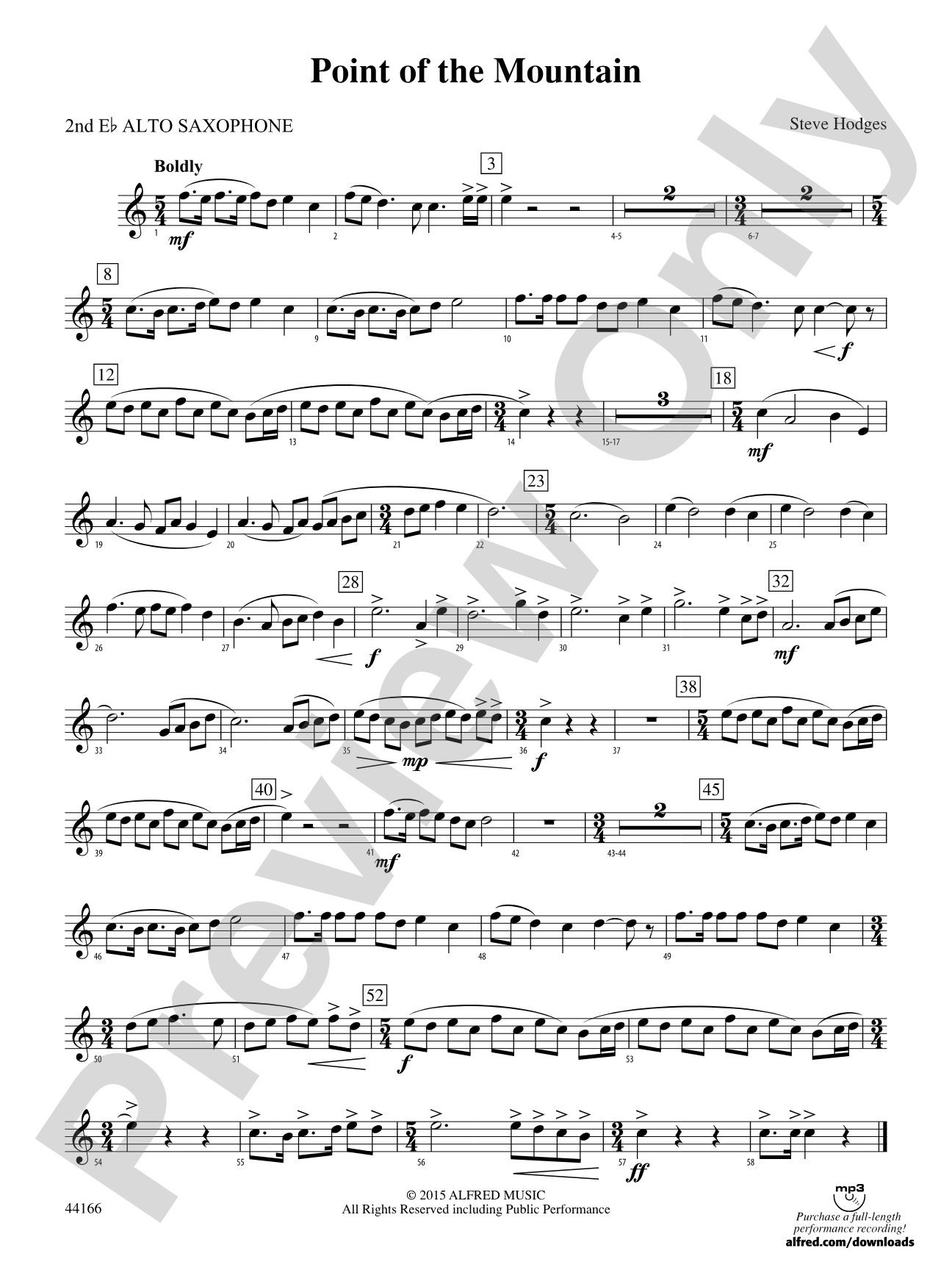

Point of the Mountain: 2nd E-flat Alto Saxophone
By Steve Hodges
Grade: 2 (Medium Easy)
Item: 00-PC-0017016_AX2
$3.00
Pickup currently not available
Description
Having many elements of a standard march but employing shifting meters from 5/4 to 3/4, give this piece a unique feel. Written while traveling through Utah, "Point of the Mountain" depicts the boldness and the rugged beauty of the Traverse Mountains, considered to be among the world's premier paragliding and hang gliding destinations in North America. (2:25)


Don't just read it, hear it, play along with it, and watch your students grow with it. In MakeMusic Cloud, Point of the Mountain: 2nd E-flat Alto Saxophone comes alive with professional accompaniment, adjustable tempo, and built-in practice tools that turn solo practice into real progress.
Open in the Player
Jump straight in and assign it today.
Start Your Free Trial
Open this title and explore the full library in minutes.
Sample Audio
1
Audio File
--:--
0:00
0:00
Sample Video
No sample videos found.
Additional Details
Series:
Challenger Band Series
Publisher:
Alfred Music
Page Count:
174
SKU:
00-PC-0017016_AX2
More about this title
About the Composer: Steve Hodges

Steve Hodges holds degrees from Western Oregon University (Bachelor of Science) and Central Washington University (Master of Music Education). He spent four decades in public school music education, directing concert bands, choirs, and chamber ensembles across multiple grade levels before retiring from the classroom.
Since 1986, Hodges has composed over 120 concert band works published by Alfred Music, along with choral arrangements distributed by Staff Music and Shawnee Press. His compositions appear regularly at state conventions and international festivals, and he has received commissions from honor bands and school programs across North America. His music has also been licensed by major television networks including TBS and ESPN. A member of ASCAP, Hodges now lives in The Dalles, Oregon, where he remains active in community music and takes particular pleasure in hearing his grandchildren perform his pieces in their school bands.
Why we love this
The shifting meters from 5/4 to 3/4 give this march a contemporary rhythmic edge while keeping the melodic and harmonic language accessible for Grade 2 ensembles. Hodges captures genuine landscape imagery without resorting to program music clichés, making it a legitimate concert piece rather than mere descriptive window dressing. It programs beautifully alongside traditional marches, giving your band exposure to metric variety without overwhelming them.
What to expect
Point of the Mountain opens with the sturdy, forward-moving energy of a traditional march, then surprises you with gentle metric pivots that evoke the shifting landscape of Utah's Traverse Range. The piece captures both the daring spirit of hang gliders riding thermal currents and the timeless, layered beauty of desert geology.
Who it's for
This piece works well for Grade 2 concert bands that have solid rhythmic fundamentals and are ready to explore mixed meters in a musically meaningful context. It appeals equally to groups preparing for festival competitions and those building a concert program with variety and geographical character.
How to get the most out of it
- Establish the 5/4 sections with confidence in rehearsal before introducing the 3/4 shifts; students who lock into the primary meter will navigate transitions more smoothly.
- Balance the "boldness" described in the title against the lyrical moments that depict the rugged landscape; avoid playing the entire piece at the same dynamic intensity.
- Let the brass lead the march-like sections, then pull back slightly when the ensemble moves into the 3/4 passages so the meter change registers clearly.
How to use it
Program this as your opening or closing concert number, where its distinctive meter work and manageable difficulty set it apart from standard march repertoire. It pairs naturally with other Grade 2-3 concert band pieces inspired by American geography, or stand it alone as your statement piece for a festival where you want to show rhythmic sophistication without sacrificing accessibility.
Skills your students will build
- Reading and performing in alternating meters (5/4 and 3/4)
- Maintaining pulse stability during metric modulation
- Balancing march-style articulation with legato phrasing
- Ensemble blend across contrasting timbral sections