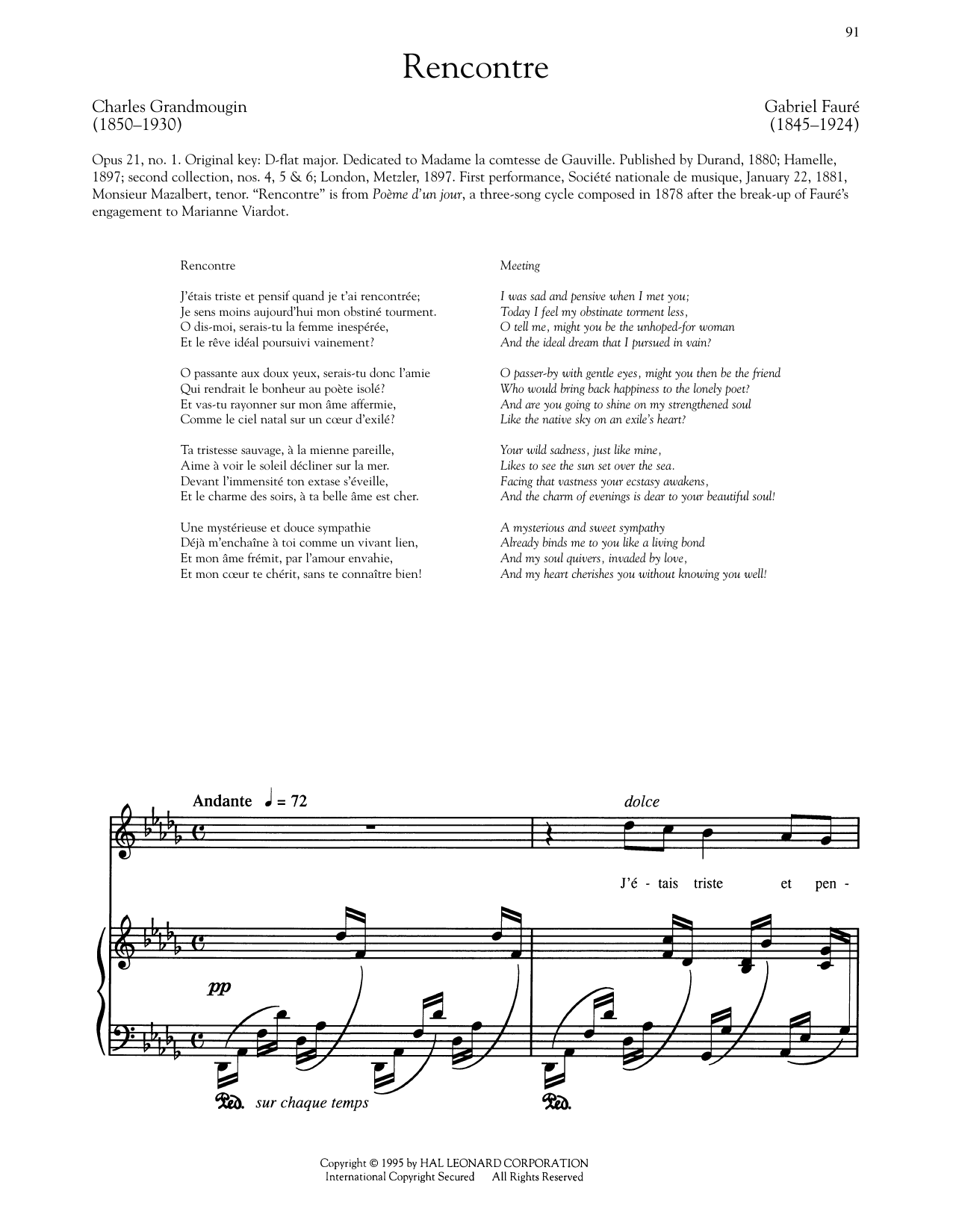
Poeme D'Un Jour: Recontre (High Voice) Sheet Music Preview

Poeme D'Un Jour: Recontre (High Voice): Piano Vocal

By Gabriel Fauré

Item: 35-DS01827439

Digital Download
$5.99
Description

Poeme D'Un Jour: Recontre (High Voice): Piano Vocal isn't in MakeMusic Cloud just yet...but it could be. Let us know you'd like to see it, and you'll help shape what comes next. In the meantime, start a free trial and dive into thousands of interactive titles your students can play along with today.

Sample Audio
No sample audio found.
Sample Video
Additional Details
Publisher: Hal Leonard
Page Count: 6
SKU: 35-DS01827439

More about this title

About the Composer: Gabriel Fauré

Gabriel Fauré (1845–1924) shaped French vocal music through his gift for setting poetry to melody with unprecedented subtlety. His songs consistently prize the expressive possibilities of the human voice over virtuosic display, making them essential to the art song repertoire and central to French music education at all levels.

Fauré's harmonic language influenced generations of composers who followed. His approach to text setting—where musical line and poetic meaning move as one—demonstrates why singers and pianists return to his catalog throughout their careers.

Why we love this

Fauré's middle song from the cycle 'Poème d'un jour' captures a moment of first encounter with crystalline beauty and restraint. The writing sits comfortably for high voices and rewards singers who understand the intimacy this music demands; it never shouts, but it never whispers either.

What to expect

Delicate and perceptive, 'Recontre' captures the breathless immediacy of recognition and attraction. The musical language is fluid and harmonically adventurous for its period, unfolding with the natural conversational rhythm of someone recounting a chance meeting they cannot quite believe happened.

Who it's for

High voice singers preparing art song repertoire in French, whether for recital, competition, or graduate study. Pianists building their collaborative skills and familiarity with the nineteenth-century French mélodie tradition will find Fauré's textures both instructive and musically nourishing.

How to get the most out of it

  • Shape the melodic line with the long breath of the poetic text rather than the bar line; the music follows the syntax of Mendès' verse.
  • Balance the voice and piano as equal partners. The accompaniment contains harmonic motion and rhythmic nuance that support rather than subordinate the vocal line.
  • Trust the silence. Fauré's use of rest and space is as important as the sung notes; resist the urge to fill every moment.
  • Approach the key relationships with clarity; slight shifts in harmonic color signal emotional turning points in the encounter.

How to use it

Pair this with other Fauré mélodies as part of a focused recital program on the art song, or program it alongside a contrasting twentieth-century setting of French verse to highlight the evolution of vocal writing. It works especially well in a chamber recital context where intimacy and refined taste take priority over scale.

Skills your students will build

  • French diction and the relationship between vowel color and melodic contour
  • Phrasing across harmonic shifts and subtle key changes
  • Collaborative listening and balance between voice and piano
  • Interpretation of understated emotional content through musical gesture rather than dramatic display
  • Reading and performing nineteenth-century vocal notation conventions

You May Also Like