
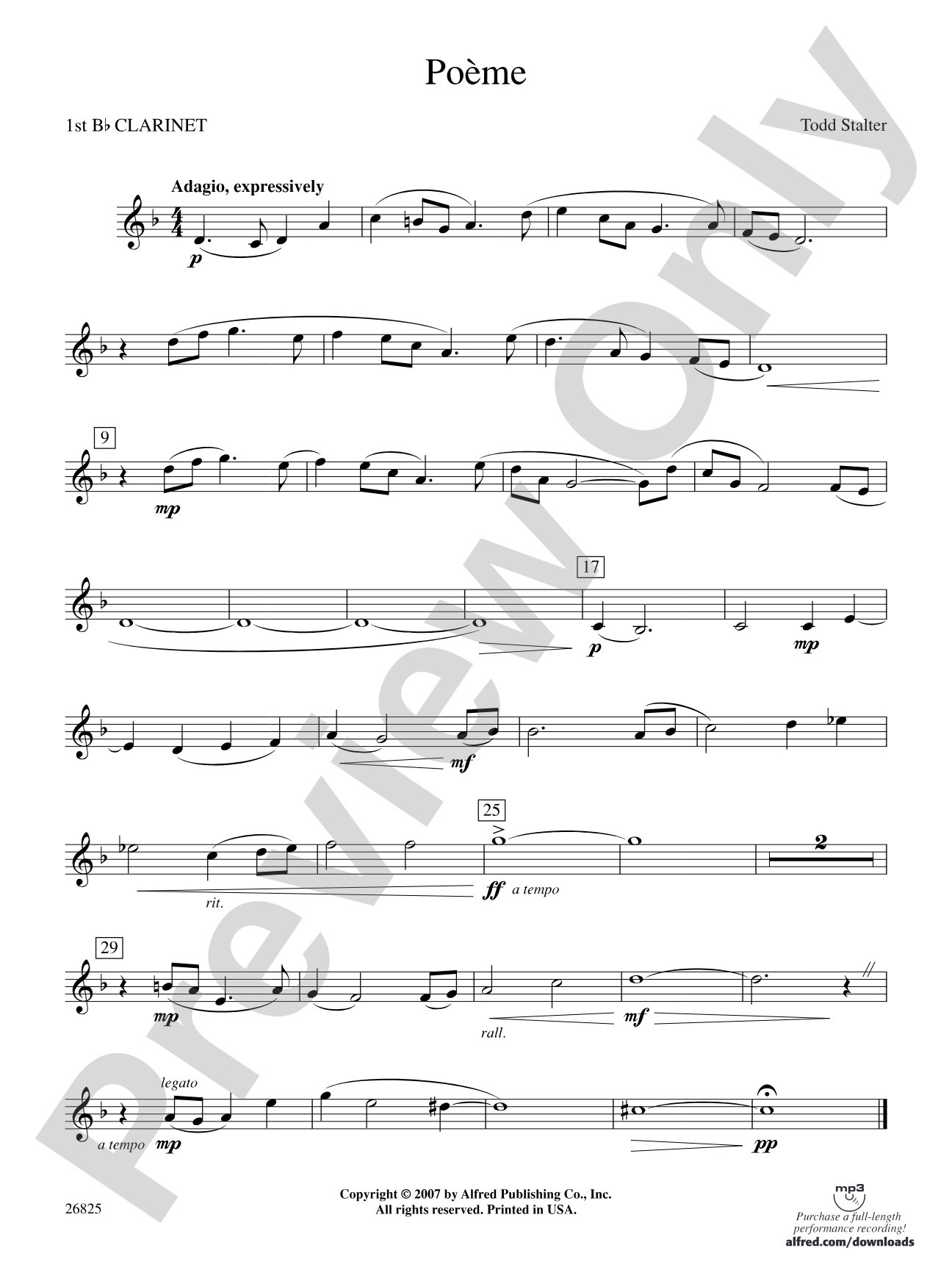

Poeme: 1st B-flat Clarinet
By Todd Stalter
Grade: 1 (Very Easy)
Item: 00-PC-0001263_C1
$3.00
Pickup currently not available
Description
Poème encourages young wind players to play expressively by giving them many opportunities to phrase and support a long musical line, all while using comfortable ranges and the entire dynamic spectrum. Written in a free form, a rising line through the ensemble carries the players and audience to a dramatic emotional peak, eventually giving way to a calm, serene ending. This title is available in MakeMusic Cloud.


Don't just read it, hear it, play along with it, and watch your students grow with it. In MakeMusic Cloud, Poeme: 1st B-flat Clarinet comes alive with professional accompaniment, adjustable tempo, and built-in practice tools that turn solo practice into real progress.
Open in the Player
Jump straight in and assign it today.
Start Your Free Trial
Open this title and explore the full library in minutes.
Sample Audio
1
Audio File
--:--
0:00
0:00
Sample Video
No sample videos found.
Additional Details
Series:
Young Symphonic
Publisher:
Alfred Music
Page Count:
65
SKU:
00-PC-0001263_C1
More about this title
About the Composer: Todd Stalter

Todd Stalter built a 34-year legacy as Director of Bands at Eureka High School in Illinois, where his ensembles became known statewide for consistent excellence. The Marching Band captured 16 Class 1A state championships, the Concert Band earned Superior ratings repeatedly at IHSA contests, and both groups performed at major venues including Orchestra Hall in Chicago and Walt Disney World. Beyond his high school tenure, Stalter has guest-conducted All-State Bands in Georgia and Delaware, adjudicated extensively across the Midwest, and presented clinics on composition and music education at state conferences.
His compositional voice has gained national reach, with band works appearing on state contest lists throughout the country and featured in the GIA Publications series Teaching Music Through Performance in Band. Stalter holds degrees in Music Education and Trumpet Performance from Illinois State University, where he studied conducting with Dr. Stephen K. Steele and trumpet with Richard Lehman of the United States Marine Band.
Why we love this
Stalter crafts this piece with remarkable care for young musicians, balancing expressive demands with genuine accessibility. The free-form structure unfolds naturally, allowing conductors to shape phrasing flexibly while the rising dramatic arc keeps players engaged and audiences invested from start to finish.
What to expect
Poème unfolds like a journey toward light. Early passages feel contemplative and intimate, gradually building emotional intensity as the ensemble's voices rise together, then dissolving into a peaceful, clarified stillness. The arc invites listeners to experience genuine drama from young musicians.
Who it's for
Beginning concert bands seeking repertoire that teaches expressive musicianship without technical overload. This work suits young players who have basic facility with their instruments but need encouragement to think beyond note-reading and engage with phrasing and dynamic shaping.
How to get the most out of it
- Shape the long line through ensemble collaboration. Younger players often need visual and verbal reminders about the overall arc; mark phrase boundaries in the score and discuss how individual sections support the larger musical gesture.
- Explore the full dynamic spectrum gradually over rehearsals. Start by finding the most comfortable mezzo-forte range, then expand into softer and louder passages once players understand the phrase contours.
- Balance transparency in the rising section. With many players contributing to a single ascending line, layer dynamics so inner voices support without obscuring the primary melody.
- Allow flexibility in tempo to serve the emotional shape. The transition to the calm ending benefits from slight tempo adjustment; experiment in rehearsal to find what feels natural for your ensemble.
How to use it
Program this as a concert opener or as a contrasting piece between faster, rhythmically driven works. Its emotional maturity and clear three-part structure (contemplation, crescendo, resolution) also make it effective for festival performance, where adjudicators appreciate the balance of technical appropriateness with musical intention.
Skills your students will build
- Sustaining long musical phrases across multiple measures
- Responding to conductor-shaped dynamic shapes and tempo inflection
- Balancing independent voice parts within a unified ensemble line
- Transitions between registers and dynamic levels with tonal consistency
- Listening to neighboring sections while maintaining personal part accuracy