
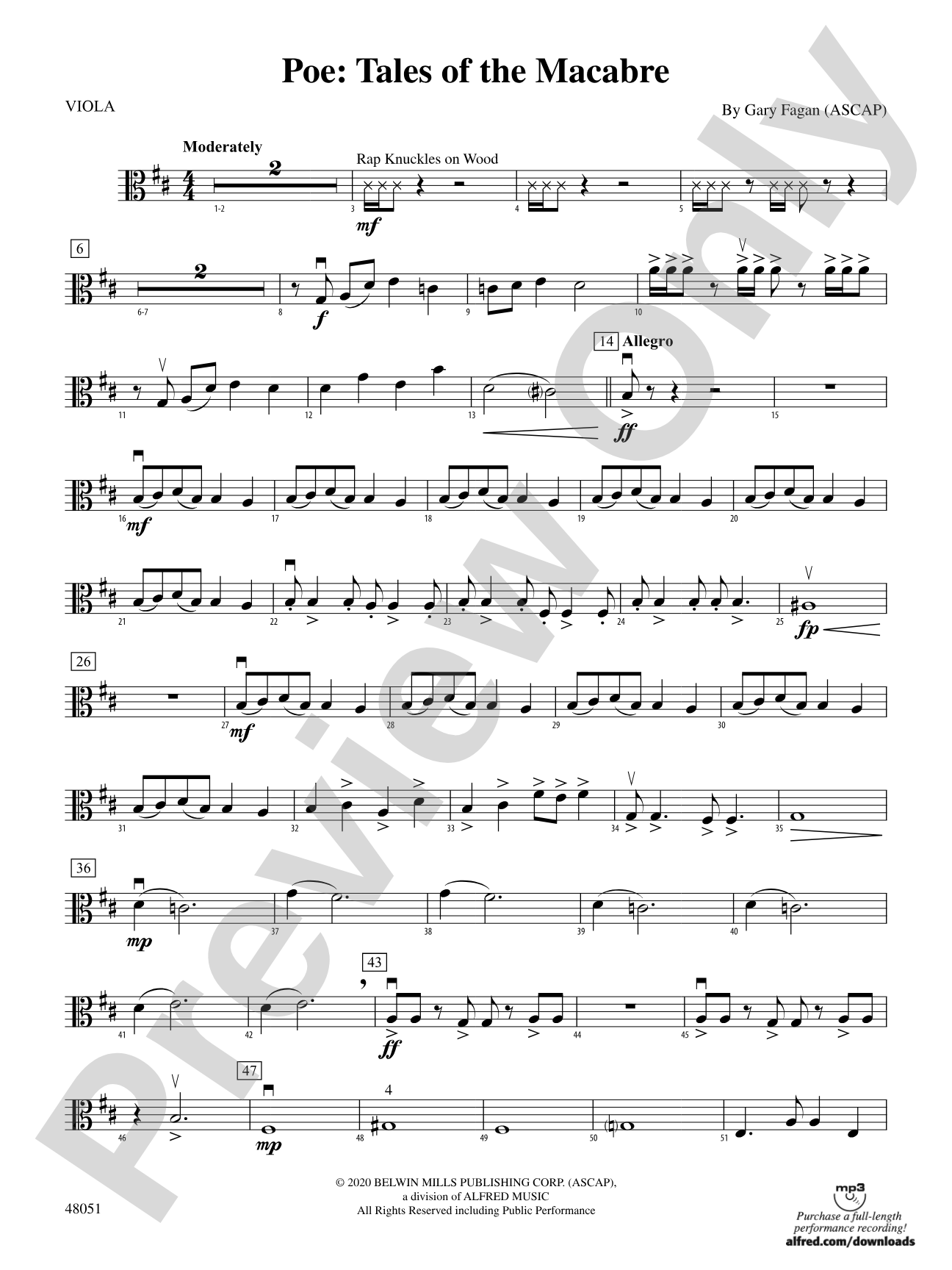

Poe: Tales of the Macabre: Viola
By Gary Fagan
Grade: 3
Item: 00-PC-0018510_VA1
$7.99
Pickup currently not available
Description
Poe: Tales of the Macabre is a mysterious and creative original work by Gary Fagan inspired by several poems and short stories by Edgar Allan Poe. Interesting and angular harmonies and a driving rhythmic structure make this piece an excellent teaching resource as well as one your students will enjoy performing. (4:00) This title is available in MakeMusic Cloud.


Don't just read it, hear it, play along with it, and watch your students grow with it. In MakeMusic Cloud, Poe: Tales of the Macabre: Viola comes alive with professional accompaniment, adjustable tempo, and built-in practice tools that turn solo practice into real progress.
Open in the Player
Jump straight in and assign it today.
Start Your Free Trial
Open this title and explore the full library in minutes.
Sample Audio
1
Audio File
--:--
0:00
0:00
Sample Video
Additional Details
Series:
Belwin Concert String Orchestra
Publisher:
Alfred Music
Page Count:
124
SKU:
00-PC-0018510_VA1
More about this title
About the Composer: Gary Fagan

Gary Fagan brings three decades of teaching experience and a proven track record as both educator and composer. A native of Maryland, he spent 36 years directing bands in Albemarle County before transitioning to university work, where he has taught arranging as an adjunct faculty member at James Madison University and currently serves as a University Supervisor. His compositions and arrangements have reached audiences at prestigious venues including the Midwest Band and Orchestra Clinic, the White House, and gubernatorial inaugural ceremonies.
Fagan's contributions to music education have earned him recognition as Central Virginia's Outstanding Middle School Teacher (Phi Delta Kappa), two listings in "Who's Who Among America's Teachers," and multiple Outstanding Educator Awards. He holds degrees in Music Education from Bridgewater College and a master's degree from James Madison University. Active as a clinician, adjudicator, and current assistant director of the Charlottesville Band, Fagan maintains membership in ASCAP, the National Band Association, Phi Beta Mu Bandmasters Fraternity, and the Music Educators National Conference.
Why we love this
Fagan crafts a piece that respects both the Grade 3 technical level and the dramatic potential of Poe's universe. The angular harmonies and propulsive rhythmic drive give students real compositional concepts to absorb while rehearsing, and the literary connection gives you a natural hook for interdisciplinary engagement. It's the kind of original work that genuinely excites young string players because the music itself feels purposeful and cinematic, not simplified.
What to expect
Mysterious and slightly unsettling in the best way. The angular harmonies and restless rhythmic energy create an atmosphere that hovers between intrigue and dread, capturing the gothic sensibility of Poe's work without resorting to cheap theatrical tricks. The piece moves with purpose and momentum, never settling into comfort.
Who it's for
String orchestras at the Grade 3 level who are ready to tackle something more conceptually interesting than standard repertoire. Students preparing for fall festivals or October concert programming will find genuine engagement here, and directors seeking pieces with literary and thematic depth will appreciate the Poe connection as an entry point for deeper musical conversations.
How to get the most out of it
- Establish the rhythmic foundation early. The driving structure only lands when your players lock the pulse together, so invest rehearsal time in rhythmic precision across all sections before layering harmonic details.
- Shape the angular harmonies with clear dynamic intention. These progressions won't feel unsettling without contrast, so use dynamics to highlight the harmonic shifts and keep the listener engaged.
- Balance texture carefully when multiple sections carry the melodic material. String players naturally want to match volume regardless of function, so assign specific dynamic zones to ensure the architecture remains clear.
How to use it
Anchor a fall or Halloween concert with this as a centerpiece work that signals to the audience that your ensemble can handle sophisticated programming. Pair it with contrasting selections to let its darker character shine, or build a thematic evening around Poe and the gothic tradition in music. The four-minute runtime also makes it ideal for festival competition formats where you need a single strong showcase piece.
Skills your students will build
- Reading and performing angular harmonic progressions
- Executing rhythmic precision in driving, complex structures
- Balancing texture and dynamics to clarify multiple simultaneous musical lines
- Interpreting programmatic intent through compositional choices
- Sustaining ensemble cohesion in contemporary harmonic language