
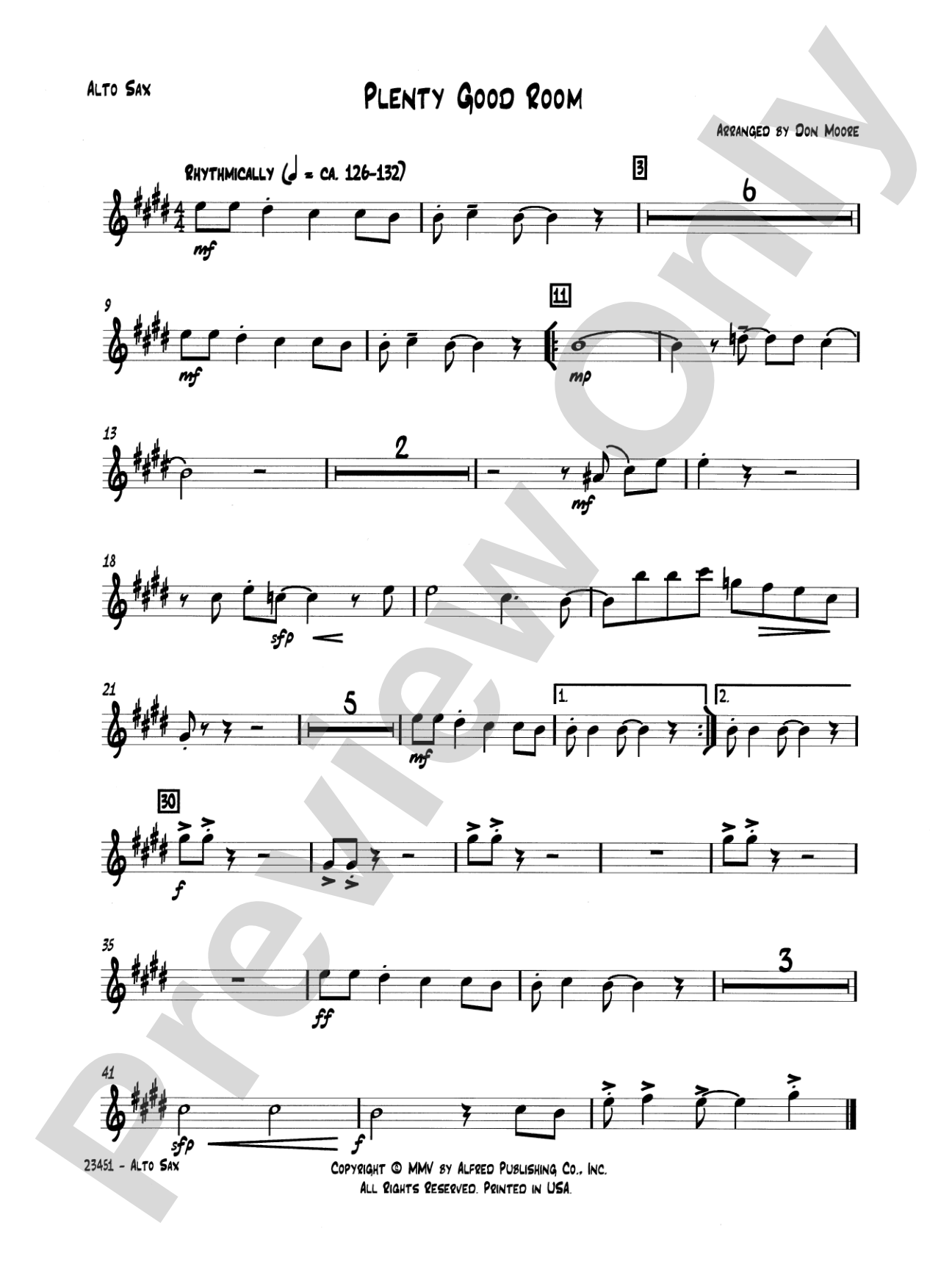

Plenty Good Room: E-flat Alto Saxophone: Choral SoundPax
Arr. Donald Moore
Item: 00-PC-0000724_AX1
$3.00
Pickup currently not available
Description
Donald Moore gives new energy to a traditional American spiritual by adding new words and contemporary musical sensibilities. Each time the chorus returns it is more embellished until reaching its ultimate "rock out" potential. The bass section gets some great moments in the SATB and SAB voicings, and Part II isn't left out in the 2-part. Optional SoundTrax CD and SoundPax parts that really deliver the goods. SoundPax includes parts for a. sax., t. sax., tpt., tbn., rhy.


Don't just read it, hear it, play along with it, and watch your students grow with it. In MakeMusic Cloud, Plenty Good Room: E-flat Alto Saxophone: Choral SoundPax comes alive with professional accompaniment, adjustable tempo, and built-in practice tools that turn solo practice into real progress.
Open in the Player
Jump straight in and assign it today.
Start Your Free Trial
Open this title and explore the full library in minutes.
Sample Audio
1
Audio File
--:--
0:00
0:00
Sample Video
No sample videos found.
Additional Details
Series:
Alfred Choral Designs
Publisher:
Alfred Music
Page Count:
18
SKU:
00-PC-0000724_AX1
Instrumentation:
SoundPax
More about this title
About the Arranger: Donald Moore
Donald Moore earned his Bachelor of Music in organ performance and Master of Arts in Teaching from Kent State University. He serves as Organist-Choirmaster at Pilgrim United Church of Christ in Cuyahoga Falls, Ohio, and has built a catalog of over 500 compositions across sacred, secular, and educational genres published through Alfred Music, Hal Leonard, Heritage Music Press, and other major houses. His work regularly appears at state contests and festivals and has been recognized at conventions across state, regional, national, and international levels.
Moore is a seventeen-time recipient of the ASCAP Composers Standard Award and was cited by the American Choral Directors Association Choral Journal as one of 400 significant composers in American choral music history. Beyond composition and arrangement, he has authored eight educational books spanning organ, piano, and choral music.
Why we love this
Moore's approach to this spiritual refuses to sit still. The chorus grows more embellished with each return, building genuine momentum toward a finale that actually earns the term 'rock out.' The bass lines are particularly inventive, giving lower voices real character throughout the SATB, SAB, and 2-part versions. When SoundPax instrumentation enters, the arrangement clicks into a contemporary groove that feels organic to the spiritual rather than imposed on it.
What to expect
The spiritual foundation remains solid and recognizable, but Moore's additions bring a modern sensibility that surprises and engages. The progression from intimate verse to increasingly elaborate chorus creates genuine forward momentum, culminating in an uninhibited section where the choir can let loose with conviction.
Who it's for
Mixed choral groups (SATB and SAB) and treble ensembles (2-part) looking for spirituals that feel contemporary without compromising sacred roots. This works equally well for concert choirs seeking diverse programming and worship settings ready to energize their repertoire.
How to get the most out of it
- Layer the embellishments gradually through each choral return; resist the impulse to pile everything on from measure one. Let the audience hear the progression Moore built into the form.
- Balance the bass writing closely during rehearsal. These lines deserve attention and clarity, not just rhythmic support beneath the melody.
- If using SoundPax parts, allow the rhythm section (saxophone, trumpet, trombone, and rhythm) to lock the groove firmly before adding vocal layers on top. The instrumental pocket makes all the difference.
- Bring out the textural shift toward the 'rock out' section with genuine energy in dynamics and articulation; treat it as a earned climax, not a novelty moment.
How to use it
Program this as a contrast piece within a concert that mixes spirituals or sacred works; its contemporary edge complements more traditional arrangements and opens space for dialogue about how traditions evolve. It also serves well as a concert closer or signature piece for groups with the chops to nail the rhythmic precision the final section demands.
Skills your students will build
- managing contrast and textural layering across multiple iterations of the same phrase
- locking ensemble rhythm within contemporary grooves (especially with instrumental accompaniment)
- balancing bass line independence with harmonic support
- performing energetic, rhythmically secure material while maintaining diction and blend