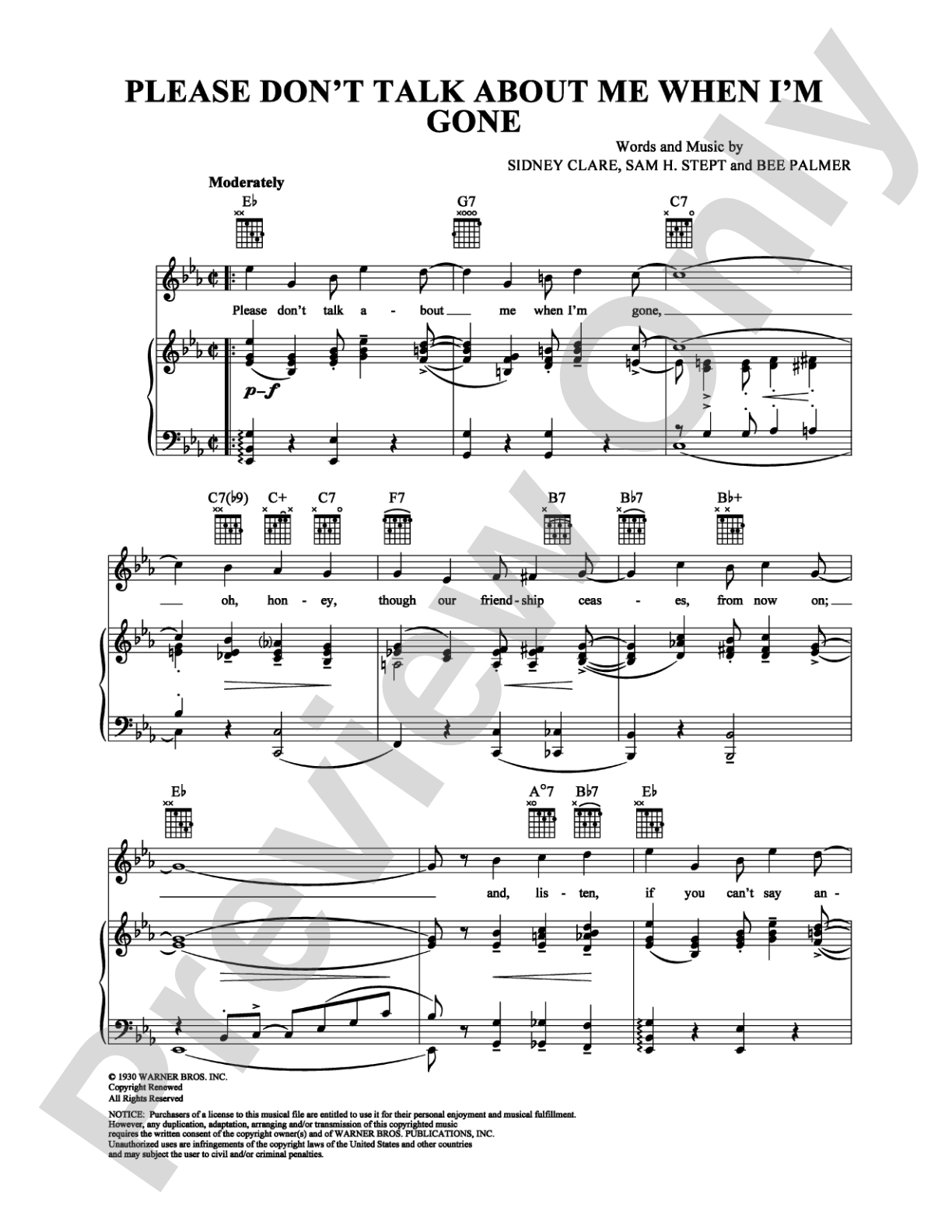
Please Don't Talk About Me When I'm Gone: Piano/Vocal/Chords Digital Sheet Music

Please Don't Talk About Me When I'm Gone: Piano/Vocal/Chords Digital Sheet Music

Sam H. Stept, Sidney Clare, Bee Palmer

Item: 00-PS-0002052

Digital Download
$3.99
Description

Please Don't Talk About Me When I'm Gone: Piano/Vocal/Chords Digital Sheet Music isn't in MakeMusic Cloud just yet...but it could be. Let us know you'd like to see it, and you'll help shape what comes next. In the meantime, start a free trial and dive into thousands of interactive titles your students can play along with today.

Sample Audio
No sample audio found.
Sample Video
Additional Details
SKU: 00-PS-0002052

More about this title

About the Artist: Bee Palmer

Bee Palmer was a jazz and blues singer who rose to prominence in the 1920s and 1930s, known for her sultry contralto voice and sophisticated interpretations of popular standards. She recorded extensively during the early swing era and became a fixture in New York's jazz clubs, where her commanding stage presence and musicality made her a favorite among both musicians and audiences.

Why we love this

This standard carries genuine emotional weight without requiring a powerhouse voice. The melody sits comfortably across a wide range, the harmonic language is both accessible and rich enough to sustain interest, and the lyrical content gives singers real interpretive choices about tone, phrasing, and emotional vulnerability.

What to expect

A bittersweet farewell wrapped in the warm, slightly hazy glow of 1920s nostalgia. The melody has a wistful quality, and the lyrical conceit (a plea not to be gossiped about after one's departure) carries both humor and melancholy. The progression moves through lush harmonic territory that feels intimate and reflective.

Who it's for

This arrangement suits singers comfortable with standards repertoire and familiar with lead sheets or chord symbols. Pianists should read fluently in multiple keys and have experience voicing jazz and popular chords. The piece works equally well for recital practice, cabaret programming, or as part of a jazz vocal curriculum.

How to get the most out of it

  • Shape the vocal line with restraint rather than drama. This song works best when the singer resists overselling the sentiment; let the harmony and melody do the heavy lifting.
  • Use the piano part to establish the conversational intimacy of the piece. The accompaniment should support, not overpower, allowing the lyrics to land clearly.
  • Attend to the harmonic movement in the bridge. The chord changes may shift expectations, so make sure both vocalist and pianist lock in the phrasing at these turning points.
  • Explore rubato in the vocal line while keeping the piano steady. The slight flexibility in timing can highlight the vulnerability without losing structural coherence.

How to use it

Pair this with other Great American Songbook standards to create a cohesive set exploring themes of departure, memory, or resilience. It sits well in a jazz vocal recital or as a solo moment in a cabaret-style concert. The song also works as a teaching piece for vocalists learning to navigate chord symbols and work collaboratively with an accompanist.

Skills your students will build

  • Reading and interpreting lead sheet notation with chord symbols
  • Phrasing and breath control across a wide vocal range
  • Harmonic awareness and voice leading within jazz and popular chord progressions
  • Collaborative listening and timing between vocalist and accompanist
  • Interpretive choices in tempo and dynamics for emotional storytelling

You May Also Like