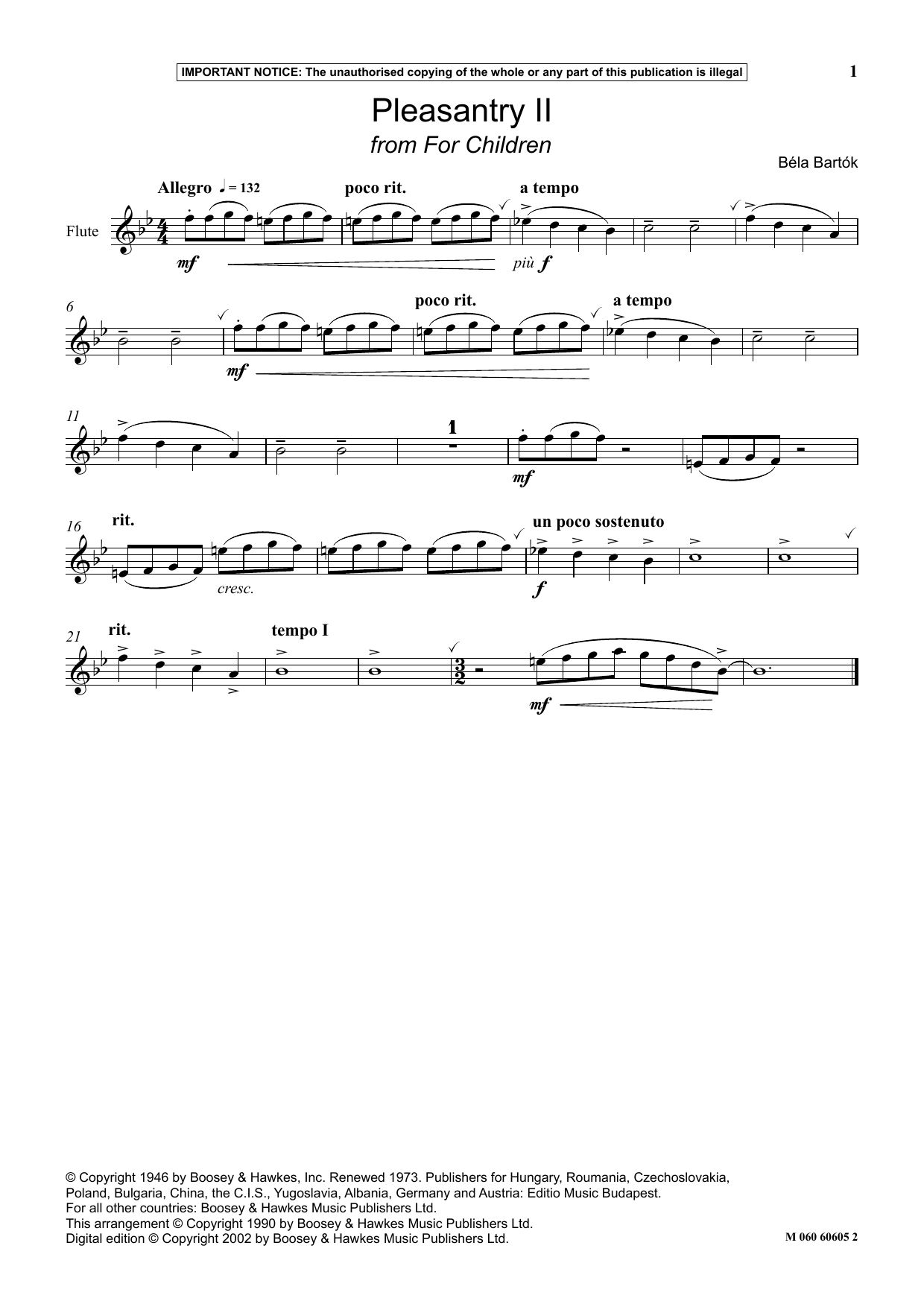
Pleasantry II (from For Children) Sheet Music Preview

Pleasantry II (from For Children): Instrumental Solo

As performed by Béla Bartók

Item: 35-DS00238314

Digital Download
$3.99
One moment…
Description

Discover MakeMusic Cloud: thousands of interactive titles your students can play along with today.

Sample Audio
No sample audio found.
Sample Video
Additional Details
Publisher: Hal Leonard
Page Count: 3
SKU: 35-DS00238314

More about this title

About the Artist: Béla Bartók

Béla Bartók (1881-1945) was a Hungarian composer and pianist whose work synthesized folk music research with modernist compositional techniques. His deep study of Eastern European folk traditions informed pieces across all genres, from solo works to large ensembles, and he became one of the twentieth century's most influential voices in bringing authentic folk idioms into concert music.

Bartók's pedagogical works remain essential in music education. Pieces like For Children demonstrate his belief that composers could write meaningful music for young performers while maintaining artistic integrity. His approach valued both technical growth and genuine musical expression, making his works as valuable for learning as they are for listening.

Why we love this

Bartók's miniatures from For Children sparkle with character and purpose. This piece balances accessibility with sophistication, giving students real musical substance to explore without excessive technical barriers. The writing feels inevitable rather than pedagogical; students sense they're playing music that matters, not just exercises dressed up as pieces.

What to expect

Pleasantry II unfolds with understated charm and subtle wit. There's a conversational quality to the melodic line, full of small gestures and unexpected turns that suggest a folk melody filtered through a sophisticated harmonic lens. The piece balances lightness with substance, never overstaying its welcome.

Who it's for

This piece suits intermediate to early advanced soloists with a secure technique and ear for stylistic detail. It works equally well in solo recitals, studio lessons, or classroom performances where individual musicianship shines.

How to get the most out of it

  • Attend to Bartók's articulation markings with precision. The staccato and legato indications are compositional choices, not casual markings, and they shape the melodic personality.
  • Find the natural breathing points and shape phrases around them. This isn't a piece that benefits from relentless evenness; allow the music space to breathe and ideas to land.
  • Balance clarity in the accompaniment with forward momentum. Harmonic support matters, but the texture should never overwhelm the primary voice.

How to use it

Pair this with other Bartók miniatures from For Children to show the breadth of his approach to composition for young musicians. It also complements twentieth-century concert programs that need intelligent, accessible works. This three-page piece fits seamlessly into recitals exploring folk influence in modern music.

Skills your students will build

  • Identifying and executing Bartók's specific articulation and phrasing intentions
  • Balancing independence between melodic and accompaniment voices
  • Understanding folk music influence in early twentieth-century composition
  • Developing stylistic awareness within modernist harmonic language

You May Also Like