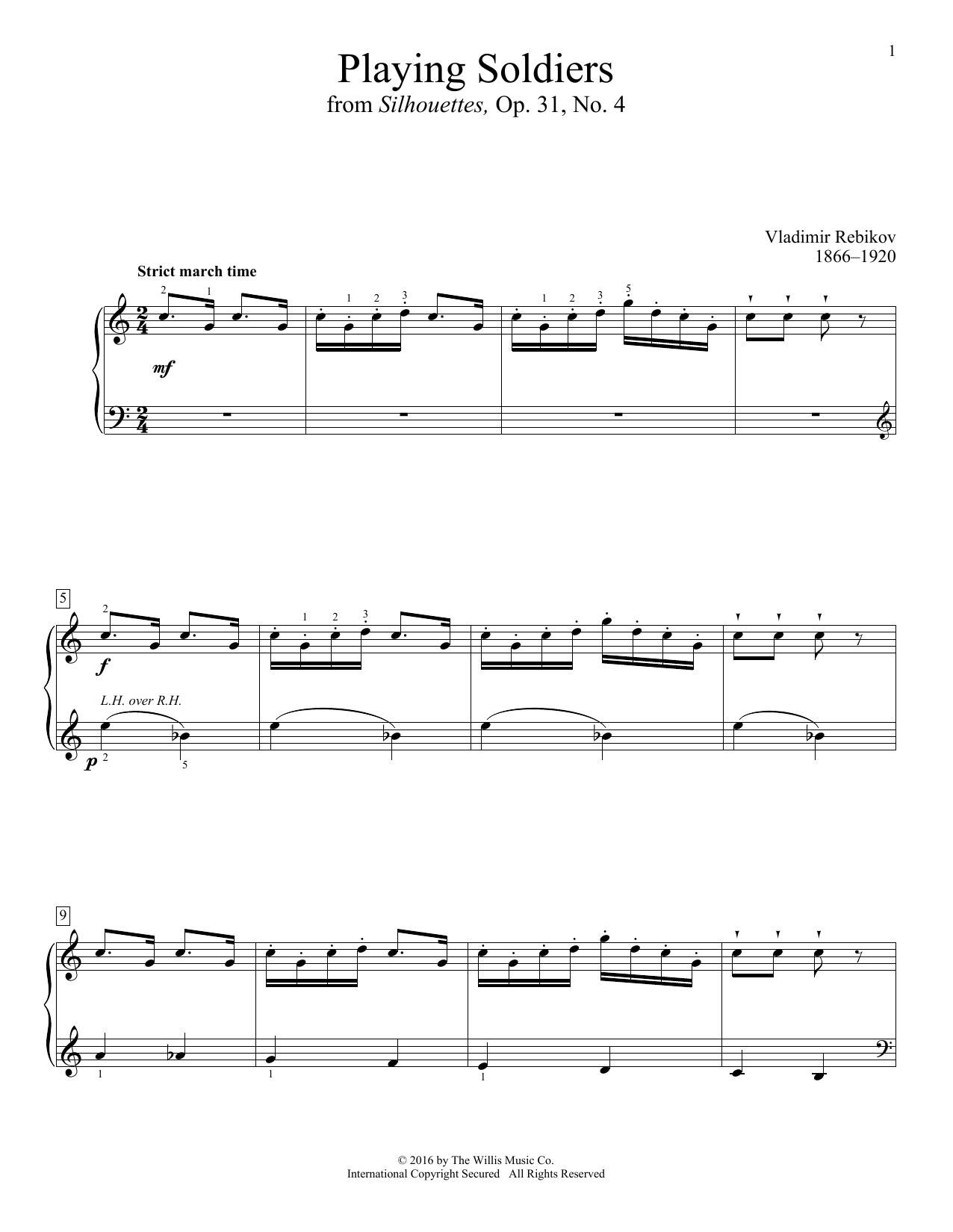
Vladimir Rebikov (1866-1920) was a Russian composer and pianist who bridged Romantic and early modern idioms. He composed extensively for piano, particularly works aimed at developing young musicians, and became known for pieces that combined technical instruction with genuine musical substance rather than dry exercises.
Why we love this
Rebikov understood what intermediate pianists actually need: music that sounds engaging without requiring virtuosic chops. The narrative element here keeps students invested in the learning process, and the two-page length makes it achievable within a single practice week without feeling like an etude.
What to expect
A procession captured in miniature. The piece evokes discipline and motion without stiffness, with moments of color that suggest the uniforms, the dust, the steady purpose of soldiers on the move. There's a playfulness here too, a lightness that keeps it from ever feeling ceremonial or heavy.
Who it's for
Intermediate pianists working on character pieces and learning to balance technical demands with musical storytelling. This sits well for students advancing through grades 3-5 repertoire who benefit from music that engages their imagination alongside their fingers.
How to get the most out of it
Shape each phrase as if telling a story rather than connecting dots. This isn't march music; it's character music that happens to use march-like rhythms.
Listen for where the left hand can breathe slightly before the right hand enters a new idea. These tiny spaces create the illusion of soldiers moving through space.
Bring out inner voices when the texture thickens. Rebikov often hides a counter-melody in the accompaniment that deserves light.
Maintain steady tempo even as dynamics shift. The soldiers march with precision, not rubato.
How to use it
Include this in a student recital where you want something shorter and more character-driven than a full sonatina, or pair it with other Russian pedagogical works to give students a sense of how composers in that tradition thought about teaching. It also works well on a studio showcase where brevity is an asset.
Skills your students will build
Executing repeated rhythmic patterns with independence between hands
Maintaining steady tempo through texture changes
Shaping short musical phrases with clear beginnings and endings
Playing with dynamic contrast while preserving legibility
Identifying and voicing embedded counter-melodies
You May Also Like
Scan to Complete Your Purchase
Use your phone's camera to scan the code below
You'll log in on your phone and the order will be added to your account