Playing at the Beach Sheet Music Preview

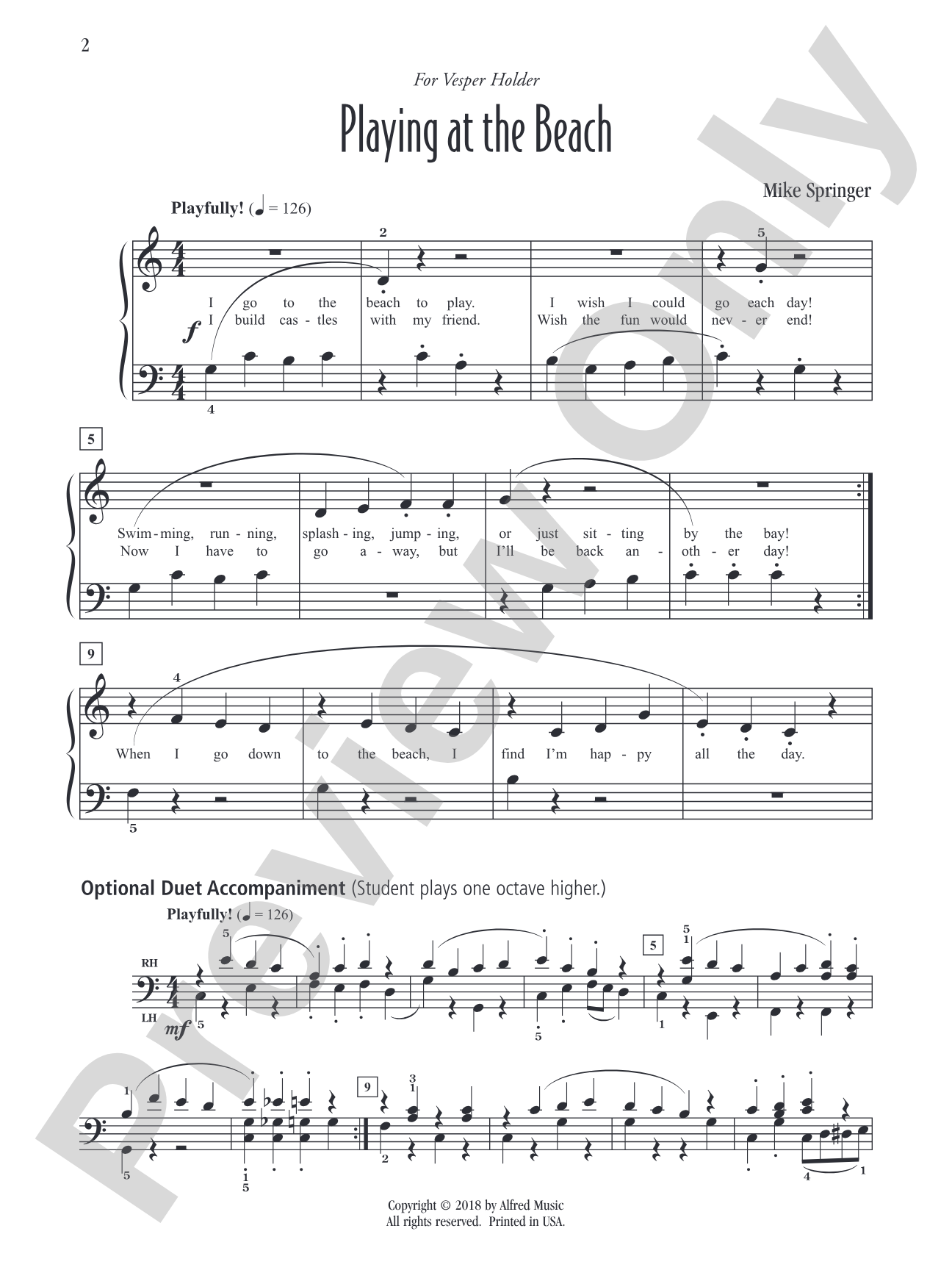
Playing at the Beach: Piano

By Mike Springer

Level: Early Elementary

Item: 00-PS-0016060

Digital Download
$3.99
Description
The hands never play together in this playful solo. Written in middle C position, the solo includes an optional duet accompaniment that provides harmonic interest and fosters rhythmic stability for students. It is also an excellent study of articulation, as many phrases contain both legato and staccato notes.

Playing at the Beach: Piano isn't in MakeMusic Cloud just yet...but it could be. Let us know you'd like to see it, and you'll help shape what comes next. In the meantime, start a free trial and dive into thousands of interactive titles your students can play along with today.

Sample Audio
No sample audio found.
Sample Video
Additional Details
Series: Signature Series
Publisher: Alfred Music
Page Count: 4
SKU: 00-PS-0016060

More about this title

Why we love this

This piece solves a real pedagogical challenge: early elementary students need repertoire that builds hand independence without requiring them to master simultaneous hand coordination. The optional duet accompaniment transforms what could be a bare-bones exercise into something genuinely musical, giving students the experience of playing within a harmonic context while they focus on their own part.

What to expect

Bright and carefree, with a playful character that matches its beach setting. The separate hand parts create a light, almost conversational quality as each hand unfolds its own melody, while articulation variety keeps the piece from feeling monotonous despite its simple harmonic language.

Who it's for

Early elementary pianists who have learned middle C position and are ready to play with both hands independently. This piece works particularly well for students in their first or second year of lessons who need confident repertoire that doesn't require page turns or large leaps.

How to get the most out of it

  • Separate hands thoroughly during practice before adding the accompaniment. Since the hands never play together, students often rush or anticipate the other hand's entrances. Lock each hand into its own steady pulse first.
  • Highlight the articulation shifts. Mark legato and staccato passages clearly in the score so students see the contrast as a musical feature, not a technical complication. This kind of attention to touch develops genuine musicianship early on.
  • Use the duet accompaniment in performance or rehearsal whenever possible. Even if the student plays the piece solo in a recital, practicing with an accompanist helps establish rhythmic security and prevents the piece from sounding hesitant.

How to use it

This belongs on early elementary recitals where you want accessible music that still demonstrates genuine musicality. It also serves as an excellent piece for group lessons or studio classes, where the optional accompaniment lets you provide harmonic support while your student performs confidently.

Skills your students will build

  • Hand independence without simultaneous hand coordination
  • Legato and staccato articulation within a single phrase
  • Rhythmic stability when playing with an accompanist
  • Reading and executing separate melodic lines across two staves

You May Also Like