
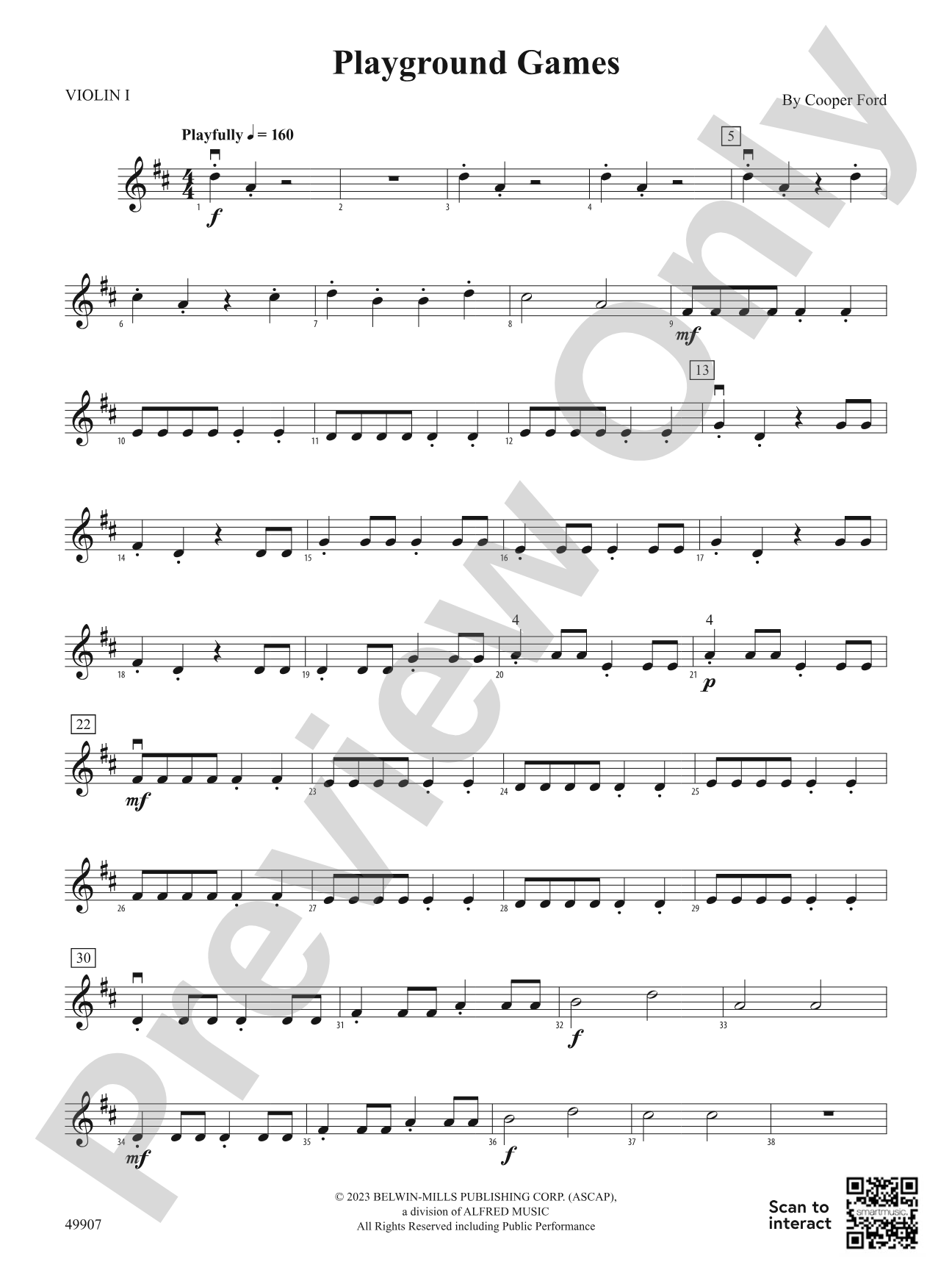

Playground Games: 1st Violin
By Cooper Ford
Grade: 1
Item: 00-PC-0018946_VN1
$3.00
Pickup currently not available
Description
Playgrounds are full of children having fun together. No matter their background, the laughter and shrieks of joy are the same as they run and play. Playground Games by Cooper Ford is a playful musical portrait of this experience. In the first section, the children gather for their game as the melody is supported by building rhythmic energy. The second section depicts another game in a round. Finally, it's time to go home, but only after one quick moment to finish! This piece uses only the notes of a D major scale and simple rhythms. Parts are doubled in second violin/viola and cello/bass. (2:00)


Don't just read it, hear it, play along with it, and watch your students grow with it. In MakeMusic Cloud, Playground Games: 1st Violin comes alive with professional accompaniment, adjustable tempo, and built-in practice tools that turn solo practice into real progress.
Open in the Player
Jump straight in and assign it today.
Start Your Free Trial
Open this title and explore the full library in minutes.
Sample Audio
1
Audio File
--:--
0:00
0:00
Sample Video
Additional Details
Series:
Belwin Beginning String Orchestra
Publisher:
Alfred Music
SKU:
00-PC-0018946_VN1
More about this title
About the Composer: Cooper Ford

Cooper Ford grew up in Chatham, New Jersey, where his school music teachers first encouraged him to pursue composition alongside his violin and trumpet studies. He holds a Bachelor of Music in Music Education from The College of New Jersey and a Master of Music in Music Education from the University of Florida. Ford currently serves as Orchestra Director at North Brunswick Township High School in New Jersey, where he also teaches Music Production. His experience includes conducting positions with the New Jersey Youth Symphony, working extensively with middle school orchestras, and he remains active as a guest conductor and clinician. He is a member of both the American String Teachers Association and the National Association for Music Education.
Ford's compositional voice reflects his deep engagement with string pedagogy and young musicians. His works prioritize accessibility without sacrificing musical substance, creating pieces that students find genuinely engaging while directors appreciate for their teaching value and performance appeal.
Why we love this
This piece captures something real about childhood without a trace of sentimentality. Ford's use of the D major scale and simple rhythms never feels reductive; instead, the clever doubling of parts and building energy in the opening section create genuine orchestral texture that beginning players feel proud to produce. The three-part arc (gathering, round game, quick finish) gives young orchestras a satisfying narrative arc to shape in rehearsal and performance.
What to expect
Sunlit and kinetic. The opening builds with the excited energy of children gathering, the round section introduces gentle complexity and dialogue between instrumental groups, and the whole piece radiates the unselfconscious joy of unstructured play. There's movement and bounce throughout without a single moment of pretense.
Who it's for
Beginning string orchestras at the elementary or early middle school level, particularly those working toward festival or contest performance. This piece works well for programs seeking repertoire that combines genuine musical interest with accessible technical demands, allowing young players to experience success with part independence and scalar facility.
How to get the most out of it
- Build the rhythmic energy gradually in the first section by having students listen to how their part either establishes or embellishes the pulse. The fun comes from the accumulation, not from rushing.
- Balance the melody and supporting voices in the second section's round. With doubled parts, you have flexibility to let one section shine while others provide harmonic anchor.
- Keep the final moment light and playful rather than precious. The energy should feel like recess ending on the students' own terms, not a formal conclusion.
How to use it
Schedule this as a spring concert opener to set an engaging, accessible tone for your audience while showcasing what your beginning orchestra can achieve. At roughly two minutes, it also works as a festival or contest piece that gives young players meaningful performance experience without fatigue. You might pair it with one or two other short Grade 1 selections to build a full concert program.
Skills your students will build
- Reading and intonating in D major (all white keys on violin and viola; one sharp on cello and bass)
- Playing with rhythmic independence within a larger ensemble texture
- Listening to and balancing with doubled parts
- Responding to musical phrasing and shaping energy through dynamics and tempo