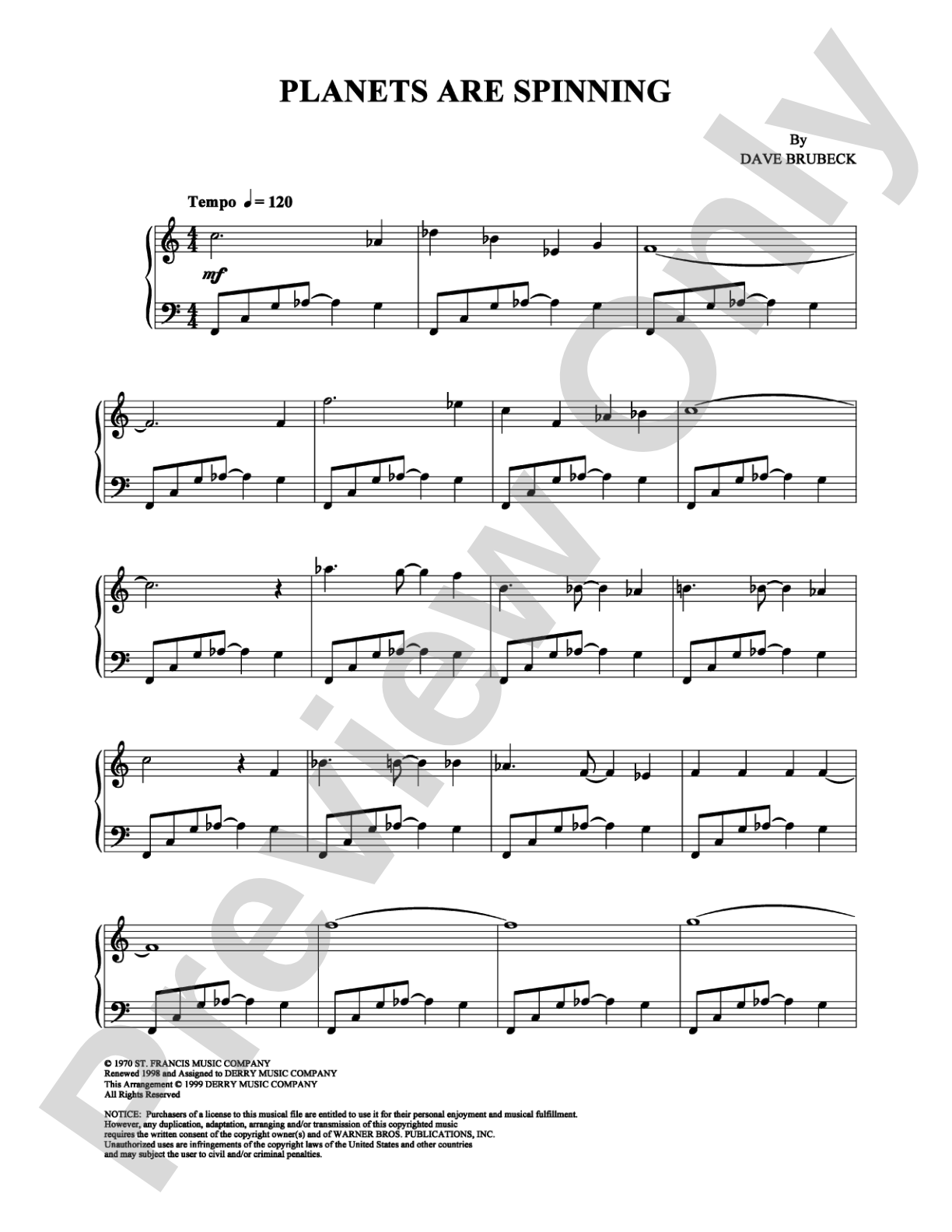
Planets Are Spinning: Piano Digital Sheet Music

Planets Are Spinning: Piano Digital Sheet Music

Dave Brubeck

Item: 00-PS-0001587

Digital Download
$3.99
Description

Planets Are Spinning: Piano Digital Sheet Music isn't in MakeMusic Cloud just yet...but it could be. Let us know you'd like to see it, and you'll help shape what comes next. In the meantime, start a free trial and dive into thousands of interactive titles your students can play along with today.

Sample Audio
No sample audio found.
Sample Video
Additional Details
SKU: 00-PS-0001587

More about this title

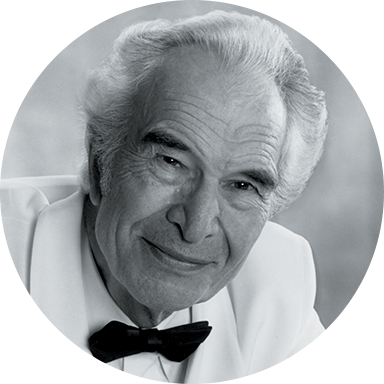
About the Artist: Dave Brubeck

Dave Brubeck

Dave Brubeck stands as one of jazz's most consequential figures, equally accomplished as an improviser and a disciplined composer. His output spans choral works, orchestral pieces, chamber music, and large-scale compositions for voices and ensemble; his 1959 album "Time Out" became the first jazz recording to sell over a million copies, anchored by the standard "Take Five." Beyond the bandstand, Brubeck championed racial integration in mid-century American jazz and earned the Presidential Medal of the Arts from President Clinton, a Grammy Lifetime Achievement Award, and induction into the American Classical Music Hall of Fame in 2003.

Brubeck studied composition with Darius Milhaud at Mills College after World War II, an encounter that shaped his lifelong synthesis of jazz vernacular and classical form. His sacred works, including the mass "To Hope!" and the oratorios "The Voice of the Holy Spirit" and "Beloved Son", have been recorded by major ensembles like the London Symphony Orchestra and performed internationally. His 1962 orchestral work "Elementals" inspired choreographer Lar Lubovitch's ballet, which continues in the San Francisco Ballet repertory.

Why we love this

Brubeck's solo piano writing draws directly from his improvisational practice, so these pieces carry real jazz vocabulary while remaining fully notated and accessible. This gives pianists an opportunity to explore jazz language through a composer's carefully crafted lens rather than starting from scratch with lead sheets. The blend of compositional rigor and jazz idiom makes for rewarding, genuine music-making.

What to expect

The piece carries the ease and forward motion of a musician thinking through problems at the keyboard, with an unhurried sophistication. Harmonic movement feels natural and inevitable rather than showy, and the melody unfolds with the kind of clarity that comes from seasoned ears.

Who it's for

This piece suits intermediate to advanced pianists exploring jazz repertoire and composers who want to study how a master improviser notates his own music. It works equally well for jazz pianists seeking repertoire with compositional depth and classical pianists curious about crossing into jazz language through trusted notation.

How to get the most out of it

  • Let the rhythmic momentum of the jazz phrasing breathe naturally; don't mechanically subdivide the beat.
  • Listen to Brubeck's own recordings to internalize how he voices chords and approaches the piano sonically.
  • Approach rubato and tempo flexibility as a jazz musician would, responding to the harmonic and melodic content rather than adhering to strict metronomic time.
  • Shape the dynamics across longer phrases rather than treating each measure as an isolated unit; the piece asks for linear, singing phrasing even within a jazz idiom.

How to use it

Feature this as a solo recital piece where you want to bridge classical and jazz audiences, or pair it alongside other twentieth-century piano works that experiment with genre. It works particularly well on a program exploring American composers or one focused on how classical training and jazz improvisation inform each other.

Skills your students will build

  • Interpreting jazz harmony and voice leading in notated form
  • Executing swing rhythm and jazz phrasing conventions
  • Balancing improvisational feel with compositional structure
  • Understanding chord substitution and reharmonization through observation of the score

You May Also Like