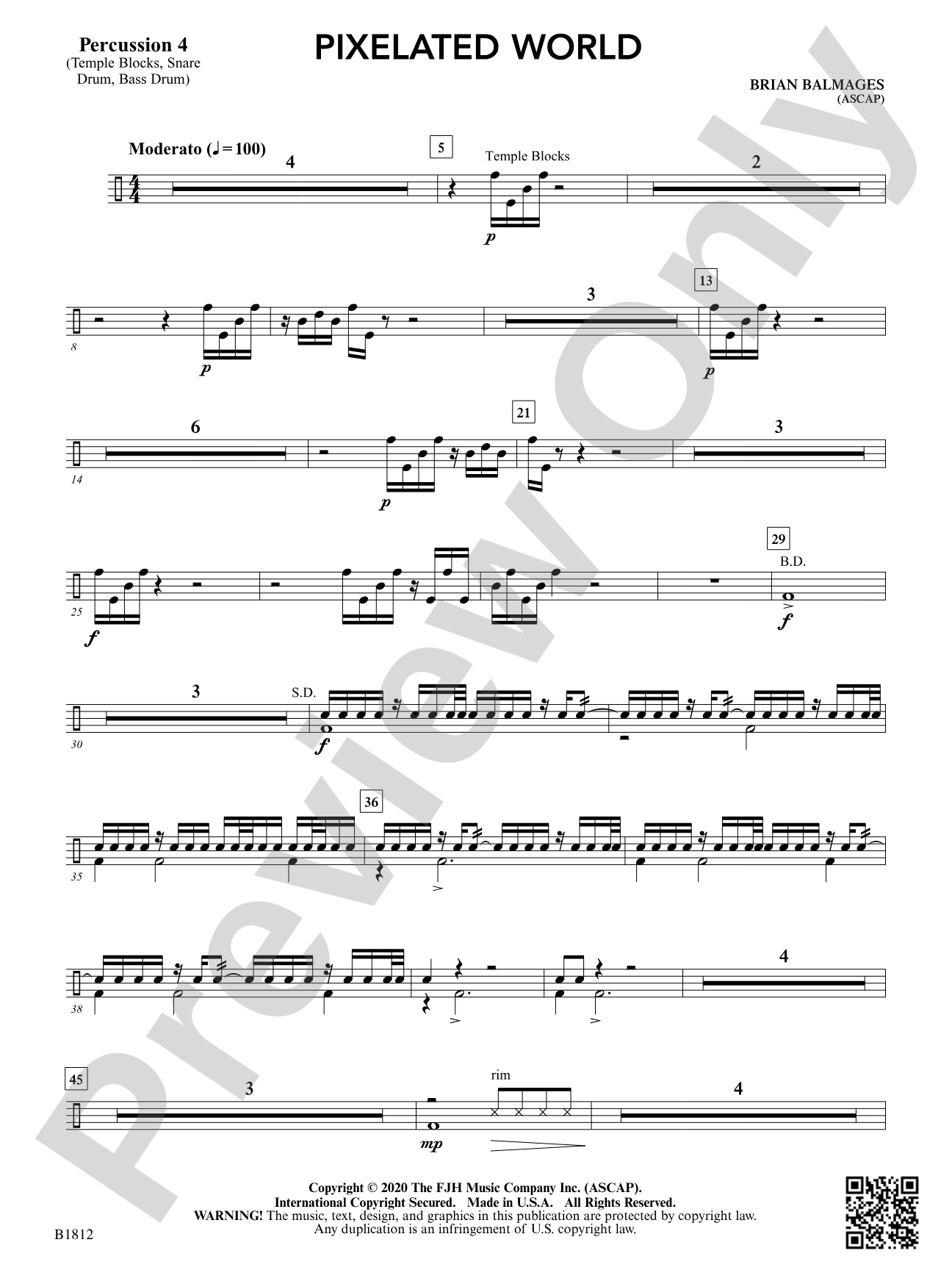
Pixelated World: Percussion 4 Sheet Music Preview

Pixelated World: Percussion 4

By Brian Balmages

Grade: 4

Item: 98-PC-DB1812_PC4

Digital Download
$7.00
Description
Tackle the complex issue of screen addiction with this intriguing work that contrasts the real world around us with the digital, pixelated world experienced through our devices. Powerful sections yield to softer, muted moments as the listener is pulled between actual and virtual realities. A powerful and thought-provoking piece that will surely stimulate discussions in your ensemble.

Pixelated World: Percussion 4 isn't in MakeMusic Cloud just yet...but it could be. Let us know you'd like to see it, and you'll help shape what comes next. In the meantime, start a free trial and dive into thousands of interactive titles your students can play along with today.

Sample Audio
0:00
0:00
Sample Video
Additional Details
Series: FJH Symphonic Band
Publisher: The FJH Music Company, Inc.
SKU: 98-PC-DB1812_PC4

More about this title

About the Composer: Brian Balmages

Brian Balmages

Brian Balmages has built a career composing across orchestral, band, and chamber idioms, with performances ranging from professional symphony orchestras to school ensembles in venues including Carnegie Hall, the Kennedy Center, and Sydney Opera House. His accolades include the A. Austin Harding Award from the American School Band Directors Association, the 2020 NBA William D. Revelli Composition Contest for Love and Light, and membership in the American Bandmasters Association. He received the inaugural James Madison University Distinguished Alumni Award and was later commissioned by the University of Miami to compose for the inauguration of its 6th president.

As a conductor, Balmages maintains active guest engagements with all-state ensembles, university groups, and professional orchestras worldwide. His conducting appearances span the Midwest Clinic, Western International Band Clinic, College Band Directors Conference, and international venues including Teatro dell'Aquila in Italy. He currently serves as Director of MakeMusic Publications and Digital Education for Alfred and MakeMusic.

Why we love this

Balmages constructs genuine musical contrast here, not surface-level program music. The piece earns its thematic tension through orchestration and harmonic language rather than gimmick, making it substantial enough for serious concert programming while remaining accessible to Grade 4 ensembles. The conceptual framework opens real conversations about technology and presence without feeling preachy.

What to expect

The piece oscillates between vivid, present musical moments and moments of digital remove, capturing the fractured attention that screen time creates. When the real world emerges, it feels immediate and grounded; when the pixelated world takes over, the sound becomes filtered and distant.

Who it's for

Band directors programming Grade 4 repertoire who want substantive contemporary music with intellectual weight. This score works for ensembles mature enough to engage with thematic contrast and willing to rehearse with intention around the piece's central idea.

How to get the most out of it

  • Shape the transitions between real and digital worlds deliberately. The pivot points between sections define the piece's argument, so mark them clearly in rehearsal and let the ensemble hear how the orchestration shifts.
  • Balance texture over dynamics in the softer sections. Muted sonorities need precise articulation and part independence to register; avoid the temptation to simply play quietly.
  • Establish a steady, confident pulse during the powerful sections. These moments anchor the piece and make the contrasts more effective.

How to use it

Program this as a centerpiece for a concert exploring technology, identity, or social commentary in music. It pairs well with both contemporary and classical works, providing a modern anchor that prompts post-concert discussion without requiring additional context or narration.

Skills your students will build

  • Navigating contrasting textures and orchestration colors
  • Executing precise, intentional transitions between distinct musical sections
  • Balancing independent parts in ensemble texture
  • Interpreting and performing muted/special effects articulations
  • Sustaining ensemble focus through rapid compositional mood shifts

You May Also Like