
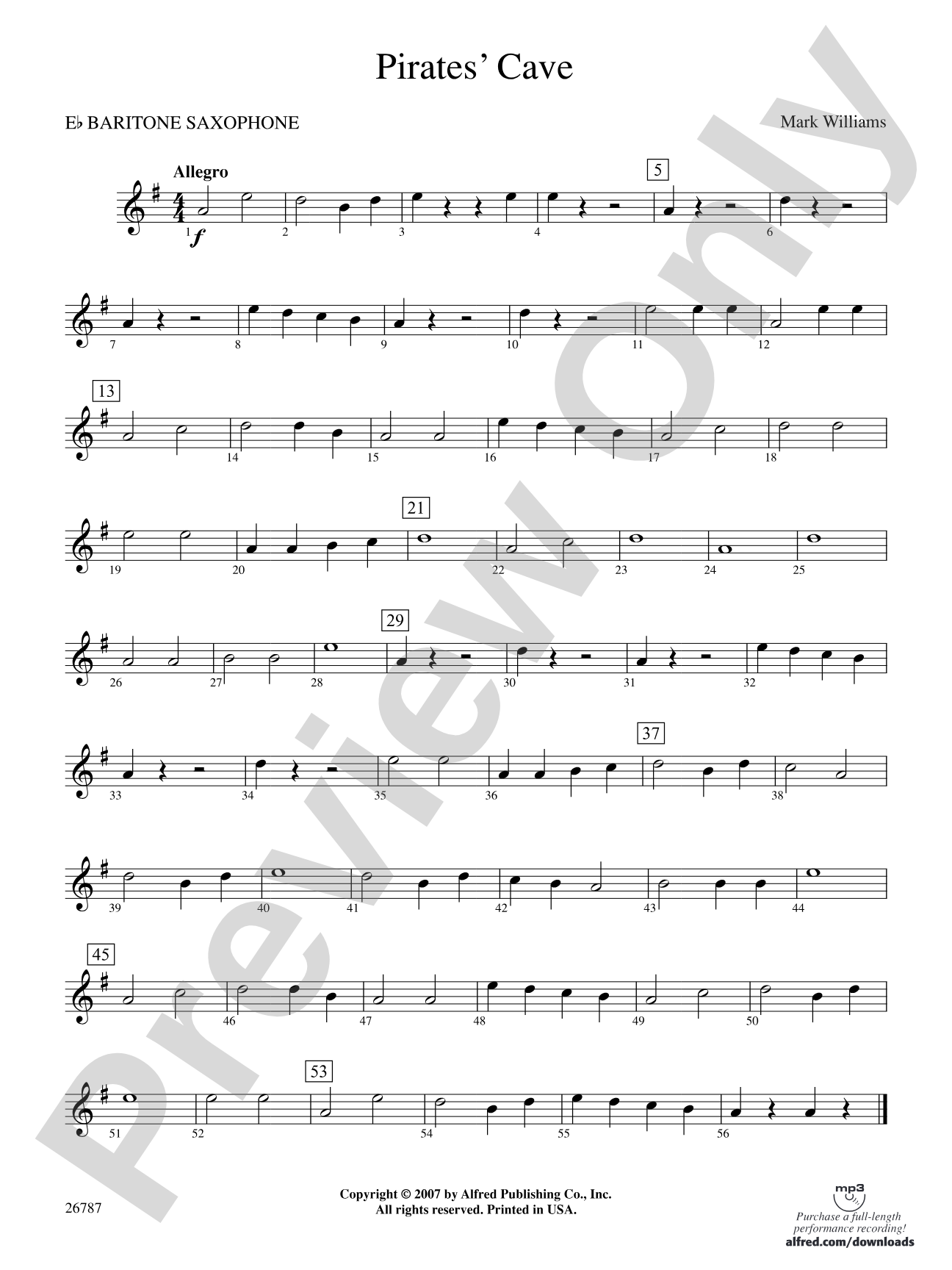

Pirates' Cave: E-flat Baritone Saxophone
By Mark Williams
Grade: 0.5 (Very Easy)
Item: 00-PC-0001225_BTX
$3.00
Pickup currently not available
Description
Tales of swashbuckling pirates and this musical depiction of the pirates' secret hideout are sure to be a hit with your students. Using only the first 7 notes taught, with no rhythms faster than a quarter-note (eighth-notes in the snare drum), this is perfect for that first-year concert.
Correlates with Accent on Achievement Book 1, page 13. This title is available in MakeMusic Cloud.


Correlates with Accent on Achievement Book 1, page 13. This title is available in MakeMusic Cloud.
Don't just read it, hear it, play along with it, and watch your students grow with it. In MakeMusic Cloud, Pirates' Cave: E-flat Baritone Saxophone comes alive with professional accompaniment, adjustable tempo, and built-in practice tools that turn solo practice into real progress.
Open in the Player
Jump straight in and assign it today.
Start Your Free Trial
Open this title and explore the full library in minutes.
Sample Audio
1
Audio File
--:--
0:00
0:00
Sample Video
Additional Details
Series:
Accent on Achievement
Publisher:
Alfred Music
Page Count:
60
SKU:
00-PC-0001225_BTX
More about this title
About the Composer: Mark Williams

Mark Williams built his reputation as a composer and clinician who understood what young musicians needed to play and learn. A prolific writer with over 200 published works for band, orchestra, and choir, he authored the Accent on Achievement Band Method alongside his compositional output. His expertise in elementary band pedagogy came from years teaching in Washington state schools, where he shaped curricula and repertoire for developing ensembles.
Williams traveled extensively as a guest conductor and clinician across 34 states, 5 Canadian provinces, and Australia, sharing his approach to accessible, engaging band music. He earned recognition from the Western International Band Clinic's Gralia Competition and multiple ASCAP Special Awards. Beyond the page, Williams performed bassoon professionally and served as conductor and artistic director for the Spokane British Brass Band, bringing his dual expertise in composition and performance to every role he held.
Why we love this
This piece does exactly what a first-concert selection should do: it builds confidence without overwhelming inexperienced players. Williams' constraint of using only the first seven taught notes creates instant success, and the absence of rhythms faster than quarter notes (except snare drum) means your students can focus on intonation, blend, and ensemble listening without technical scrambling. The thematic connection to a pirates' hideout gives the piece narrative and character that young musicians actually care about performing.
What to expect
A swashbuckling adventure that captures the intrigue and mystery of a secret hideout without demanding virtuosity. The limited harmonic and melodic palette creates cohesion and clarity, allowing the narrative of pirates and hidden treasure to shine through accessible, confident playing.
Who it's for
First-year concert band students ready to perform their first public concert or festival. This is the piece for that group still navigating the early pages of a method book who need repertoire that matches their technical reality while giving them a genuine performance experience.
How to get the most out of it
- Establish a steady pulse early in rehearsals and lock the rhythm section (bass drum and snare) before layering the melodic voices; younger bands settle faster when percussion anchors the tempo.
- Balance the full band carefully since limited pitch variety means exposed lines stand out immediately; use sectional rehearsals to ensure no single instrument overwhelms the texture.
- Encourage players to listen across the band rather than down at their own part; young musicians often play in isolation, and ensemble awareness transforms this from functional to musical.
- Build suspenseful dynamics and character through articulation and phrasing rather than complexity; a mysterious pirates' theme depends on attitude as much as notes.
How to use it
Open a first-concert program with this piece to establish your ensemble's musicality and poise before programming slightly more complex selections. It also serves beautifully as a confidence builder within the concert itself, or as a festival entry that showcases young musicians' fundamentals without overreaching their ability. The direct correlation to Accent on Achievement Book 1, page 13, means it can anchor a rehearsal cycle within your method book study.
Skills your students will build
- Reading treble and bass clefs with the first seven notes of each
- Maintaining steady tempo in concert band ensemble context
- Listening for balance and blend across sections
- Responding to articulation and phrasing as expressive tools
- Performing with awareness of ensemble sound rather than individual part