Pirate's Tarantella Sheet Music Preview

Pirate's Tarantella: Piano

By Catherine Rollin

Level: Late Elementary

Item: 00-PS-0017740

Digital Download
$3.50
Description
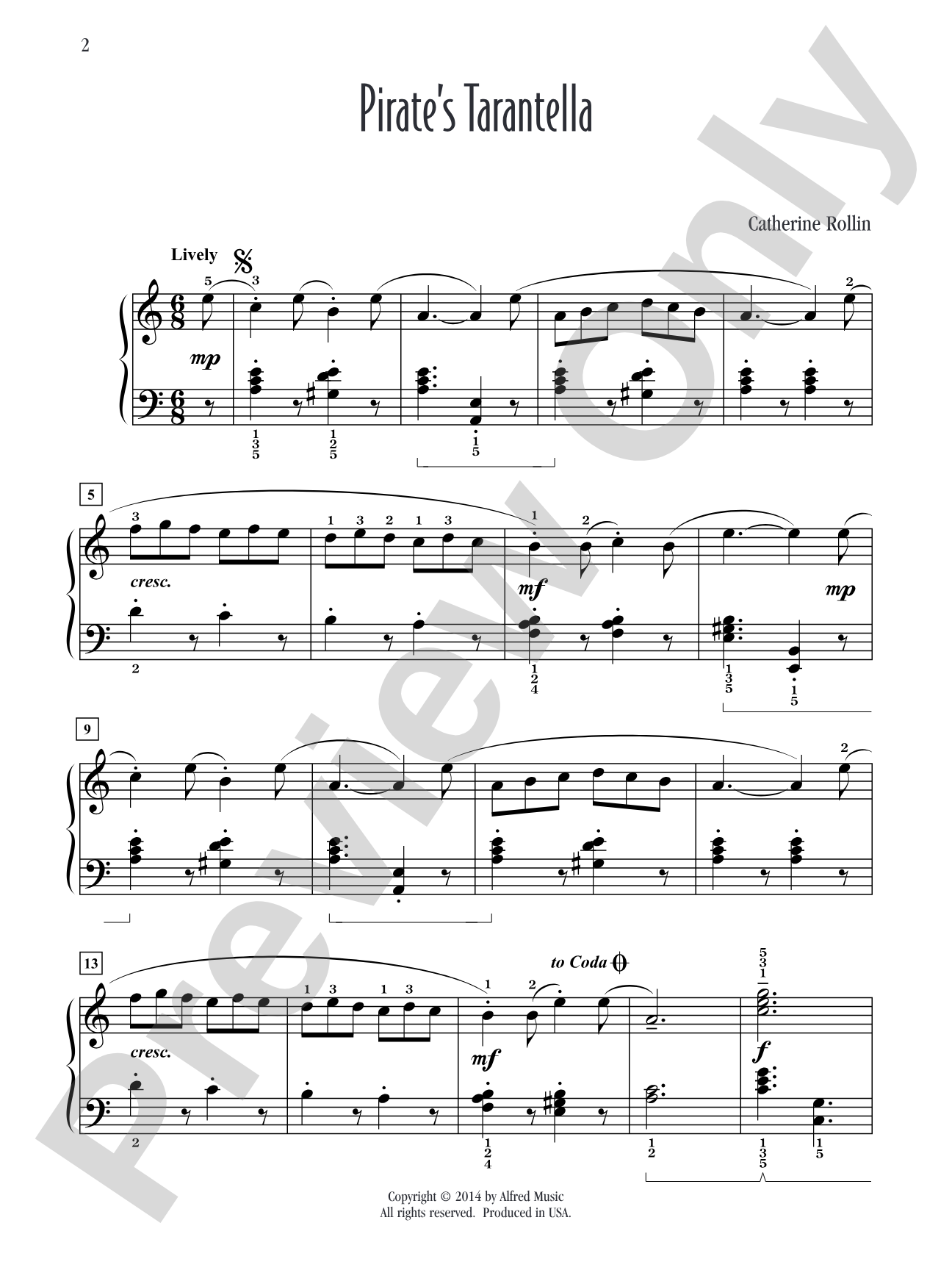
Catherine Rollin has created a bold and lively pirate's dance in this fun-filled solo. The key of A minor sets the proper "pirate mood", and the quick 6/8 meter is perfect for a spirited dance. The running eighth-note melody shows off agile fingers, and the majestic chords in the middle section add an exciting contrast in this A-B-A form. A Federation Festivals 2016-2020 selection.

Pirate's Tarantella: Piano isn't in MakeMusic Cloud just yet...but it could be. Let us know you'd like to see it, and you'll help shape what comes next. In the meantime, start a free trial and dive into thousands of interactive titles your students can play along with today.

Sample Audio
No sample audio found.
Sample Video
Additional Details
Series: Signature Series
Publisher: Alfred Music
Page Count: 4
SKU: 00-PS-0017740

More about this title

About the Composer: Catherine Rollin

Catherine Rollin

Catherine Rollin balances an active composing practice with mentoring accomplished students and performing across North America and Asia. She holds degrees from the University of Michigan and Oakland University School of Performing Arts, and her compositions have earned commissions from Clavier Companion, the Music Teachers National Association (MTNA), and the Michigan Music Teachers Association, with many selections appearing in the National Federation of Music Clubs Festivals Bulletin.

Rollin's work carries significant recognition within the music education and professional communities. She has adjudicated national-level competitions for MTNA and served on the panel for the Lynn Freeman Olson Composition Contest. Her ASCAP award-winning series "Museum Masterpieces" (Books 1-4) received a multimedia presentation by the Steinway Society in 2018, and her commissioned trio "Suite Detroit" for flute, alto saxophone, and piano premiered at the MTNA 2018 national conference.

Why we love this

Rollin has crafted a piece that feels narrative and theatrical without sacrificing solid pedagogy. The A-B-A structure gives students a satisfying arc to learn and perform, while the A minor key and 6/8 meter create authentic character that engages young pianists far beyond a typical etude.

What to expect

A swashbuckling adventure on the keyboard. The quick 6/8 meter propels you forward like a ship at sail, while running passages mirror the swiftness of a sword fight. The dramatic chords in the middle section anchor you in a moment of power and triumph before the dance returns.

Who it's for

Late elementary pianists ready to play with character and style. This piece suits students who can execute even sixteenth-note passages cleanly and grasp sectional form, but who still thrive on repertoire with a strong narrative hook and playful energy.

How to get the most out of it

  • Shape the running eighth-note passages with clear articulation and even spacing; think of the notes as individual sword strokes rather than a blur of motion.
  • Balance the majestic chords in the B section so they sit above the accompaniment without swallowing the overall texture.
  • Emphasize the return to the A section as a dramatic moment; reestablish the liveliness and forward momentum after the contrasting middle.
  • Let the 6/8 meter breathe as a dance rhythm with natural pulse points on each beat rather than driving through in eighth notes.

How to use it

This works beautifully as a recital opener or closer, especially alongside other character pieces. Its theatrical quality also makes it an excellent selection for student festivals where engaging performance and musical storytelling matter as much as technical precision.

Skills your students will build

  • Executing running eighth-note passages with evenness and clarity in 6/8 meter
  • Reading and playing in A minor with confident key signature navigation
  • Recognizing and performing A-B-A form with intentional contrasts between sections
  • Building hand independence between a rhythmic left hand and melodic right hand
  • Sustaining musical character and tempo integrity through repetitive rhythmic figures

You May Also Like