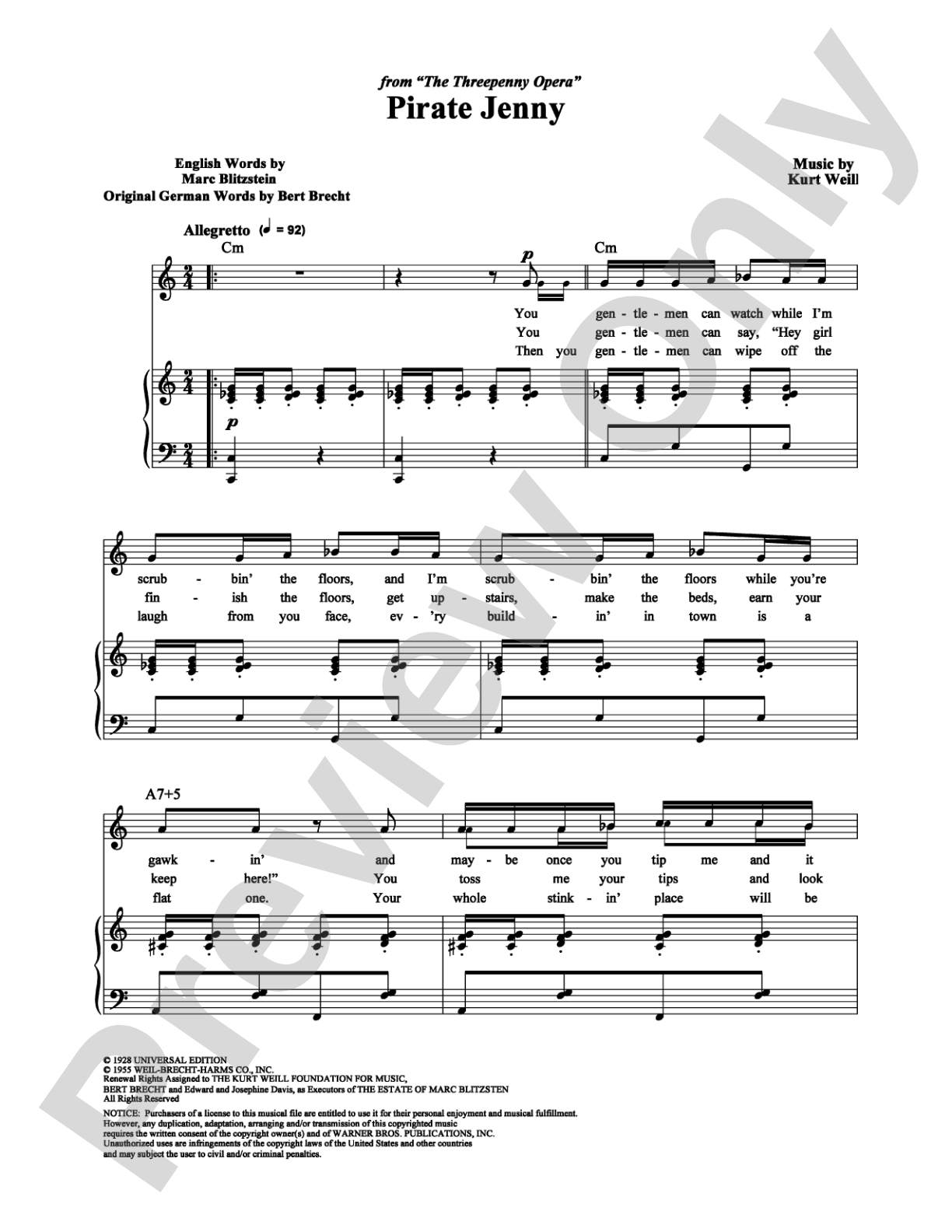
Pirate Jenny: Piano/Vocal/Chords Digital Sheet Music

Pirate Jenny: Piano/Vocal/Chords Digital Sheet Music

Kurt Weill, Lotte Lenya

Item: 00-PS-0004454

Digital Download
$3.99
Description

Pirate Jenny: Piano/Vocal/Chords Digital Sheet Music isn't in MakeMusic Cloud just yet...but it could be. Let us know you'd like to see it, and you'll help shape what comes next. In the meantime, start a free trial and dive into thousands of interactive titles your students can play along with today.

Sample Audio
No sample audio found.
Sample Video
Additional Details
SKU: 00-PS-0004454

More about this title

About the Artist: Lotte Lenya

Lotte Lenya (1898, 1981) was an Austrian-American performer and actress whose interpretations of Kurt Weill's work became definitive. She created the role of Jenny in the original 1928 Berlin production of Die Dreigroschenoper (The Threepenny Opera), delivering a performance that combined theatrical presence with a distinctive vocal approach that prioritized text and character over conventional beauty of tone.

Lenya's partnership with composer Kurt Weill shaped how generations of musicians understand early 20th-century German musical theater. Her recordings and live performances established a model for interpreting this repertoire: clear diction, emotional directness, and an understanding that the music serves the story rather than overshadowing it. For educators, her work demonstrates how a performer's choices can clarify a composer's intentions and make complex material accessible to audiences.

Why we love this

This is the song as Lenya sang it—gritty, sharp-edged, and dramatically uncompromising. Her interpretation refuses sentimentality; instead, it leans into the song's biting social commentary and dark humor. For any director seeking to understand how Weill's music operates as drama rather than decoration, this performance and score are indispensable references.

What to expect

Darkly comic yet menacing. The music sways between intimate confessions and moments of bitter, fantasized violence. There's an unsettling beauty here: Weill pairs unsettling minor harmonies with almost ballad-like simplicity, creating a sound that feels both vulnerable and caustic.

Who it's for

Singers performing Threepenny Opera, music theater students studying Weill, and classical vocalists exploring 20th-century art song repertoire. This score is also valuable for choral directors and coaches seeking touchstones for how Brecht-Weill style shapes character interpretation.

How to get the most out of it

  • Study Lenya's phrasing and diction on the original recording; notice how she delays notes, clips syllables, and treats rhythm conversationally rather than metrically. The piano/vocal score captures notation, but her interpretation teaches you where the drama lives.
  • Approach the character voice as spoken-sung hybrid. Weill writes angular, irregular melodic lines intentionally; resist smoothing them into traditional legit phrasing. The awkwardness is the point.
  • Balance the piano texture carefully so it doesn't overshadow the voice. This is intimate storytelling, not grand statement. The accompaniment should feel like it's conspiring with the singer.
  • Commit fully to the lyrical content. 'Pirate Jenny' is a revenge fantasy set to music. Without genuine emotional investment in the character's rage and defiance, the number falls flat.

How to use it

Program this as a solo cabaret piece in recital, or as part of a music theater survey concert exploring early 20th-century theatrical song. It works powerfully alongside other Weill vocal scores in an art song recital focused on character and social commentary. For teaching purposes, pair it with the Lenya recording to model how singers make text and dramatic intention visible through music.

Skills your students will build

  • Handling irregular phrase lengths and angular melodic contours
  • Integrating spoken and sung delivery within a continuous line
  • Reading and performing piano/vocal scores with accurate chord notation
  • Building character motivation from lyrical content and harmonic choices
  • Managing rhythmic independence between vocal and piano lines

You May Also Like