
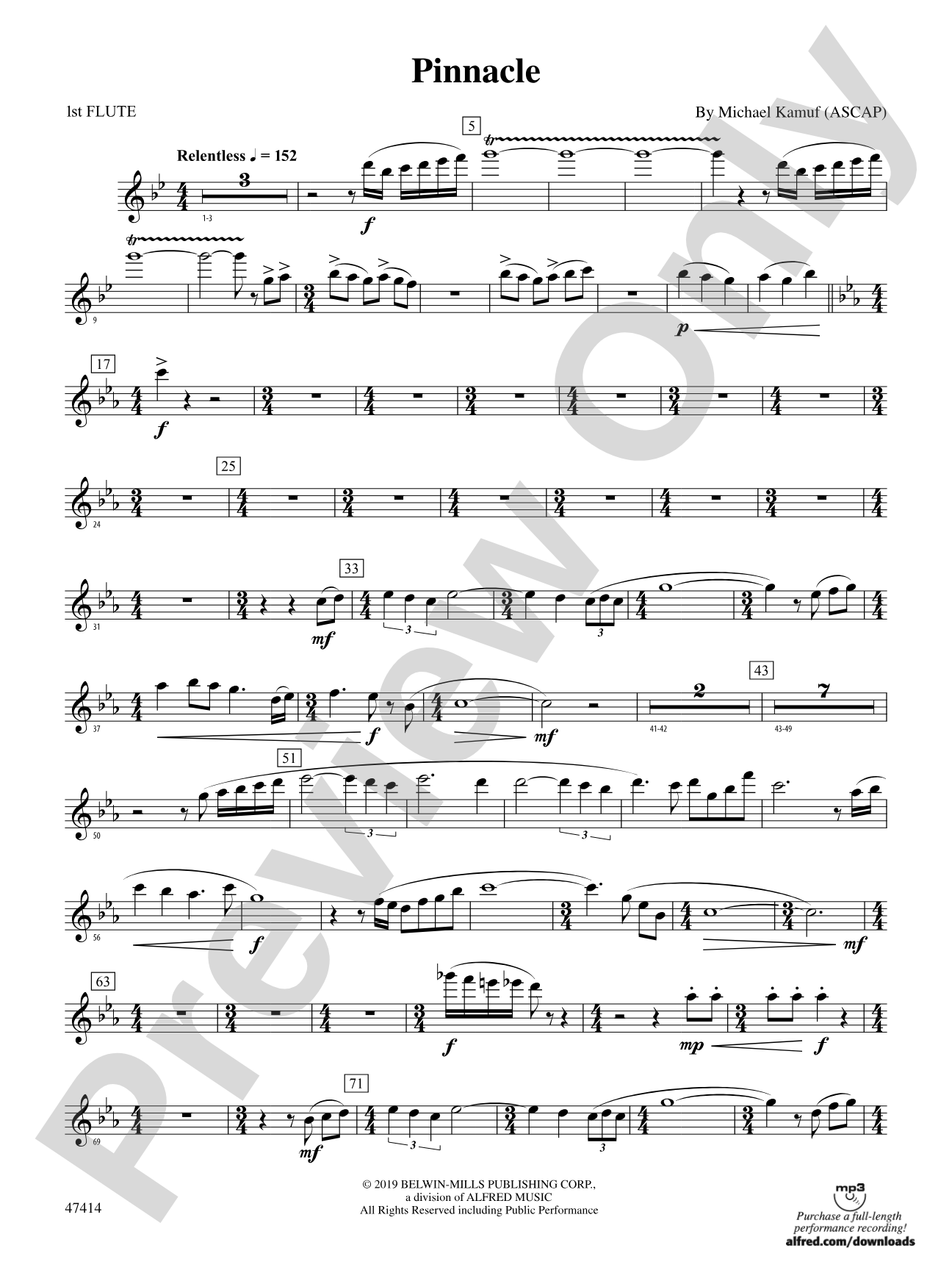

Pinnacle: Flute
By Michael Kamuf
Grade: 3 (Medium Easy)
Item: 00-PC-0017946_F1
$5.99
Pickup currently not available
Description
This bold and exhilarating original work for concert band combines mixed meters, lyrical themes, and powerful harmonies, taking your musicians and audiences on a thrilling musical journey. The compelling, energetic grooves in the alternating 3/4 and 4/4 sections look and sound complex, but are repetitive and easily mastered. Perfect as a concert or festival opener or closer! (3:45)


Don't just read it, hear it, play along with it, and watch your students grow with it. In MakeMusic Cloud, Pinnacle: Flute comes alive with professional accompaniment, adjustable tempo, and built-in practice tools that turn solo practice into real progress.
Open in the Player
Jump straight in and assign it today.
Start Your Free Trial
Open this title and explore the full library in minutes.
Sample Audio
1
Audio File
--:--
0:00
0:00
Sample Video
Additional Details
Series:
Belwin Concert Band
Publisher:
Alfred Music
Page Count:
280
SKU:
00-PC-0017946_F1
More about this title
About the Composer: Michael Kamuf

Michael Kamuf earned degrees in Jazz Performance and Music Education from Youngstown State University's Dana School of Music, followed by a Master of Arts in Instrumental Conducting from George Mason University. His compositions and arrangements have been performed by prestigious ensembles including the Woody Herman Orchestra, Glenn Miller Orchestra, USAF Airmen of Note, and US Navy Commodores, as well as by accomplished soloists such as James Moody, Eddie Daniels, and Sean Jones.
Kamuf has been an exclusive writer for Belwin/Alfred Music Publishing across their jazz, orchestra, and concert band catalogs, with over 100 published works in print. His jazz ensemble arrangements have become standard repertoire for young musicians, published by UNC Jazz Press, Neil A. Kjos Music, and FJH Music Company. He taught instrumental music for Montgomery County Public Schools in Maryland for three decades, serving twenty-seven years as Director of Bands and Orchestras and Music Department Chairperson at John T. Baker Middle School, where he led ensembles to consistent festival recognition and commissioned multiple works for young concert bands. Kamuf currently leads the Mike Kamuf Little Big Band, a jazz octet based in the Baltimore and Washington, DC region.
Why we love this
Kamuf has written a piece that sounds far more intricate than its Grade 3 scoring suggests. The alternating 3/4 and 4/4 meters create genuine rhythmic interest without requiring your ensemble to grapple with complex subdivision; the repetitive grooves sit comfortably in the fingers and ears. It's the kind of opener or closer that energizes both your musicians and your audience without eating up rehearsal time on metric confusion.
What to expect
Pinnacle pulses with driving rhythmic vitality and bold harmonic colors. Beneath the energetic grooves sit lyrical passages that breathe and reflect, creating dynamic contrast that keeps the piece from becoming one-dimensional. The whole arc feels purposeful and shaped, like a confident opening statement or a striking closing gesture.
Who it's for
Directors programming Grade 2-4 concert bands who want repertoire with contemporary energy and metric sophistication that doesn't derail rehearsal planning. Your musicians will experience the satisfaction of mastering mixed meters without the grinding repetition that often accompanies that skill work, and your audiences will hear a piece that feels polished and intentional.
How to get the most out of it
- Lock the rhythmic foundation early by drilling the alternating meter patterns in isolation. Sectional rehearsals on just the groove sections (before the lyrical material enters) will accelerate ensemble confidence.
- Balance the powerful harmonies against the lyrical themes by shaping dynamic contours through the chord progressions rather than playing every section at full volume.
- Lean into the groove language of this work. The repetitive figures benefit from the kind of rhythmic precision and pocket awareness you'd bring to a jazz chart, even in a concert band setting.
- Use the conductor score to map out where harmonic color shifts, so you can guide the ensemble toward tonal clarity when new sonorities appear alongside the established rhythmic patterns.
How to use it
This work functions beautifully as either a concert opener (its exhilarating energy sets an engaging tone) or as a finale (its compositional satisfaction and festival appeal make it a strong closing statement). It also serves well in festival rotation, where its brevity (3:45), Grade 3 accessibility, and metric sophistication position it as a strong contest or adjudicated performance piece.
Skills your students will build
- Reading and executing alternating 3/4 and 4/4 meters within repeating groove patterns
- Responding to harmonic color changes and tonal shifts while maintaining rhythmic precision
- Balancing lyrical phrasing against groove-based accompaniment figures
- Developing rhythmic pocket awareness and ensemble groove cohesion in a concert band setting