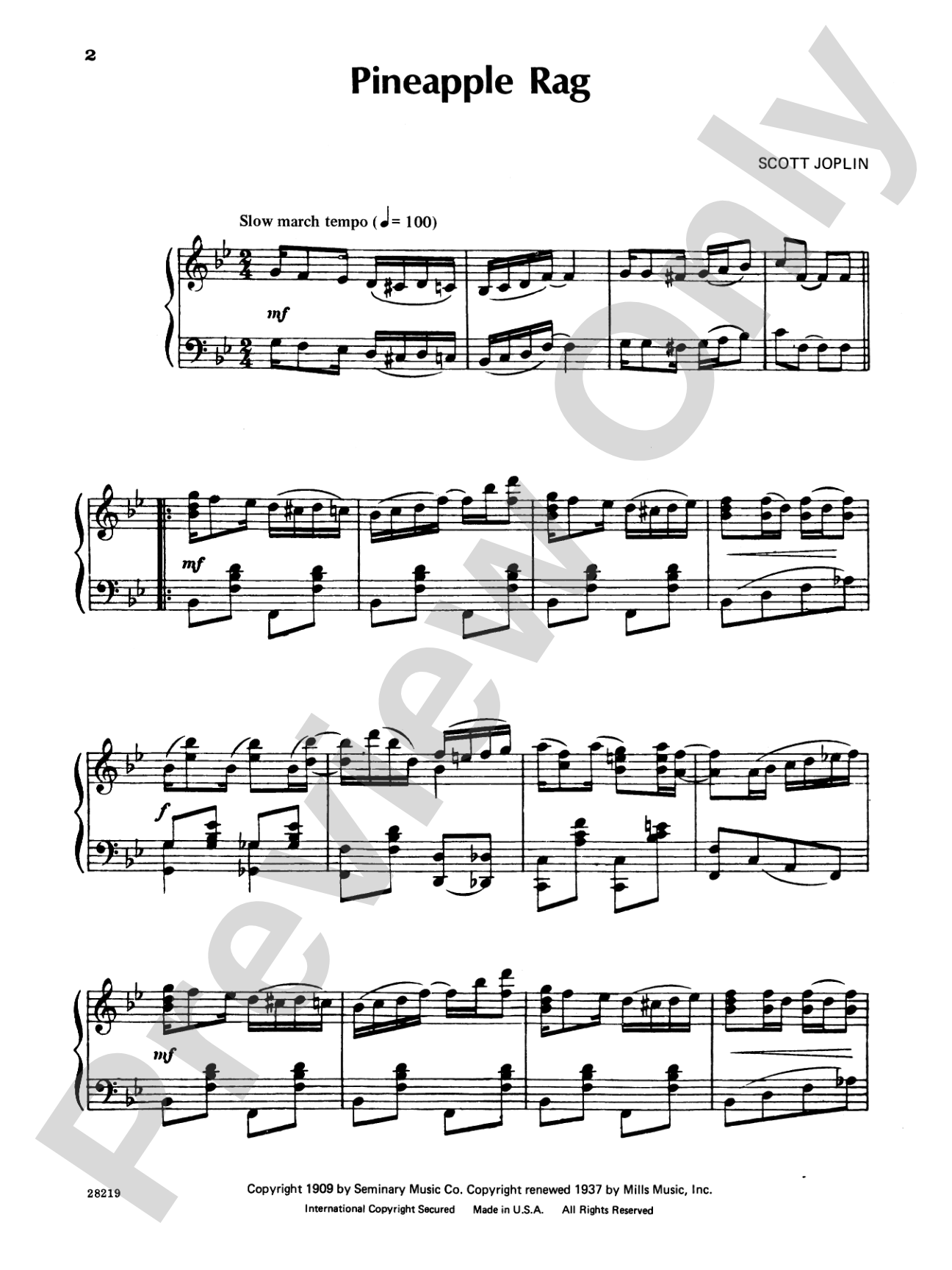
Pineapple Rag (from The Sting) - Piano Solo Sheet Music Preview

Pineapple Rag (from The Sting) - Piano Solo: Piano

By Scott Joplin

Level: Late Intermediate

Item: 00-PB-0000792

Digital Download
$3.99
Description
A popular ragtime piano piece by Scott Joplin, also featured in the 1973 Academy Award winning movie, The Sting. A Federation Festivals 2016-2020 selection. A Federation Festivals 2020-2024 selection. A Federation Festivals 2024-2028 selection.

Pineapple Rag (from The Sting) - Piano Solo: Piano isn't in MakeMusic Cloud just yet...but it could be. Let us know you'd like to see it, and you'll help shape what comes next. In the meantime, start a free trial and dive into thousands of interactive titles your students can play along with today.

Sample Audio

Pineapple Rag

0:00
0:00
Sample Video
Additional Details
Publisher: Alfred Music
Page Count: 6
SKU: 00-PB-0000792

More about this title

About the Composer: Scott Joplin

Scott Joplin (1868-1917) stands as the preeminent composer of American ragtime and one of the most influential keyboard composers in U.S. history. His systematic approach to ragtime composition elevated the genre from popular entertainment to concert music, and his works remain central to piano pedagogy and performance. Joplin's compositions, including "Maple Leaf Rag" and "The Entertainer," are studied by pianists across all levels and continue to define how musicians understand syncopation, stride technique, and American musical identity.

Why we love this

Pineapple Rag sits at that rare sweet spot where technical rigor and infectious joy coexist. The syncopation demands precision and independence between hands, but the driving rhythmic energy makes students want to nail it rather than grind through it. Its featured role in The Sting gives it cultural weight that motivates practice while introducing late intermediate pianists to a cornerstone of American musical tradition.

What to expect

Pineapple Rag bounces with unstoppable energy, its syncopated melody dancing above a propulsive stride bass that never lets up. The piece has a buoyant, slightly playful character that evokes both the ragtime salon and the film's clever caper storytelling. Each phrase unfolds with clear rhythmic personality, making it deeply satisfying to perform once the technical foundations are secure.

Who it's for

Late intermediate pianists preparing for festival competitions, recitals, or simply wanting to engage with a repertoire staple that rewards both technical work and musical expression. This piece serves students ready to manage syncopation and hand independence without the virtuosic demands of early advanced literature.

How to get the most out of it

  • Establish a steady left-hand pulse before adding the syncopated right-hand figures. The stride bass patterns must be metronomically consistent so the syncopation reads clearly.
  • Practice the syncopated passages hands separately at a slower tempo, then gradually increase speed while maintaining articulation. Ragtime loses its character if notes blur together.
  • Shape the piece into distinct sections with subtle tempo and dynamic changes. Ragtime thrives on forward momentum, but each strain should feel like a fresh idea rather than repetition.
  • Listen to period recordings and contemporary performances to internalize the style. Ragtime swing and articulation are heard, not written.

How to use it

Program this alongside other American ragtime works for a concert devoted to popular piano classics, or feature it on a mixed recital where it provides stylistic contrast to Romantic or Contemporary pieces. It also works beautifully as a statement closer, leaving audiences with upbeat energy and a piece many recognize from film.

Skills your students will build

  • Syncopation and rhythmic independence between hands
  • Stride bass technique and left-hand coordination
  • Ragtime articulation and swing feel
  • Maintaining consistent tempo through complex rhythmic figures
  • Pedal control in syncopated passages
  • Stylistic interpretation and historical context awareness

You May Also Like