
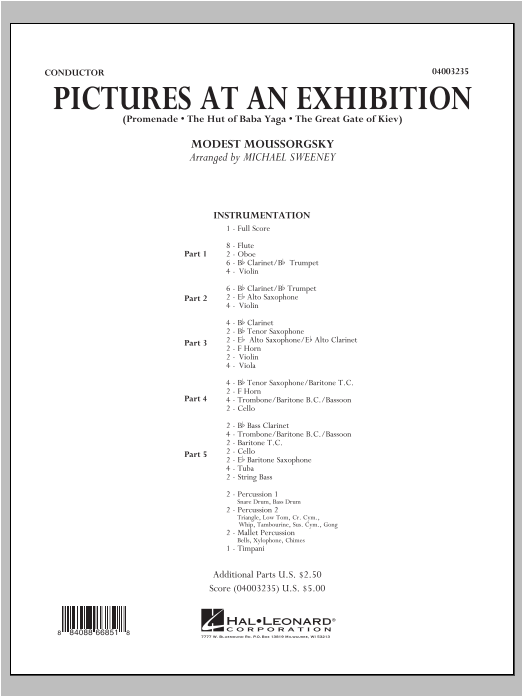

Pictures At An Exhibition (Excerpts): Flex Ensemble Conductor Score & Parts
By Modest Moussorgsky / Arranged by Michael Sweeney
Grade: 2-3
Item: 35-PK00247676
$65.00
Pickup currently not available
Buy Extra Parts (Digital PDF Download)
Parts Added to Cart!
Description
Even using the reduced instrumentation inherent in the Flex-Band format, Michael brings the power and excitement of the original in this authentic-sounding arrangement for inexperienced players. Includes: "Promenade, The Hut of Baba Yaga" and "The Great Gate of Kiev".Dur: 3:30


Pictures At An Exhibition (Excerpts): Flex Ensemble Conductor Score & Parts isn't in MakeMusic Cloud just yet...but it could be. Let us know you'd like to see it, and you'll help shape what comes next. In the meantime, start a free trial and dive into thousands of interactive titles your students can play along with today.
Request This Title
Tell us you want it.
Start Your Free Trial
Explore everything that's ready to play right now.
Sample Audio
No sample audio found.
Sample Video
No sample videos found.
Additional Details
Publisher:
Hal Leonard
SKU:
35-PK00247676
More about this title
About the Composer: Modest Moussorgsky
Modest Moussorgsky (1839–1881) was a Russian composer who fundamentally changed what orchestral music could express. Working largely outside formal conservatory training, he composed with raw emotional honesty and a keen ear for orchestral color. His masterpiece Pictures at an Exhibition emerged from a deeply personal place: a memorial to his friend Viktor Hartmann, paired with Moussorgsky's own visceral responses to Hartmann's paintings and drawings.
For music educators, Moussorgsky matters because he proved that dramatic power comes from clear musical ideas, not complexity. His melodies and harmonies are bold enough to grab listeners instantly. Every section of Pictures at an Exhibition tells a story through music alone, making it an ideal gateway work for young musicians learning how a composer builds mood and tension.
Why we love this
Michael Sweeney has preserved the visceral drama of these three movements while making them genuinely playable for a mixed ensemble with limited experience. The orchestration sings across Flex Band instrumentation without shortcuts that strip away character. Students encounter real compositional architecture here, not a watered-down approximation.
What to expect
Opening with the familiar Promenade creates immediate engagement, as listeners recognize themselves among the exhibition. The Baba Yaga movement jolts in with grotesque energy and unsettling harmonies. The finale swells into something grand and ceremonial, leaving the group and audience with a sense of having witnessed something substantial.
Who it's for
Grade 2 and 3 ensembles ready to move beyond simplified folk arrangements into genuine art music. Your students need enough security with rhythmic reading and ensemble balance to handle three distinct movements, but not advanced technique.
How to get the most out of it
- Balance the famous Promenade opening so the melody cuts through harmonic accompaniment. The tune drives the momentum; everything else supports it.
- Shape The Hut of Baba Yaga with clear dynamic contrast between the grotesque theme and quieter passages. This movement lives in extremes.
- Ground The Great Gate of Kiev with a solid, unhurried tempo. Rushing diminishes the grandeur that makes this finale land.
How to use it
This works beautifully as the anchor to a program built around art music inspiration or cultural narratives. Pair it with shorter pieces that share either Russian heritage or story-driven compositional approaches. The three-movement arc also suits a concert midpoint where you want to reclaim focus after lighter opening material.
Skills your students will build
- Sustaining tension and momentum across multi-movement forms
- Responding to frequent meter and key changes
- Balancing melody against harmonic texture
- Interpreting dynamic extremes that define character
- Reading and executing Russian-influenced harmonic language