
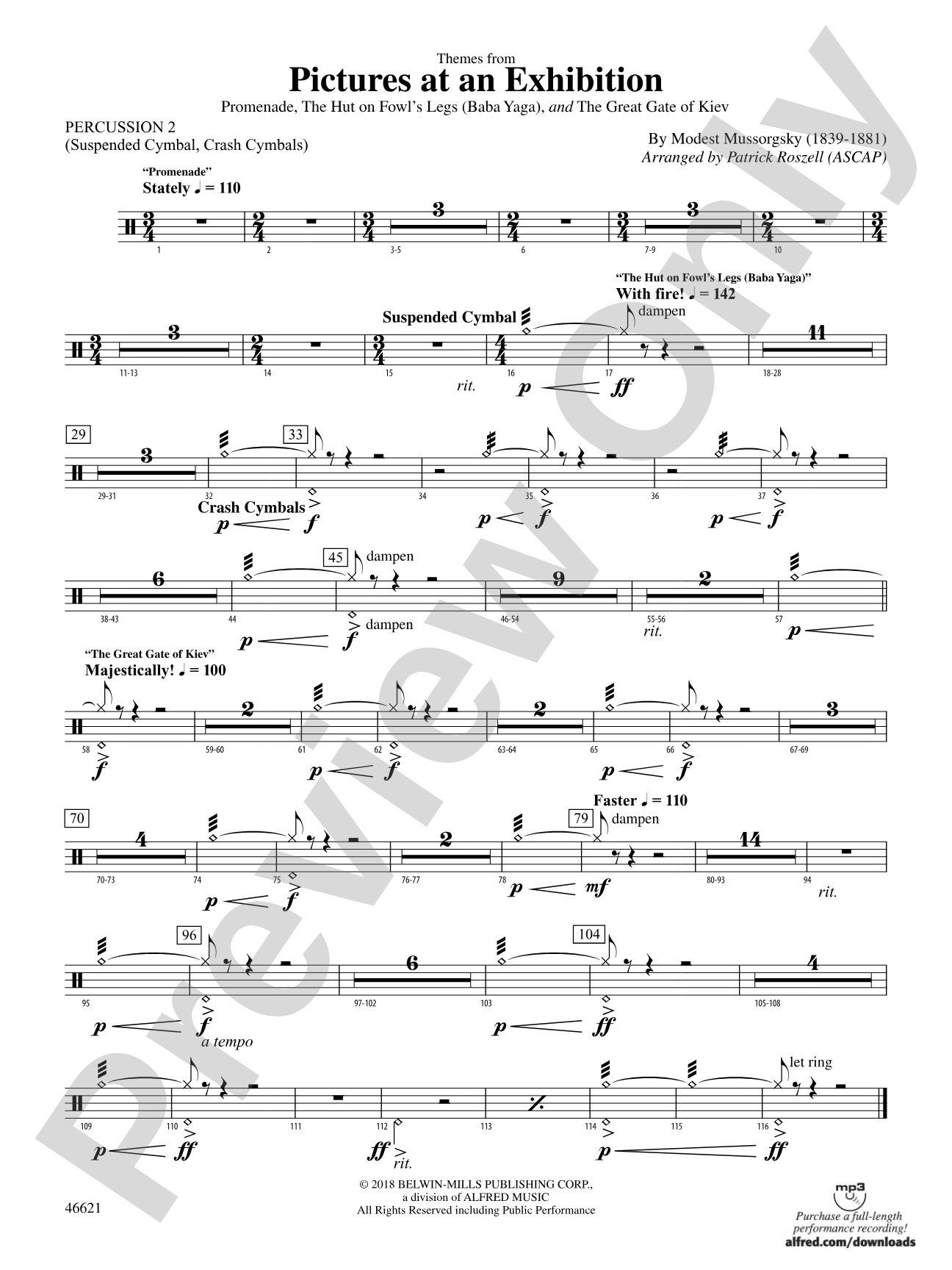

Pictures at an Exhibition: 2nd Percussion
Featuring: Promenade / The Hut on Fowl's Legs (Baba Yaga) / The Great Gate of Kiev
By Modest Mussorgsky / arr. Patrick Roszell
Grade: 2.5 (Easy to Medium Easy)
Item: 00-PC-0018055_PC2
$5.99
Pickup currently not available
Description
Expose your students to one of the great compositions of the 19th century. In the selections from this Mussorgsky masterpiece, numerous teaching opportunities are present with articulations, phrasing, and dynamics. The three titles included in this through-played arrangement are "Promenade," "The Hut on Fowl's Legs (Baba Yaga)," and "The Great Gate of Kiev." An impressive contest or concert piece!


Don't just read it, hear it, play along with it, and watch your students grow with it. In MakeMusic Cloud, Pictures at an Exhibition: 2nd Percussion comes alive with professional accompaniment, adjustable tempo, and built-in practice tools that turn solo practice into real progress.
Open in the Player
Jump straight in and assign it today.
Start Your Free Trial
Open this title and explore the full library in minutes.
Sample Audio
1
Audio File
--:--
0:00
0:00
Sample Video
Additional Details
Series:
Belwin Young Band
Publisher:
Alfred Music
Page Count:
238
SKU:
00-PC-0018055_PC2
More about this title
About the Composer: Modest Mussorgsky
Modest Mussorgsky (1839-1881) was a Russian composer who fundamentally changed how music could sound and what it could express. He rejected the European classical formulas that dominated his era, instead building his compositions from Russian folk melodies, speech rhythms, and vivid musical storytelling. His harmonic language was daringly original for the time, full of unexpected progressions and colors that anticipated modern music by decades.
Pictures at an Exhibition stands as his most enduring work, a solo piano suite that has inspired countless orchestrations and arrangements. Mussorgsky wrote it as a musical walk through an art gallery, with each movement depicting a different painting or sculpture. The piece demands imaginative interpretation and rewards conductors and performers who find its narrative depth and emotional honesty.
Why we love this
This arrangement opens a masterwork to young band musicians without compromising its essential character. Roszell's scoring captures the vivid imagery and harmonic color of the original while keeping the technical and range demands accessible to Grade 2.5 ensembles. Three contrasting movements mean you get genuine variety in a single, unified concert piece that sounds far more sophisticated than its difficulty level suggests.
What to expect
Walking through a gallery of vivid, shifting scenes. The opening Promenade is stately but slightly uneasy; Baba Yaga erupts into shadowy, driving menace with angular rhythms and clashing harmonies; The Great Gate of Kiev swells into broad, ceremonial grandeur. The piece moves through mood and color the way an exhibition moves through rooms.
Who it's for
Concert bands at the Grade 2 to 2.5 level ready for music that stretches their interpretive skills and exposes them to serious orchestral literature. This works equally well for students preparing for contest and for those seeking a mature concert repertoire selection that isn't dumbed down.
How to get the most out of it
- Balance the melodic layers carefully in the Promenade; the theme often passes between sections, and clarity matters more than volume. Listen for who has the tune and support that voice while keeping accompaniment textures transparent.
- Attack the dissonant harmonies in Baba Yaga with confidence. The piece's unsettling character comes from harmonic color and rhythmic drive, not from apologetic playing. Let the strangeness land intentionally.
- Shape The Great Gate of Kiev as a processional. Build the dynamics gradually across full measures rather than jumping suddenly between levels; the grandeur emerges from sustained architectural line, not dramatic crashes.
- Use the dynamic markings as dramatic signposts. This arrangement relies heavily on dynamic contrast to convey the gallery's shifting moods, so rehearse the staff's ability to execute terraced dynamics with clean ensemble response.
How to use it
Program this as an anchor piece on a concert that mixes familiar selections with more ambitious literature. Its three movements allow flexible programming, or present all three as a suite to demonstrate your ensemble's range. The contest context is natural, but a school concert in spring gives audiences a chance to experience a genuine 19th-century masterwork in a form their ears can follow.
Skills your students will build
- Executing dynamic contrast with ensemble precision (ppp to ff within a single movement)
- Balancing competing melodic lines and transparent accompaniment textures
- Interpreting harmonic color and dissonance as expressive tools, not obstacles
- Sustaining phrasing across longer architectural structures
- Responding to rapid stylistic shifts between movements (processional to frantic to majestic)