
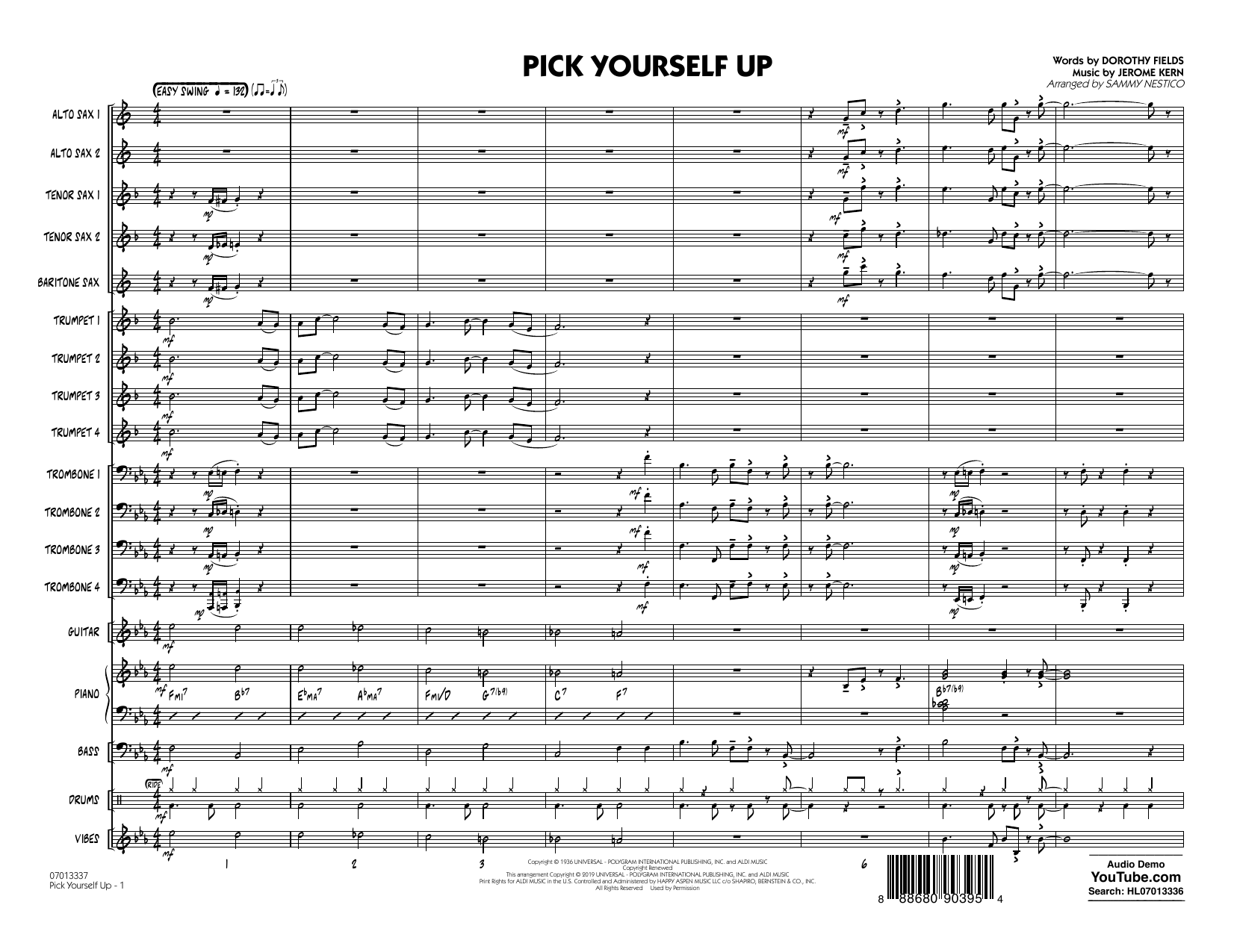

Pick Yourself Up (arr. Sammy Nestico): Jazz Ensemble Conductor Score & Parts
Arranged by Sammy Nestico
Grade: 4
Item: 35-PK00432541
$50.00
Pickup currently not available
Buy Extra Parts (Digital PDF Download)
Parts Added to Cart!
Description
Featuring the magical Nestico touch, Sammy's medium swing arrangement of this familiar standard evolves from a relaxed 2-beat in the beginning, to a jazz waltz in the middle, and finally straight ahead swing to finish out. No solos are required, but the feature spots are skillfully traded between all sections of the band.


Pick Yourself Up (arr. Sammy Nestico): Jazz Ensemble Conductor Score & Parts isn't in MakeMusic Cloud just yet...but it could be. Let us know you'd like to see it, and you'll help shape what comes next. In the meantime, start a free trial and dive into thousands of interactive titles your students can play along with today.
Request This Title
Tell us you want it.
Start Your Free Trial
Explore everything that's ready to play right now.
Sample Audio
No sample audio found.
Sample Video
No sample videos found.
Additional Details
Publisher:
Hal Leonard
SKU:
35-PK00432541
More about this title
About the Arranger: Sammy Nestico
Sammy Nestico stands among the most recorded arrangers in jazz history, with a career spanning decades of work for big bands, orchestras, and film scores. His arrangements are prized in educational settings for their clarity, musicality, and ability to elevate standard repertoire without overwhelming student musicians.
Nestico's gift lies in creating logical progressions that build ensemble confidence. He writes with deep knowledge of how each section functions, ensuring that every player contributes meaningfully to the whole. His voicings sit naturally under the hands while maintaining sophisticated harmonic color, making him essential reading for any serious jazz program.
Why we love this
Nestico refuses to let a familiar tune sit still. This arrangement moves through three distinct feels with such musical purpose that students grasp the concept of form and style contrast through direct experience rather than explanation. The sectional trading keeps everyone engaged; no player watches from the sidelines.
What to expect
The piece opens as a invitation to settle in, almost conversational. The middle section bobs and weaves with waltz time elegance before the final push gathers momentum and confidence, landing exactly where the tune wanted to go all along.
Who it's for
Grade 4 jazz ensembles ready to work with sophisticated arranging technique. This works for groups with solid fundamental swing vocabulary who can handle multiple feels in one piece and respond to flexible conducting.
How to get the most out of it
- Shape the opening 2-beat section with genuine legato phrasing. The relaxed feel depends on players resisting the urge to rush; conduct with space between beats to establish the pocket.
- The transition into jazz waltz territory requires a clean meter shift in your conducting. Give your ensemble a clear preparatory gesture so the rhythmic pivot feels intentional rather than accidental.
- Balance the feature spots so each section gets its moment without overshadowing the others. The arrangement asks for trading, not soloing; keep the energy collaborative and forward-moving.
- Reserve the straight-ahead swing ending for maximum contrast. By this point, your ensemble will have earned the technical confidence to lock into the groove.
How to use it
Slot this into a concert that showcases your ensemble's stylistic range. It pairs well alongside a ballad and an up-tempo burner; the three-section structure means you can program it as a single statement of what medium-swing can accomplish. It also serves beautifully as a closer to a jazz studies unit where students are learning about form and arrangement choices.
Skills your students will build
- Maintaining consistent tempo and pocket across multiple swing feels (2-beat, waltz, straight-ahead)
- Reading sectional trading passages and responding to cues in ensemble context
- Balancing feature melodies with accompaniment roles without needing solo space
- Responding to conducting that shapes transitions between meter and style changes
- Understanding how arrangement decisions (tempo, feel, voicing) serve the melody rather than the reverse