Piano Variations Sheet Music Preview

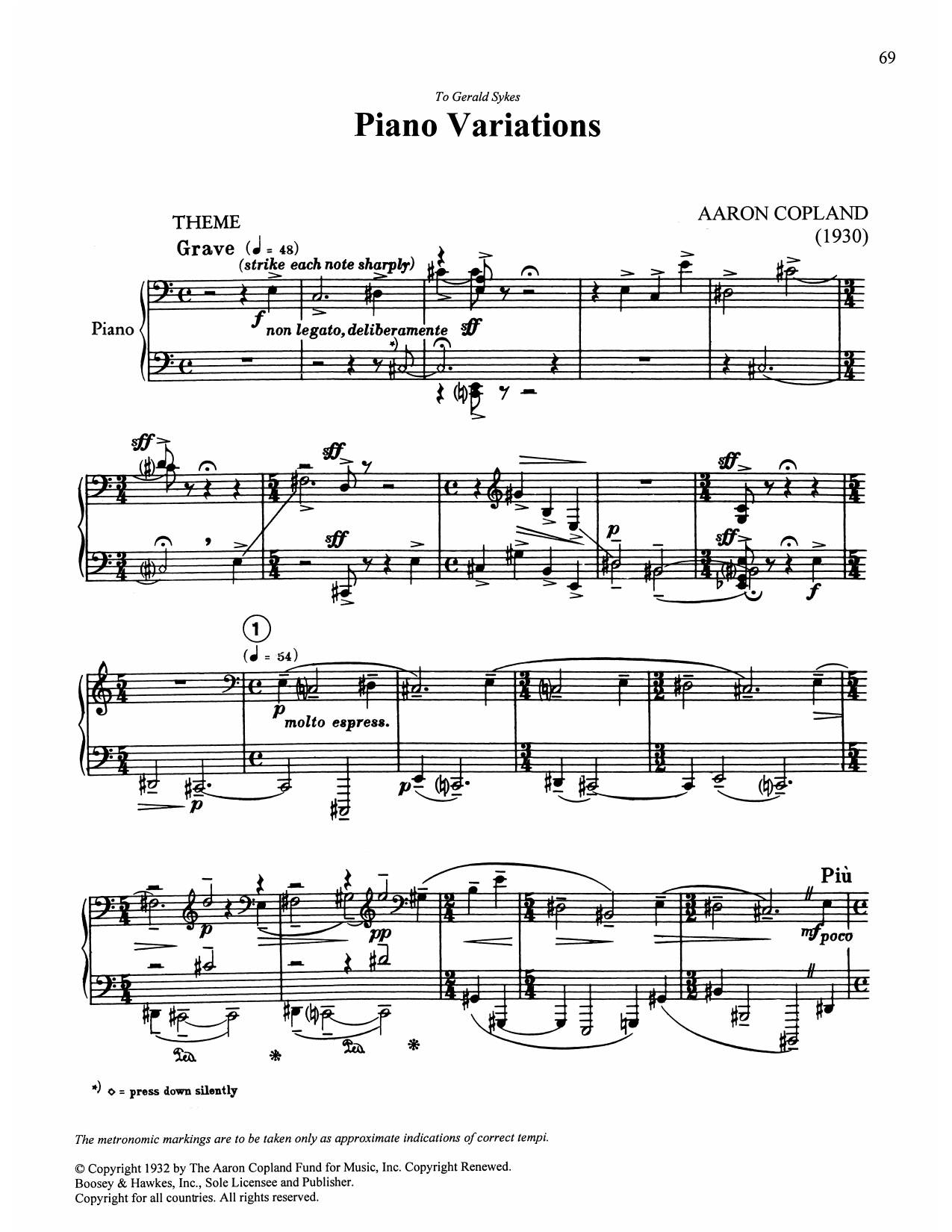
Piano Variations: Piano Solo

By Aaron Copland

Item: 35-DS01979712

Digital Download
$5.99
One moment…
Description

Discover MakeMusic Cloud: thousands of interactive titles your students can play along with today.

Sample Audio
No sample audio found.
Sample Video
Additional Details
Publisher: Hal Leonard
Page Count: 14
SKU: 35-DS01979712

More about this title

About the Composer: Aaron Copland

Aaron Copland (1900-1990) shaped American classical music by drawing directly from folk idioms, hymn tunes, and the rhythmic energy of the nation's landscape. His compositional voice emerged from serious study in Paris under Nadia Boulanger, but he chose to write accessibly rather than abstractly, believing that concert music could speak to broad audiences without sacrificing artistic integrity.

Copland's piano works span his entire career and reveal his harmonic sophistication alongside his gift for melody. The Piano Variations, in particular, demonstrates his mastery of the variation form and his ability to build architectural power from economical material. His influence on American music education remains profound; generations of students have learned to hear modern classical music as something vital and connected to their own cultural moment.

Why we love this

This work showcases Copland's architectural gift in its purest form. The compact yet expansive scope makes it compelling for recital programming at the intermediate-advanced level, where students can experience real compositional development without overwhelming demands on stamina. The piece rewards deep study because every variation reveals something new about how a composer can transform material while preserving its essential character.

What to expect

The music unfolds with deliberate purpose, each variation peeling back layers of the thematic material as if examining it under changing light. There's an architectural quality to the work, both austere and deeply musical, that conveys both intellectual rigor and genuine emotional weight.

Who it's for

Advanced high school pianists and undergraduate music majors ready to tackle substantial contemporary classical works will find genuine artistic substance here. This piece appeals to students pursuing serious music study who want to expand beyond Romantic repertoire into the 20th-century American idiom.

How to get the most out of it

  • Establish the theme's character with clarity and restraint in the opening statement. The variations build power through accumulation, not from expressive excess at the start.
  • Pay close attention to Copland's articulation markings and dynamic shaping within each variation. These details create the sense of transformation rather than surface-level changes.
  • Balance harmonic complexity with forward momentum. The piece contains rich chords, but they should feel functional rather than impressionistic.
  • Find the underlying pulse across metric or textural shifts. Copland's variations often disguise the theme's rhythmic profile, and maintaining subtle metric continuity keeps the work cohesive.

How to use it

Include this in a solo recital focused on American piano literature or modern variations of classical forms. It pairs well alongside earlier 20th-century European modernists to demonstrate Copland's distinct approach to contemporary composition, or stand it alone as the centerpiece of a recital exploring theme and transformation.

Skills your students will build

  • Sustaining coherence across thematic variations while maintaining individual character in each section
  • Managing harmonic language that moves beyond functional tonality without losing tonal reference points
  • Executing precise articulation and dynamic control within complex rhythmic contexts
  • Building structural momentum across a multi-section form without relying on melodic singability
  • Interpreting 20th-century American classical notation and performance conventions

You May Also Like