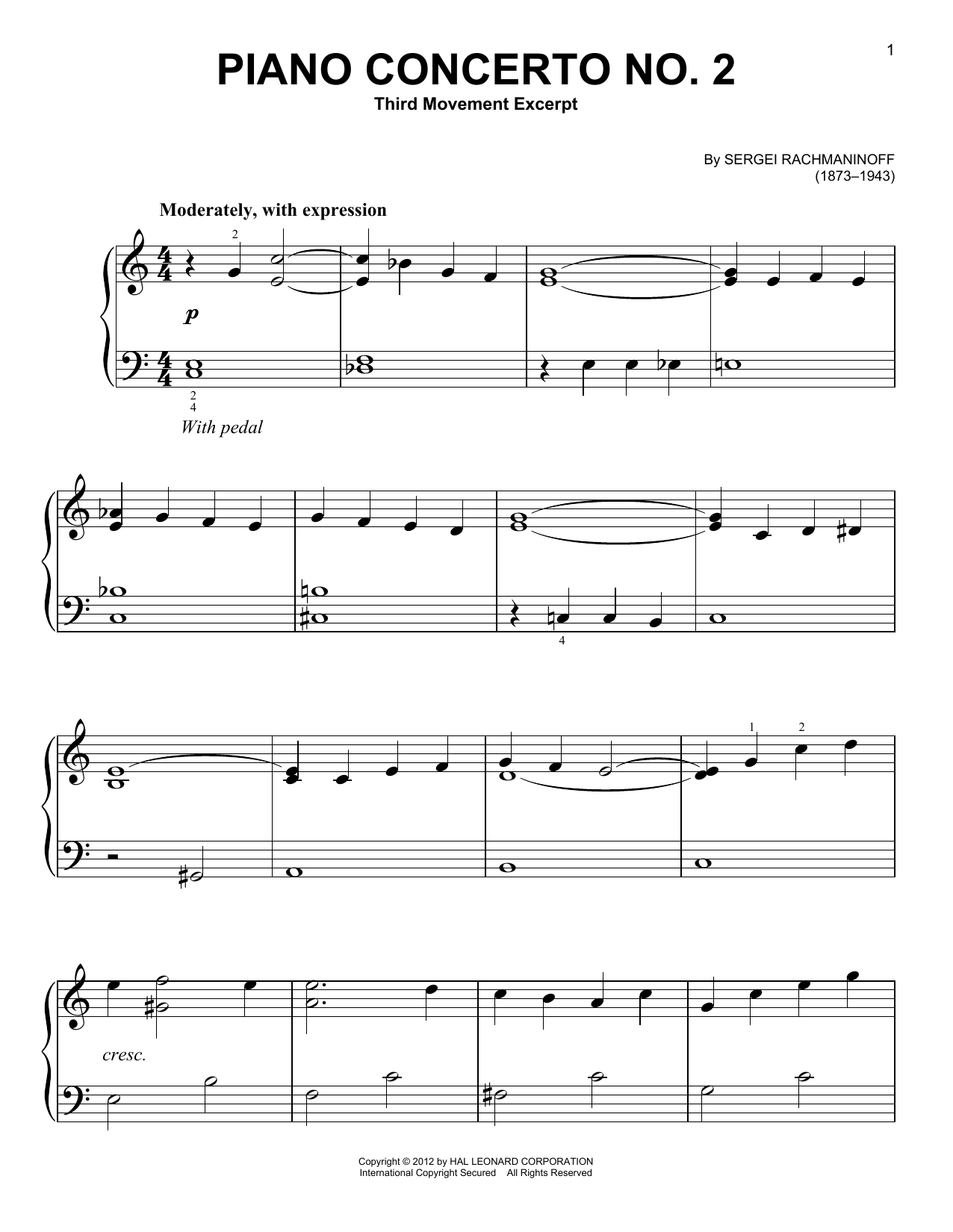
Piano Concerto No. 2, Third Movement Excerpt Sheet Music Preview

Piano Concerto No. 2, Third Movement Excerpt: Very Easy Piano

By Sergei Rachmaninoff

Item: 35-DS00302071

Digital Download
$4.99
Description

Discover MakeMusic Cloud: thousands of interactive titles your students can play along with today.

Sample Audio
No sample audio found.
Sample Video
Additional Details
Publisher: Hal Leonard
Page Count: 2
SKU: 35-DS00302071

More about this title

About the Composer: Sergei Rachmaninoff

Sergei Rachmaninoff (1873-1943) was a Russian composer and virtuoso pianist whose works remain cornerstones of the Romantic piano repertoire. His compositions are celebrated for their lyrical melodies, rich harmonic language, and technical brilliance, making them essential study material for advancing pianists. Rachmaninoff's influence on twentieth-century music extends far beyond the concert hall into music education, where his pieces serve as bridges between classical forms and modern sensibilities.

His Piano Concerto No. 2, composed in 1901, stands as one of the most frequently performed concertos worldwide. The work showcases Rachmaninoff's gift for memorable themes and orchestral writing, qualities that shine even in simplified arrangements designed for developing musicians.

Why we love this

Students get genuine access to one of the most beloved concertos in the repertoire without years of technique ahead of them. The simplified arrangement preserves the signature sweeping lyricism and emotional depth of the original, letting young pianists experience the satisfaction of playing real Rachmaninoff rather than generic etudes.

What to expect

This passage glows with Romantic warmth and introspection. The music breathes like a singer taking a moment to reflect, offering moments of grandeur without demanding virtuosic fireworks. There's an intimacy here that makes young performers feel like they're sharing something genuinely beautiful rather than proving their chops.

Who it's for

Elementary-level pianists who have solid right-hand technique and basic chord awareness but aren't yet ready for full sonata forms. Teachers seeking repertoire that rewards careful listening and expressive playing while staying within clear technical boundaries will find this excerpt particularly valuable.

How to get the most out of it

  • Shape the melodic line with clear phrase contours. The beauty of this excerpt rests on singing tone, not speed, so use rubato generously to bring out the harmonic movement beneath the melody.
  • Pay attention to dynamic shading within each measure. Rachmaninoff's scoring often hints at countermelodic material in the middle voices that can easily disappear if you focus only on the top line.
  • Practice slowly with a metronome to establish rhythmic security, then gradually add expressive timing. This prevents mechanical playing and builds confidence for flexible interpretation.
  • Listen to professional recordings before and during your practice. Hearing how accomplished pianists balance the romantic expansiveness with structural clarity will guide your own interpretive choices.

How to use it

Feature this as a recital piece that demonstrates how well your students understand phrasing and emotional content, or use it to introduce Rachmaninoff alongside more advanced students performing the full concerto with orchestral accompaniment. In studio teaching, this works beautifully as a confidence builder between etude work and more substantial multi-movement forms.

Skills your students will build

  • Singing tone production in the right hand
  • Harmonic awareness through listening to inner voices
  • Phrase shaping and musical punctuation
  • Tempo rubato and expressive timing
  • Sustaining lyrical intensity across longer melodic arcs

You May Also Like